
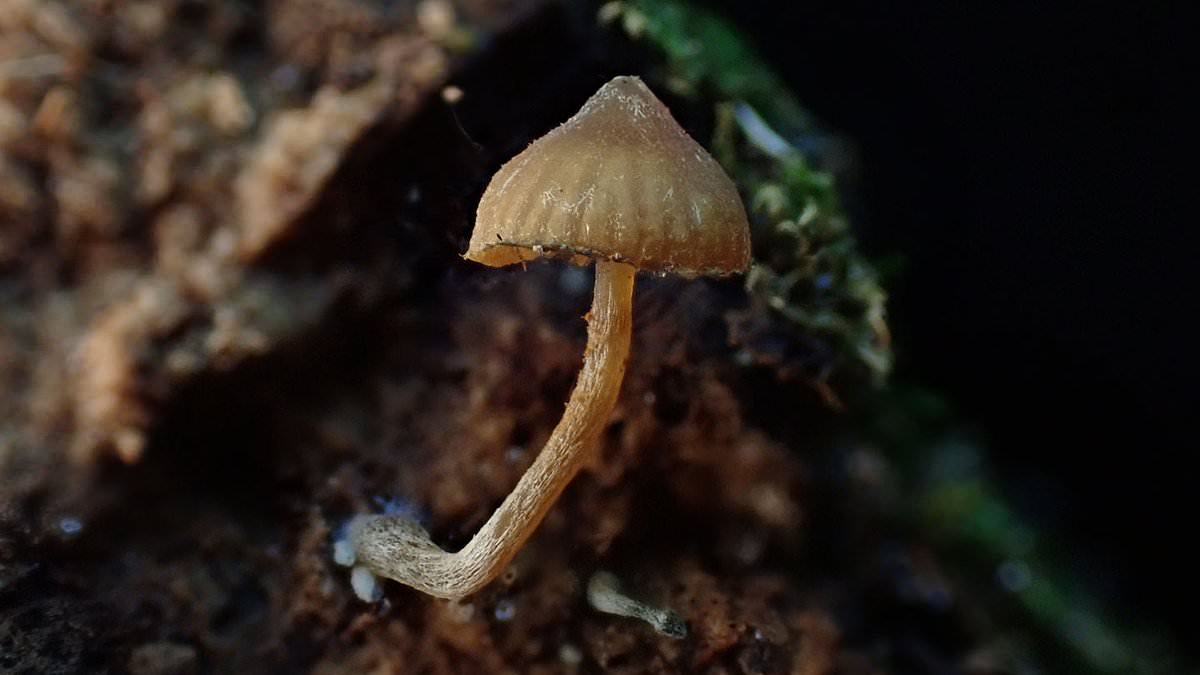
Scientists have discovered a bizarre new 'dark magic mushroom' that combines hallucinogenic chemicals with some of nature's deadliest toxins.The tiny brown mushroom, known as Galerina indica, was found growing on moss-covered palm trunks in Florida wetlands.Scientists found it produces both psilocybin, the mind-altering compound in magic mushrooms, and amatoxins, the class of poisons responsible for most fatal mushroom poisonings worldwide.According to the team, from the University of Florida, it is the first known mushroom ever discovered to contain both chemicals.'A little brown mushroom found in Florida's swamps coproduces the psychedelic compounds of 'magic mushrooms' and amatoxins like those found in the world's deadliest mushrooms,' the paper, published in the journal Current Biology, reads.'These compounds are known to occur in several distantly related groups of fungi but have never been shown to co-occur within a single species.' The tiny brown mushroom, known as Galerina indica, was found growing on moss-covered palm trunks in Florida wetlands According to the team, from the University of Florida, it is the first known mushroom ever discovered to contain both psilocybin and amatoxinsResearchers had originally set out to search for little-known poisonous mushrooms in the southeastern United States but were astonished to detect psychedelic compounds instead.Tests revealed the fungus contained psilocybin and psilocin alongside two amatoxin compounds.One of those toxins, a chemical named alpha-proamanitin, turned out to be entirely new to science.Researchers believe the mushroom acquired its psychedelic-producing genes from unrelated fungi through a rare process known as horizontal gene transfer, effectively allowing it to borrow useful genetic material from another species.The study suggests this transfer occurred after the mushroom's ancestors had already evolved the ability to manufacture deadly toxins.'Psychedelic and deadly poisonous mushrooms epitomize humanity's enduring cultural fascination with fungi,' the paper reads.'Remarkably, the biosynthetic pathways responsible for psiloid and amatoxin production co-occur in Galerina indica.' According to the researchers, the tiny mushroom is the first ever discovered to contain both chemicals Researchers believe the mushroom acquired its psychedelic-producing genes from unrelated fungi through a rare process known as horizontal gene transferThe authors warned that the discovery carries an important public health message.Many mushroom hunters assume that mushrooms which bruise blue are likely to be psychedelic rather than deadly or poisonous.However, the researchers said their findings show that hallucinogenic compounds and dangerous amatoxins can coexist in the same species, meaning such visual clues may not always be reliable.'From a public-health perspective, our finding cautions against interpreting blue bruising as evidence that an uncharacterized psiloid-containing mushroom is free of amatoxins,' they wrote.'The blue pigmentation resulting from psilocin oligomers, often used to discriminate between co-habiting psychedelic and amatoxin-producing mushrooms, may only be useful in well-characterized or cultivated 'magic mushroom' species that have a tradition of human use.'Psilocybin, the psychedelic compound present in 'magic mushrooms', can alter perception, mood and a person's sense of time, causing vivid visual distortions, intensified emotions and, in some cases, hallucinations.Effects typically begin within an hour of consumption and can last for several hours.Many countries classify psilocybin as a controlled substance, although it is also being investigated as a potential treatment for conditions including depression and PTSD.Matthew Smith, a professor in the Department of Plant Pathology, said: 'Part of my job as Florida's state mycologist is to identify poisonous or potentially poisonous species.'I regularly consult with the Florida Poison Control as well as ER doctors, veterinarians and others who think that a person or dog may have consumed a mushroom, so it is important to know what species we have and whether they might cause problems for people or pets.'He added: 'These mushrooms are really hard to find. They are small and brown, like hundreds of other mushroom species.'It's hard to differentiate from others, even for a trained expert.'Researcher Andrew Kunik added: 'We still don't fully understand why mushrooms produce psilocybin.'Amatoxins may help protect mushrooms from animals that eat them, but their precise ecological role isn't entirely clear either.'That's what makes the discovery of the 'dark magic mushroom' so interesting. Why would a mushroom produce both of these compounds, and what advantage might that give it in nature?'What's exciting is that there are small, seemingly uninteresting fungi that can conceal extraordinary chemistry that we're only beginning to understand.'What are the dangers of eating death cap mushrooms?Amanita Phalloides, commonly known as the death cap, is a deadly poisonous fungus. A few mouthfuls of the death cap mushroom can kill.They often grow near established oak trees, and are found when there is warm, wet weather.The fungi stand out due to the pale green colouring of their caps, a bulbous end at the foot of the stalk and an annulus - a ring-like collar - at the top. Amanita Phalloides, or death cap, often grow near oak trees and are highly toxicThe death cap is native to Europe, where it is widespread in Britain and Ireland. It is also commonly found in northern Africa and in many parts of Asia, including the forests of Iran.People are warned against picking or consuming wild death cap mushrooms. Cooking the fungi does not remove the death cap’s deadliest toxins, called amatoxins.Looking like a delicious white button mushroom when young, the death cap's appearance is far from deadly. It can be extremely difficult even for experienced collectors to distinguish them from an edible mushroom.Symptoms of death cap mushroom poisoning generally occur six to 24 hours or more after ingestion of the mushrooms. They include stomach pains, nausea, vomiting and diarrhoea. The symptoms may subside after one to two days, giving a false impression of recovery. However, by this stage the toxin would have already caused serious liver damage and may result in death.
Beware the 'dark magic mushrooms': Scientists discover a new strain that contains a deadly combination of chemicals NEVER seen before
Full Article
Original Source
Read the full article at Dailymail →KhanList aggregates and links to publicly available news content. We do not host full articles from third-party sources. Always verify important information with original sources.