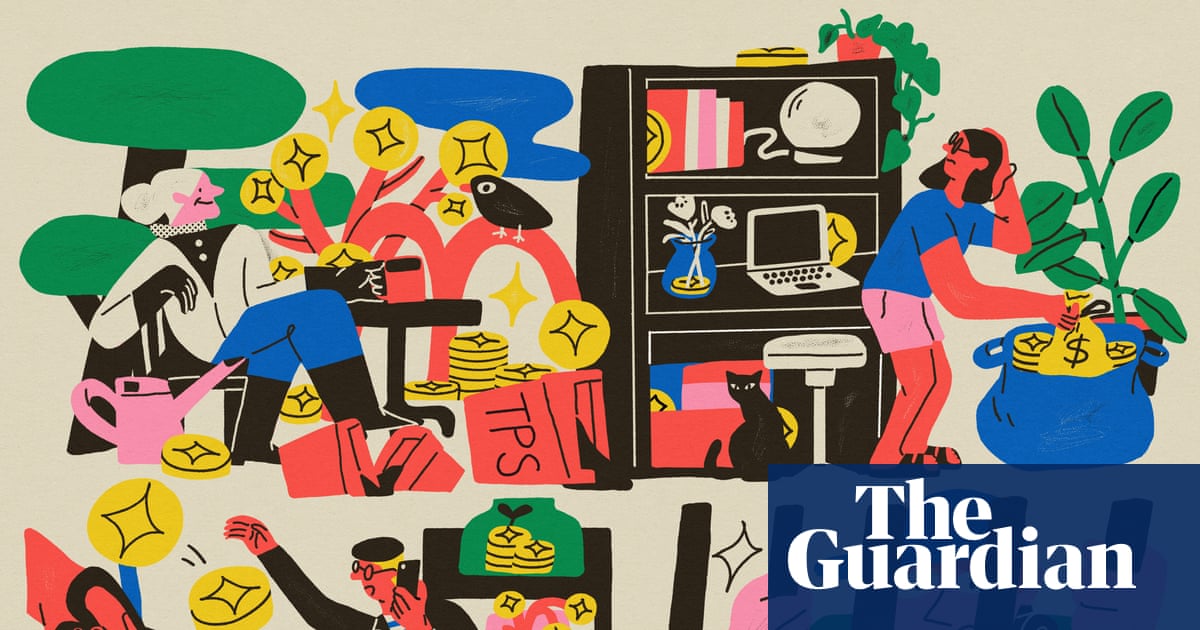
How many pensions do you have? In the days of a job for life, many people had just two: the state pension and the one offered by their employer. But a combination of people changing jobs more often and rules that force employers to enrol workers into schemes automatically, means you are likely to end up with more.The number of people saving into a private sector workplace pension has doubled since 2012 to reach 23 million, according to the Pensions Regulator, largely because of “auto-enrolment”. On top of that, millions of people have personal pensions and self-invested private pensions (Sipps). And some will have all three.“Every time we change jobs, we are likely to begin a new pension,” says Alistair McQueen, the head of savings and retirement at Aviva. “With average [job] tenure at about five years, we may end our working lives with many pension pots.”As a result, he says, there is growing interest in consolidation: combining some or all of your pensions, except those that you get from the state.Pros and consOne big benefit of consolidation is it arguably makes things a lot simpler. “There is quite a strong argument to say that if you’ve got all your pensions in one place, it’s less of a daunting task to try to engage more with how it’s invested rather than having four or five little pots all over the place, which doesn’t feel as meaningful,” says Kirsty Stone, a partner and chartered financial planner at The Private Office.Combining pension pots, whether workplace schemes or Sipps, into a fund with lower annual management fees can save you thousands of pounds. Moving money out of an underperforming fund into one providing better returns can also add thousands.There are potential post-retirement benefits, too. Having your pensions in one place can be beneficial if you want to access your money through “flexible drawdown” – whereby, instead of buying an annuity, you take out chunks of your pension to live on.Stone says: “If you want to pay yourself £500 a month, say, that is much easier to do if you access it all from one provider.” If the pension pots remain separate, you need to deal with each provider individually, which, says Stone, “will just be messy in retirement”.There are, however, situations where combining pensions could make you worse off.“It’s definitely not a no-brainer,” says Steve Webb, a partner at the consultancy firm LCP and a former pensions minister. “If someone is thinking about consolidating pensions, the question is always why? What is the problem you are trying to solve?”He adds: “If you leave pensions where they are, they are not frozen or lost – they will continue growing. And, depending on the pensions, leaving them there might be the best choice.”You need to weigh up whether combining your pensions will make you better off in retirement. Photograph: John Hopkins/AlamyBefore deciding to combine your retirement savings, it is important to be aware of the implications and, crucially, understand the benefits offered by your existing pension. These could include guaranteed annuity rates and the right to take more than the standard 25% as a tax-free lump sum. In certain cases, where the contract stipulates you can take the tax-free lump sum at the age of 55 rather than saying the “normal minimum age”, this will override changes coming in 2028 that raise it to 57.If you have a defined benefit pension, also known as a final salary pension, you would almost certainly lose money by moving it. There is legislation to protect people from this: anyone with a cash equivalent transfer value of more than £30,000 is obliged to take financial advice before transferring out. Most experts would advise taking advice even if its value is below that amount.FeesIf you have built up a number of very small pension pots while job-hopping, the earlier you are in your career, the more you could benefit from grouping those small pensions together and getting them working harder for you.But if you are approaching retirement, you may get more flexibility by keeping them separate.There are specific rules for pension pots worth less than £10,000 that allow you to withdraw the money in a way that you cannot for larger pensions.If you have built up small pension pots while job-hopping, the earlier you are in your career, the more you could benefit from grouping them together. Photograph: Fredrick Kippe/AlamyThen there is the question of fees. Not all providers charge exit or transfer fees for moving your pension, but if they do, these fees will eat into your savings.And you will want to avoid a situation where you move all your pensions into one private pension or Sipp, only to find yourself paying higher management fees than previously. Annual management fees on workplace schemes have been negotiated with providers based on bulk membership, so they are typically lower than on private schemes, Webb says.So while there are plenty of online services offering to consolidate your pension, you always need to check the fees. If they are charging twice as much as your workplace pension, your investments would need to work very hard to better your returns.The processCombining defined contribution pensions, also known as money purchase pensions, is usually straightforward, largely thanks to the fact that providers will be very pleased to take your money.Typically, you would begin by contacting the scheme into which you want to pool the funds.“They will ask for the details of the pensions you are transferring, and they take it from there. It is normally a fairly simple process you can request online,” Stone says. “However, on occasion, you’ll be asked to complete paper forms or answer questionnaires as part of this process.”Importantly, while the provider will oversee the process and take care of much of the admin, they will not offer advice and will just follow your instructions.How to trace old pensionsMake a list of your former employers and the dates you worked there, as well as the pension providers for each employer, if you know the names. If any of the companies have closed since you left, you may be able to track down the pension scheme they used through the Pension Protection Fund website.If you can’t find the contact details, try the government’s search service. You will need employers’ or providers’ names, and it will only tell you how to get in touch with the pension provider, not whether you have a pension. You can also try Gretel, a free online service that traces dormant accounts including pensions, using your own address history rather than the details of former employers or providers.Next, contact the providers to find out if you have a pension, and how much is saved. The more information you can give (such as employment dates, former names and your national insurance number), the better. Once you have tracked them down, you can decide whether consolidating retirement savings is the right plan for you.Four pension scenariosAnita, 59 Illustration: Yufei Yang/The GuardianStarted her career as a teacher in secondary schools and paid into the Teachers’ Pension Scheme (TPS) until she left to work in the private sector 15 years ago. She has worked for three different employers since, and has workplace pensions with each. She checked recently and has £95,000, £77,500 and £83,000 in these schemes, all of which have annual charges of 0.3%. She is interested in using flexible drawdown to take her pension money as and when she needs.What should Anita consider? The TPS is sometimes considered the “gold standard” in pensions. There are different versions of this scheme depending on the date of membership. Anita’s pension will be based on her final salary, because she was teaching before changes to the system in 2015.“It’s likely Anita has built up significant benefits in the TPS, and the pension she will get in retirement is based on length of service and earnings as a teacher,” says Charlene Young, a senior pensions and savings expert at the investment platform AJ Bell.Anita may be able to start taking this pension from as young as 60. So she should leave this one where it is.Kirsty Stone at The Private Office says it is worth considering consolidating the other pensions, particularly if Anita decides she wants to use flexible drawdown. “It’s much easier to do this with one pension rather than taking small amounts from different pots,” Stone adds.Gemma, 33 Illustration: Yufei Yang/The GuardianHas had several jobs. She did not opt out of auto-enrolment and so has four or five workplace pensions. She would like to put everything in one place as she feels a bit confused by all the different providers, and has even lost some of their details in house moves.What should Gemma consider? It would be best to take direct action to track down and combine her pensions before things get harder to manage. Gemma can begin by using a tracing service to find her old pensions.“She next needs to decide whether it’s best to combine what she has built up so far into her current active workplace pension, or into another scheme running alongside it, so that there are no more than one or two plans to manage,” Young says.This could also help Gemma to engage with her retirement savings because it is often easier to understand what is there when it is all in one place. Stone suggests Gemma should look beyond a scheme’s default fund to maximise the growth. “You want to be sure you’re making your investments work as hard as possible while you’re younger, and the default strategy is very rarely the best strategy from an investment standpoint,” Stone says.Phil, 51 Illustration: Yufei Yang/The GuardianHas five different pensions, one of which allows him to take a tax-free lump sum at 55. One is a Sipp that he set up when he was briefly self-employed. He has left it in the default fund and knows the charges are 1%, which is higher than for his workplace schemes. The other pensions are defined contribution schemes – all are worth more than £10,000.What should Phil consider? That the older pension allows him to take a tax-free lump sum at 55, rather than 57 under the new rules, is a benefit he probably will not want to lose, and it would be wise to move the Sipp into a lower-cost pension, as those fees will eat into his savings.“The three other pots might still be good candidates for combining, so that Phil can focus on the investment strategy in one additional pot rather than all three,” Young says.Because of the benefits and decisions to make around lump sums, Phil should consider financial advice, she suggests. “He will need to pay a fee, but advice can help avoid costly mistakes, and a recommendation based on personal circumstances should give greater peace of mind with retirement planning.”Sam, 27 Illustration: Yufei Yang/The GuardianHas had a few jobs since graduation and has three pension pots worth a lot less than £10,000 each. He is not currently working but is applying for jobs. He could do with the cash, so wonders if he could access funds from his pensions.What should Sam consider? “Unfortunately, you cannot usually access pension pots until age 55, rising to 57 from 6 April 2028,” Young says. Since the money is tied up, “it’s worth considering combining the existing small pots into the lowest-cost suitable scheme”.Stone says: “What combining does is provide you with simplicity. And even if the pensions are worth £10,000 in total, say, you can get that working harder and get into a stronger place by the time he retires.”With decades to go until retirement, she also says Sam should opt for higher-risk investments to benefit from more growth.
Better off together: could combining pension pots boost your retirement income?
Full Article
Original Source
Read the full article at Theguardian →KhanList aggregates and links to publicly available news content. We do not host full articles from third-party sources. Always verify important information with original sources.