
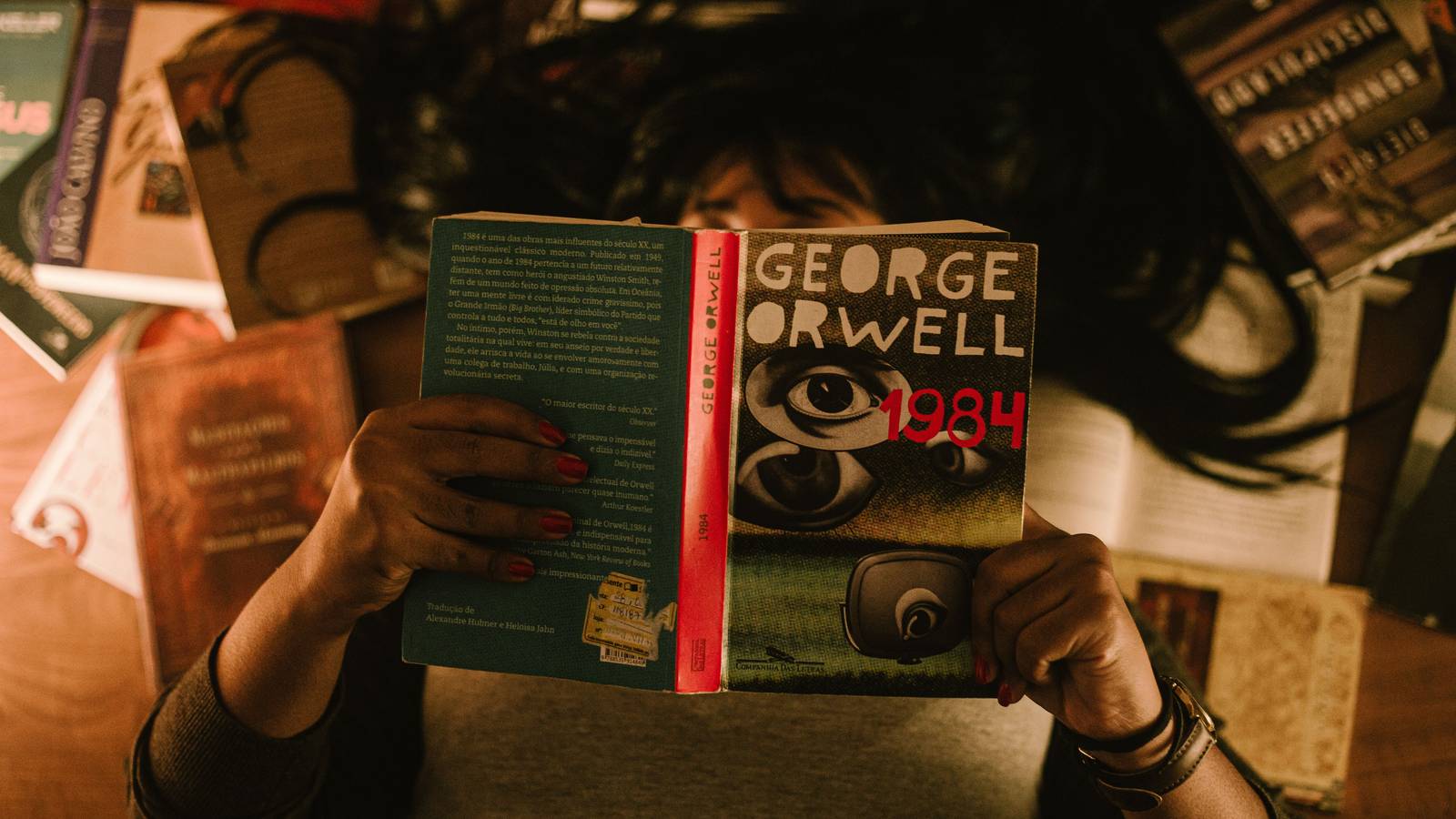
Published Oct 10, 2026, 1:00 PM EDT Hannah is a senior writer and self-publisher at ScreenRant. There, she focuses on writing news, features, and list-style articles about all things comics, books, anime, and manga. She works as a freelance writer in the entertainment industry, focusing on video games, anime, and literature. Her published works can be found on Screen Rant, FinanceBuzz, She Reads, and She Writes. Dystopian fiction explores what happens when societies sacrifice freedom, individuality, and human dignity in pursuit of security, stability, or power. From authoritarian governments that rewrite history to environmental catastrophes that dismantle civilization, the genre imagines futures that are frightening precisely because their underlying problems remain recognizable. The best dystopian books combine compelling characters with unsettling questions about how people live when their choices are restricted. Some of these novels envision technologically advanced societies that conceal horrific truths beneath an appearance of happiness, while others examine humanity's struggle to survive after civilization collapses. Whether written decades ago or relatively recently, these books continue to influence science fiction, young adult literature, and political stories. Each offers a different perspective on the dangers of unchecked authority, social inequality, conformity, and the erosion of basic human rights. 10 Parable of the Sower by Octavia E. Butler Parable of the Sower is available to purchase now through this link Octavia E. Butler's Parable of the Sower imagines an America devastated by climate change, economic inequality, and failing public institutions. Set primarily in California during the 2020s, the novel follows Lauren Olamina, an 18-year-old Black woman whose hyperempathy causes her to experience the physical pain of others. When violence destroys her walled community, Lauren must travel north through an increasingly dangerous landscape. What distinguishes Butler's novel is Lauren's determination to build something beyond mere survival. She develops Earthseed, a belief system centered on the idea that change is the fundamental force shaping existence. As she encounters other displaced people, Lauren begins assembling a community around her philosophy. The novel's combination of environmental collapse, social fragmentation, and cautious hope makes it an especially powerful exploration of rebuilding civilization. 9 I Who Have Never Known Men by Jacqueline Harpman I Who Have Never Known Men is available to purchase now through this link Jacqueline Harpman's I Who Have Never Known Men presents a hauntingly sparse vision of a world whose history and circumstances remain largely unexplained. Its unnamed narrator grows up imprisoned underground alongside 39 other women, all guarded by armed men. Unlike her fellow captives, she has no memories of life before imprisonment, leaving her without a reference point for understanding humanity or the society that confines her. When an unexpected event gives the women an opportunity to escape, they discover a landscape that offers few answers about their past or future. Harpman focuses the book around uncertainty rather than conventional action, exploring how people construct meaning when familiar institutions, relationships, and cultural knowledge disappear. The narrator's perspective makes ordinary concepts such as freedom, companionship, and identity feel newly complicated, creating a dystopian story that is unsettling because so much remains unknown. 8 Brave New World by Aldous Huxley Brave New World is available to purchase now through this link Aldous Huxley's Brave New World depicts a future World State that maintains social order through genetic engineering, psychological conditioning, consumerism, and readily available pleasure. Citizens belong to predetermined castes, while reproduction takes place outside traditional families. Emotional discomfort is discouraged through entertainment and soma, a drug that helps people escape unpleasant feelings. The result is a seemingly harmonious civilization built on restrictions its inhabitants have been conditioned to accept. The story's main conflict develops through John, known as the Savage, who was raised outside the World State and encounters its culture with fresh eyes. His resistance exposes the price of a society that eliminates suffering by suppressing individuality, complex relationships, and independent thought. Published long before contemporary debates about algorithmic influence and manufactured desire, Huxley's novel remains a striking examination of whether constant comfort is worth surrendering the freedom to live authentically. 7 The Giver by Lois Lowry The Giver is available to purchase now through this link Lois Lowry's The Giver introduces readers to a community that appears peaceful because its leaders have eliminated many sources of conflict, including emotional extremes, personal choice, and meaningful differences. Twelve-year-old Jonas expects an ordinary assignment during the Ceremony of Twelve, but he is selected to become the Receiver of Memory. His training with the elderly Giver gradually reveals the experiences and truths that his carefully managed society has erased. As Jonas receives memories of color, love, pain, and loss, he discovers that his community's apparent perfection depends on keeping its citizens ignorant. Lowry makes the consequences of conformity accessible through a young protagonist whose understanding of the world changes with every revelation. The novel won the 1994 Newbery Medal and remains a significant work of young adult dystopian fiction because it questions whether eliminating hardship also eliminates the experiences that make life meaningful. 6 Wool by Hugh Howey Wool is available to purchase now through this link Hugh Howey's Wool follows humanity's survivors in an enormous underground silo where life continues under rigid rules. The outside world appears uninhabitable, and residents are forbidden from discussing it freely. The story initially follows Holston, the silo's sheriff, before expanding to other characters, including Juliette, a mechanically gifted worker whose practical knowledge draws her into the community's deepest mysteries. Howey initially released Wool as a self-published short story in July 2011, then expanded the narrative into additional installments as reader interest grew. That development mirrors the novel's gradual revelation of a much larger conspiracy: every rule has a history, and the information citizens receive may be deliberately incomplete. Its claustrophobic setting, mechanical details, and mounting tension make Wool an absorbing dystopia about institutional secrecy, survival, and the risks of asking questions. 5 Lord of the Flies by William Golding Lord of the Flies is available to purchase now through this link William Golding's Lord of the Flies begins when a plane crash strands a group of British schoolboys on an uninhabited island during a global conflict. With no adults to supervise them, the boys initially attempt to establish rules and organize their survival. Ralph becomes their elected leader, while Piggy advocates for reason and practical planning. A conch shell serves as a symbol of authority and the right to speak. Order gradually disintegrates as Jack prioritizes hunting, dominance, and intimidation over cooperation. Fear of a mysterious beast intensifies existing divisions, allowing violence to replace the group's fragile democratic arrangements. Although the novel differs from dystopias built around elaborate governments or futuristic technology, its examination of social collapse fits the genre's darkest concerns. Golding suggests that civilization's rules are vulnerable when fear, group loyalty, and the desire for power overwhelm collective responsibility. 4 The Handmaid's Tale by Margaret Atwood The Handmaid's Tale is available to purchase now through this link Margaret Atwood's The Handmaid's Tale takes place in Gilead, a totalitarian regime established after the overthrow of the United States government. Facing environmental disasters and declining birthrates, the new leadership uses religious justifications to impose rigid social roles and control reproduction. The protagonist, Offred, is a fertile woman forced to serve as a Handmaid, expected to bear a child for a powerful Commander and his wife. Offred's narrative moves between memories of her former life and the restrictions governing her daily existence. Her husband, daughter, financial independence, and personal identity have been taken from her, yet she continues searching for small opportunities to exercise agency. Atwood's novel examines how political extremism can transform intimate relationships, language, and reproductive rights into instruments of government control. Its chilling power comes from showing oppression not as an abstract policy but as an everyday reality. 3 Fahrenheit 451 by Ray Bradbury Fahrenheit 451 is available to purchase now through this link Ray Bradbury's Fahrenheit 451 envisions a society in which books are prohibited and firemen burn them rather than extinguishing fires. Guy Montag is one such fireman, initially accepting his work as an ordinary public duty. His encounters with Clarisse, a curious young woman who challenges conventional ideas about happiness, begin unsettling his assumptions about the shallow, tightly controlled world around him. As Montag becomes increasingly interested in the books he is supposed to destroy, he discovers how thoroughly his society discourages independent thought. Citizens are distracted by relentless entertainment, while meaningful conversation and complex ideas are treated as threats to social stability. Bradbury's dystopia is particularly memorable because censorship does not operate in isolation: it flourishes alongside voluntary distraction and public indifference. The novel asks what happens when people lose both access to knowledge and the desire to question what they are told. 2 1984 by George Orwell 1984 is available to purchase now through this link George Orwell's 1984 follows Winston Smith, a government employee living in Airstrip One, the territory encompassing a future version of Britain within the superstate of Oceania. Under the Party's rule, citizens face pervasive surveillance and political repression, with Big Brother serving as the ever-present symbol of authority. Winston works at the Ministry of Truth, where he alters historical records to ensure that the past always supports the government's current position. Winston's private doubts lead him to pursue forbidden independence, including a relationship with Julia and an attempt to understand resistance to the Party. Yet Orwell's most frightening ideas extend beyond surveillance: Newspeak restricts language, while doublethink encourages citizens to accept contradictory claims. These mechanisms undermine people's ability to reason independently or preserve a shared understanding of reality. Few dystopian novels depict the relationship between propaganda, historical revision, and authoritarian power with comparable precision. 1 The Hunger Games by Suzanne Collins The Hunger Games is available to purchase now through this link Suzanne Collins's The Hunger Games introduces Panem, a nation divided into the wealthy Capitol and 12 districts forced to serve its interests. Every year, the Capitol selects one boy and one girl from each district to participate in the Hunger Games, a televised fight to the death designed to punish the districts for a past rebellion. When her younger sister Prim is selected, District 12 teenager Katniss Everdeen volunteers to take her place. Alongside fellow tribute Peeta Mellark, Katniss enters an arena where survival requires physical skill, strategic thinking, and an understanding of how the Capitol manipulates its audience. Her decisions gradually turn the spectacle into a challenge to the government's authority, even when she is not deliberately seeking revolution. Collins combines fast-paced action with a critique of inequality, propaganda, and entertainment built on suffering in her books, making Panem one of modern young adult fiction's most recognizable dystopian societies.
Best Dystopian Books Of All Time
Full Article
Original Source
Read the full article at Screenrant →KhanList aggregates and links to publicly available news content. We do not host full articles from third-party sources. Always verify important information with original sources.