
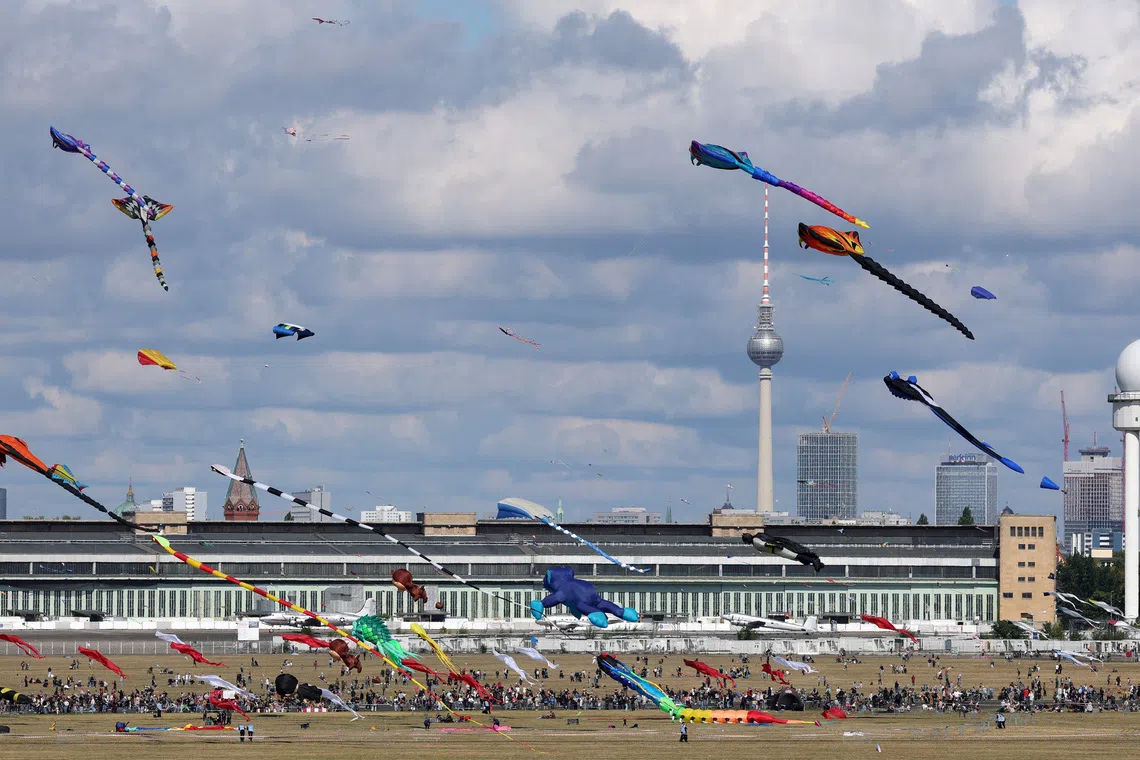
BERLIN, Sept 18 - Berliners cycle, picnic and fly kites on the city's vast former Tempelhof airfield that opened as a park in 2010, yet developers are circling and whether to build homes on the historic site has dominated debate ahead of an election on Sunday.While immigration has featured prominently in other German state elections and driven a surge in support for the far-right Alternative for Germany (AfD) party, in Berlin, where 85% of households rent their homes, housing and rents are voters' top concerns.The city will need 211,000 more homes by 2040 and advertised rents have nearly doubled since 2014, stoking deep frustration at the city government, which mirrors Germany's national coalition in its alliance of centre-right Christian Democrats (CDU) and centre-left Social Democrats (SPD).The vote on September 20 therefore marks another test of support for Chancellor Friedrich Merz's struggling government two weeks after the AfD swept to victory in the eastern state of Saxony-Anhalt.Neighbouring Mecklenburg-Western Pomerania also votes on September 20.The far-left Left Party stands at 23% in Berlin, Merz's CDU on 21% and the AfD at around 17%, ahead of the SPD and the environmental Greens, according to the latest poll on September 11 by Forschungsgruppe Wahlen.For the AfD, Berlin's housing crisis has fed into its argument for restricting immigration. The Left Party meanwhile is pledging to build affordable new homes, freeze rents for one year then limit increases to 1%, forcibly reduce rents that are 20% over the local average, curb holiday rentals in housing blocks, and offer flats that become vacant in the centre to those with a right to social housing.Both it and the AfD have roughly doubled their support since Berlin's last election in 2023.FROM NAZI AIRPORT TO MUCH-LOVED PARKThe fate of the Tempelhofer Feld - which is almost twice the size of London's Hyde Park and one of the largest urban open spaces in the world - reflects a broader conflict between the need for more housing and desire to protect public green space.The original 1920s airport was expanded by the Nazis and after World War Two became a lifeline for the city during the 1948-49 Berlin Airlift, when Western allies supplied the blockaded city by air. The airport closed in 2008. Four years after opening as a park, nearly two-thirds of Berliners voted to keep the site largely free of development in a referendum."Open space is not land for development. It is social and ecological infrastructure — and Tempelhofer Feld is Berlin's open space," said Anita Moeller, a member of the 100% Tempelhofer Feld initiative, which opposes development.The CDU, Free Democrats (FDP) and AfD support limited housing development on parts of Tempelhofer Feld. The SPD, Greens and Left Party oppose construction there and favour developing other sites."The referendum was 12 years ago, the need was nowhere near as great then as it is today," said Stefan Evers, the Berlin CDU's lead candidate, in an interview with Tagesspiegel.GROWTH HAS A DOWNSIDEFor the past decade, Berlin's economic growth has outpaced Germany's sluggish economy, mainly due to its services sector, which generates almost 90% of the city's economic output.Berlin is Germany's startup capital, with more than 600 companies founded in 2025 alone. E-commerce group Zalando and fintech N26 are among the digital consumer-services companies headquartered in the capital.But that growth has come at a cost, pushing up rents as the population has grown. Would-be developers of Tempelhof say it will help ease the shortage of homes, but many struggling to pay their rent say more needs to be done to make housing affordable.Others say that the German capital, once a global symbol of rough-edged urban cool and dubbed "poor but sexy" by former mayor Klaus Wowereit, simply now resembles Europe's other major cities in costs.On September 5, thousands of demonstrators gathered in Berlin to protest against high rents. Among them was Mareen Harant. In Berlin you can easily end up paying €1,500 ($1,720) or more a month for a one- or two-room apartment, she said. "Who on earth is supposed to be able to afford that?"The election campaign has been anything but a triumph for the ruling CDU and SPD. In July, CDU Mayor Kai Wegner withdrew as lead candidate amid criticism of his handling of a January power outage that left large parts of the capital without electricity for four days.The SPD has also faced turbulence after police raided the home and offices of its lead candidate Steffen Krach as part of an investigation into a tender process in the health sector. He denies any wrongdoing."Growth also has a downside: prices rise and, above all, land prices rise, so space becomes scarce," said Martin Gornig, a researcher at the German Institute for Economic Research, DIW Berlin.Berlin's legendary nightclub scene has also been hit."We had to move because we simply could no longer afford the rent," said Jakob Turtur, managing director of Jonny Knueppel, a collectively run club. REUTERS
Berlin's acute housing shortage and soaring rents dominate city election
Full Article
Original Source
Read the full article at Straitstimes →KhanList aggregates and links to publicly available news content. We do not host full articles from third-party sources. Always verify important information with original sources.