
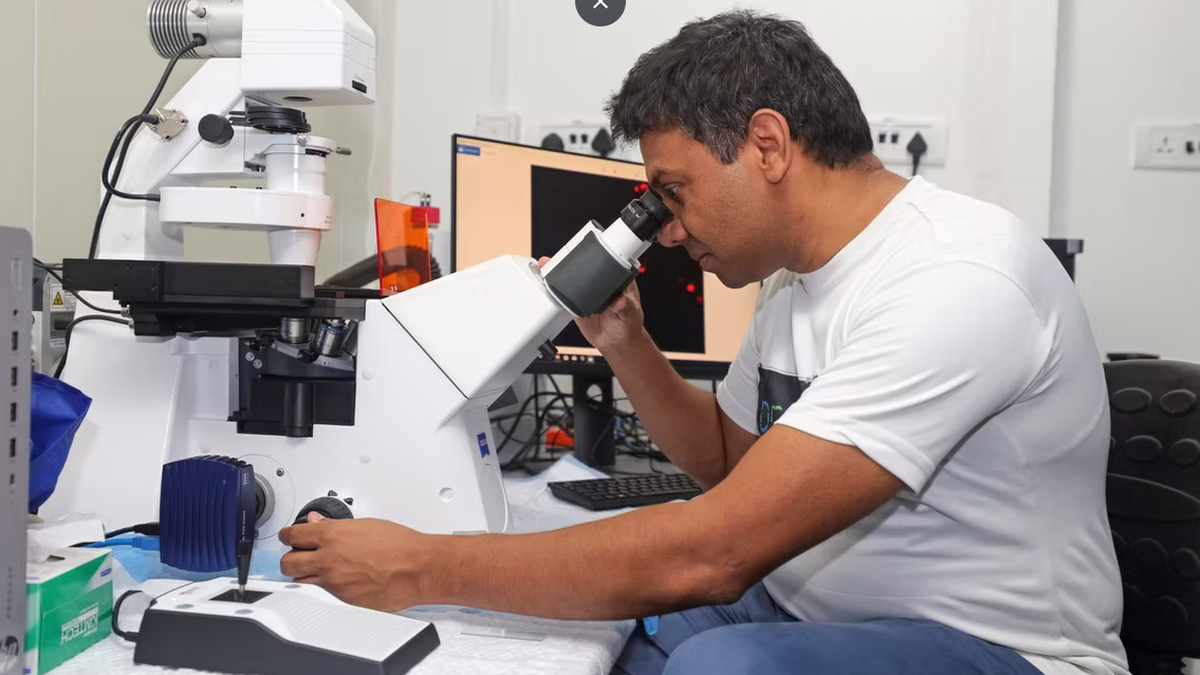
The 2026 Nobel Prize in Physiology or Medicine, awarded to Karl Deisseroth, Peter Hegemann, and Georg Nagel “for their discoveries concerning light-gated ion channels and optogenetics”, has brought renewed attention to using light to investigate fundamental biological processes. These include memory formation, feelings, and behaviours relevant for neurological and psychiatric disorders, as well as processes involved in infectious disease.Editorial | Let there be light: On the 2026 Nobel Prize in Physiology/MedicineFor Nishith Gupta, professor of Biological Sciences at BITS Pilani, Hyderabad, and founder of the Intracellular Parasite Education and Research Labs (iPEARL), the recognition has a personal significance in his own scientific journey.Mr. Gupta’s decades-long collaboration with Hegemann at Humboldt University of Berlin, where Hegemanna is Hertie Senior Professor of Neuroscience, helped extend optogenetic approaches beyond neuroscience into his study of Toxoplasma gondii, an intracellular parasite that infects humans, mammals, and birds.Interactive Guide | Nobel Prize 2026 Professor of Biological Sciences at BITS Pilani-Hyderabad Campus, Nishith Gupta with Peter Hegemann, 2026 Nobel Prize in Physiology or Medicine laureate. Optogenetics enables scientists to control selected cells or biological processes using light-sensitive proteins.The Nobel Committee for Physiology or Medicine stated: “It all began with Peter Hegemann’s curiosity. He wondered how Chlamydomonas, a single-celled alga, is able to swim towards a light source. In the early 2000s, he and Georg Nagel discovered channelrhodopsin, an algal protein with unique properties, found on the surface of the cell. When it is illuminated by blue light, a channel opens through the protein. Charged ions then flow into the cell, creating an electrical impulse. They found that regardless of which cell they put the protein in, those cells became light sensitive.” In 2005, Deisseroth showed that introducing channelrhodopsin into rat neurons allowed blue light to trigger nerve signals. In 2007, he showed light-based control in mice. A researcher at iPEARL, BITS Pilani-Hyderabad Campus with Peter Hegemann, 2026 Nobel Prize in Physiology or Medicine laureate. In contrast, Mr. Gupta, Mr. Hegemann and others used light-regulated enzyme adenylate cyclase, which converts adenosine triphosphate (ATP), the primary energy of a living cell, to produce cyclic Adenosine Monophosphate (cAMP). This molecule acts as messengers, helping transmit signals within cells.Put simply, the researchers showed that light controls the enzyme, the enzyme produces cAMP, and cAMP helps regulate what happens inside the parasite (Toxoplasma gondii): how it enters cells, moves, and exits cells. This landmark study was published in the Journal of Biological Chemistry in 2013.While Mr. Deisseroth, Mr. Hegemann, and Mr. Nagel’s optogenetics “solves one of humanity’s great mysteries, how our incredible brain works”, Mr. Gupta, Mr. Hegemann and others’ found light-regulated signalling to investigate parasite’s lifestyle, and infection. A researcher at iPEARL, BITS Pilani-Hyderabad Campus with Peter Hegemann, 2026 Nobel Prize in Physiology or Medicine laureate. Mr. Gupta says that working alongside Hegemann in Berlin, with their laboratories in neighbouring departments, was an important part of this scientific journey. Joint funding from the German Research Foundation (DFG) supported their collaboration.After Mr. Gupta relocated to India, Mr. Hegemann continued to support his research through Mr. Gupta’s Wellcome Trust–DBT Senior Fellowship project at BITS Pilani. Researchers from his team continued to visit Hegemann’s group in Berlin. Peter Hegemann, 2026 Nobel Prize in Physiology or Medicine laureate. For Mr. Gupta, the Nobel Prize awarded to Mr. Hegemann and his fellow laureates underscores the far-reaching consequences of fundamental research. A protein that evolved to help an alga sense light has become a tool for probing the brain, investigating infection and understanding how cells function. He says the broader lesson is that technologies developed to answer one biological question can open entirely new avenues of research.“Light has become more than a means of observation; it is a way to intervene, test, and uncover cause-and-effect relationships,” Mr. Gupta says.
Berlin to BITS Pilani: How Nobel-winning Optogenetics connects to parasite research in Hyderabad
Full Article
Original Source
Read the full article at Thehindu →KhanList aggregates and links to publicly available news content. We do not host full articles from third-party sources. Always verify important information with original sources.