
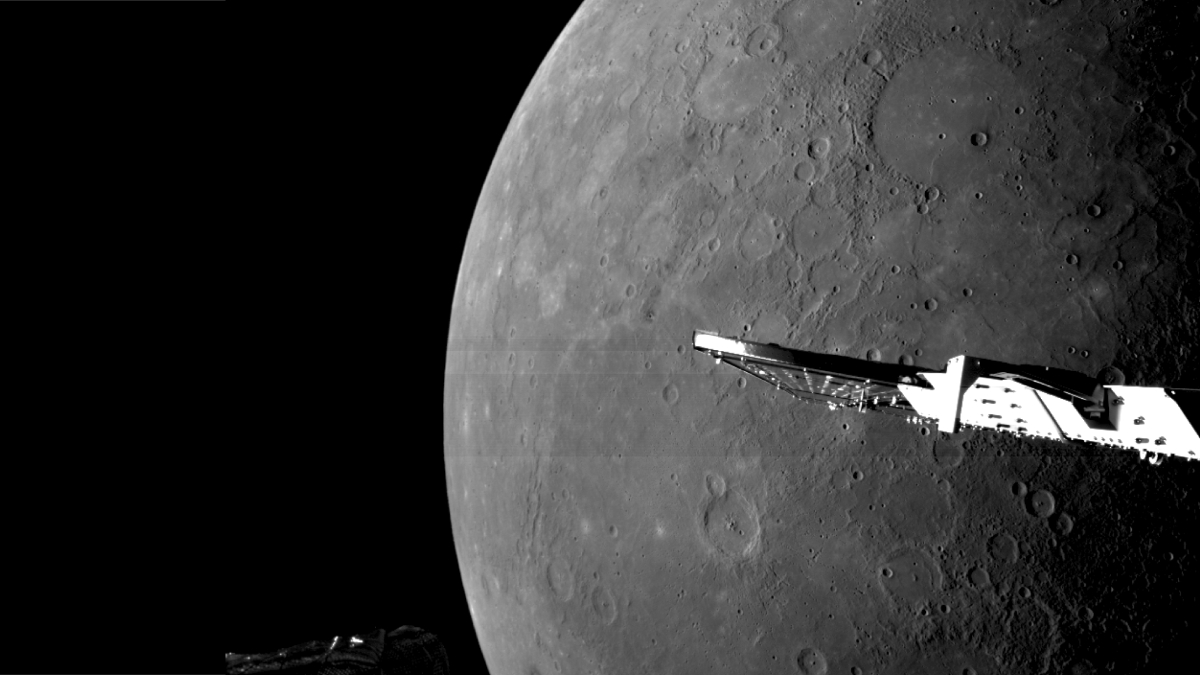
BepiColombo snapped this image of Mercury’s sunlit northern hemisphere on 9 January 2025 during its sixth and final flyby of the planet. Credit: ESA/BepiColombo/MTM, CC BY-SA 3.0 IGO Research & Developments is a blog for brief updates that provide context for the flurry of news that impacts science and scientists today. After an eight-year journey, the BepiColombo mission has entered orbit around Mercury, where it will settle in for at least a year of science observations. “Mercury is a challenging destination,” Santa Martinez, the European Space Agency’s (ESA) mission manager for BepiColombo, said during a 31 August press event. “What makes this mission really unique is that for the first time in space exploration, we are bringing two spacecraft to the vicinity of the planet, and we are going to put them in orbit around this mysterious body.” BepiColombo is only the third mission to visit Mercury. NASA’s Mariner 10 flew by Mercury in 1973 and NASA’s MESSENGER mission orbited the planet from 2011–2015. BepiColombo is a joint mission from ESA and the Japanese Aerospace Exploration Agency (JAXA). The mission is made up of two orbiters: the Mercury Planetary Orbiter (MPO) from ESA and the Mercury Magnetospheric Orbiter (Mio) from JAXA. Both orbiters were carried to Mercury by the Mercury Transfer Module (MTM) and are protected by a sun shield. This animation shows BepiColombo approaching Mercury ahead of its orbital insertion. The conjoined spacecraft approached the planet’s night side and entered into an elliptical orbit. MPO and Mio will separate from the craft in early December and enter individual polar orbits. Credit: ESA, CC BY-SA 3.0 IGO MTM separated from the orbiters on 3 September. The still-connected MPO-Mio entered Mercury’s orbit today. MPO’s mission is to map Mercury’s heavily-cratered surface and catalog its surface geology. Spectrometers focusing on several wavelengths will create maps of the planet’s surface composition and temperature, an altimeter will map surface topography, an accelerometer and gravitometer will map the planet’s gravitational field, and a radio science experiment will determine the size of the planet’s core. Another instrument will study Mercury’s exosphere and its interactions with solar plasma. Mio will map Mercury’s magnetosphere, magnetic field, and plasma environment. Mercury has a magnetic field but scientists don’t understand what sustains it or why it is offset from the planet’s center. Mio is designed to help answer these questions, study how the magnetic field changes over time, and observe how the planet magnetically interacts with its closest neighbor, the Sun. An Arduous Journey BepiColombo launched in 2018 and completed several flybys of Earth, Venus, and Mercury as it fought against the Sun’s gravity on its journey to the inner solar system. Each flyby provided valuable scientific data that the team is still exploring. “Reaching Mercury is actually harder than reaching Pluto,” Azul Pinochet-Barros, editor for operations activities at ESA’s European Space Operations Centre, said during the 3 September livestream of MTM’s separation from the propulsion module. “The challenge isn’t getting closer to the Sun. It’s losing enough energy to match Mercury’s path around the Sun. This makes Mercury the least explored planet in the inner solar system.” Each of the nine planetary flybys was critical for shedding some of the spacecraft’s momentum as it spiraled inward toward Mercury. In 2024, a glitch in the mission’s thrusters prevented them from operating at full power, which necessitated an adjustment in the craft’s trajectory and a delay in BepiColombo’s arrival at Mercury from December 2025 to November 2026. The next step in the mission will happen on 9–10 December when MPO and Mio will separate and enter individual polar orbits around Mercury. Science operations will begin in April 2027. The nominal mission will last a year, with a planned extended mission through 2029. “This is going to bring to humanity and to the scientific community unprecedented views of the Mercury planet, and it’s going to open a new chapter in our understanding of the solar system,” Martinez said. —Kimberly M. S. Cartier (@astrokimcartier.bsky.social), Staff Writer These updates are made possible through information from the scientific community. Do you have a story about science or scientists? Send us a tip at [email protected]. Text © 2026. AGU. CC BY-NC-ND 3.0Except where otherwise noted, images are subject to copyright. Any reuse without express permission from the copyright owner is prohibited.
BepiColombo Arrives at Mercury
Full Article
Original Source
Read the full article at Eos →KhanList aggregates and links to publicly available news content. We do not host full articles from third-party sources. Always verify important information with original sources.