
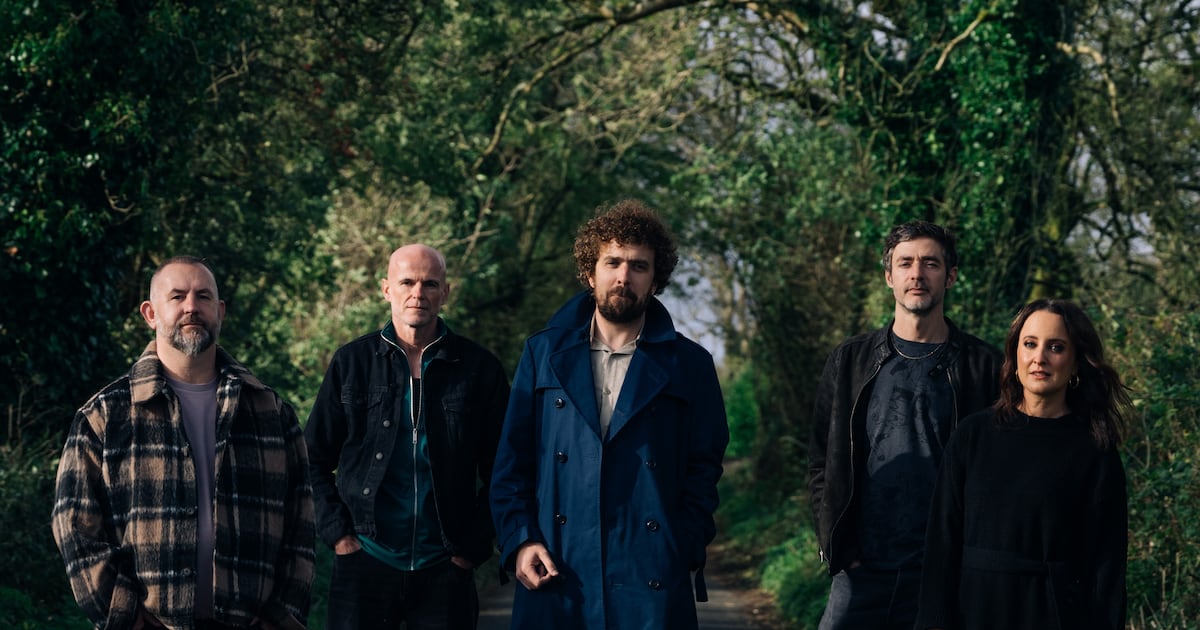
Twenty-five years is a long time to be together in a band. You couldn’t stay the course, according to Niamh Dunne, unless you genuinely enjoyed being in a room together and making music. That’s something celebrity plays no role in.“We have always been low-key,” Beoga’s singer and violinist says as she sips a black coffee with Eamon Murray, the band’s bodhrán player. “We’re not pushing ourselves for the exposure or the limelight.” Dunne and Murray are friendly, unassuming and good company. Beoga are not a band who sought to make a splash, as their manager knows well, Dunne says, with a wry laugh. What they are is a band who have to follow their principles, as became clear last month.Beoga, whose other members are Liam Bradley, Seán Óg Graham (who is married to Dunne) and Damian McKee, spent the summer on tour in North America as Ed Sheeran’s house band. It was a big gig for them, a “life-changing” role with opportunities that could have gone on for years.READ MOREIn early September, the American rapper Macklemore performed at two shows in New Jersey as Sheeran’s opening act. He urged support for a free Palestine and sang his pro-Palestinian song Hind’s Hall. In response, the Israeli-American Council launched a petition calling for him to be dropped from the tour. Venue owners, led by Robert Kraft of the Gillette Stadium in Foxborough, Massachusetts, who is a donor to Israeli causes, said they did not want Macklemore on their stages. On September 14th Macklemore was removed as the opening act from the remainder of Sheeran’s tour.Macklemore: the US rapper was dropped from Ed Sheeran’s Loop tour. Photograph: Arnaud Finistre/AFP via Getty When Sheeran released a statement that said the decision was the promoter’s and not his, Beoga and their fellow tour acts Aaron Rowe, the Irish singer-songwriter; the Danish band Lukas Graham; and Finneas, Billie Eilish’s brother and producer, left the tour in solidarity with Macklemore.With their manager Sarah Casey (“who is amazing,” Dunne says), Beoga released a statement on Instagram: “To play in venues that silence anyone advocating for a Free Palestine is not an option for us.”The band refused all interviews bar a short one with RTÉ Radio, to speak about the Garvaghy Road protests in Portadown. “I didn’t see any point,” Dunne says. Now they’re ready to talk about what happened in North America, albeit still looking slightly shell-shocked. Dunne has driven to Dublin from her home in Antrim. Murray has taken a flight from his home in Co Kerry. It’s the day of the public-sector strikes, and cars are honking as I drive to meet them, which feels cosmically appropriate.The band were in Ireland when the statement from Sheeran came through on September 15th. They had flown from New York as Dunne’s father, the uilleann piper Mickey Dunne, was receiving a lifetime-achievement award, and Murray’s wife, Pauline Scanlon, had won singer of the year at the TG4 Gradam Ceoil. “We were celebrating,” Dunne says.They were planning to fly back to the US the next day, for a stadium show in Philadelphia, when Sheeran delivered his statement distancing himself from responsibility for Macklemore’s firing. “It was a red line,” Murray says. “Statements were flying. We made it clear we would not be going back out on the road.”“The decision to stand up for free speech and the right to speak about Palestine was a very easy decision for us as a band to make,” Dunne says. “The professional and financial stakes are very real. But the decision was easy. We jumped on Zoom and it was, like, ding-ding-ding, done.”What happened next was hard for a band who don’t seek the limelight. “Our phones were exploding,” Murray says. “The world’s looking at you and wanting to talk – every news outlet.” Beoga: the band quit Ed Sheeran’s Loop tour after Macklemore was dropped. Photograph: Ruth Medjber John Reynolds, Sinéad O’Connor’s producer, called them to offer support. “John is a good friend. He said, ‘Watching the news cycle post Saturday Night Live and what Sinéad did’” – in 1992 the late singer ripped up a photograph of Pope John Paul II on the television show, to protest against child sexual abuse and its cover-up in the Catholic Church – “‘I remember feeling like the world is going to eat me up.’ He was talking about the overwhelmingness of it. He said, ‘Sinéad was right, and [Sheeran] is wrong and you are right.’”What did they think about Sheeran’s performance in Philadelphia, when, performing solo, with no tour support, he cried as he spoke, saying that he was not an “activist musician”, had made mistakes, was “deeply worried” about the idea that venues should preapprove the content of a performance, and felt abandoned by friends and family?“My position has been to Ed and anybody, you can say whatever you want; if you don’t take action, it doesn’t matter,” Murray says. “You can make 100 statements. But if you don’t cancel the shows, it doesn’t matter what you say if you don’t do anything.”So Sheeran needed to cancel the shows? “In our opinion, yes,” Dunne says. “We should all be able to freely and openly stand up and say ‘Free Palestine’. We support a free Palestine.”[ You don’t boycott an Ed Sheeran tour just to look cool with a peace sign. Boycotts hurtOpens in new window ]They are still friends with Sheeran. “We haven’t fallen out with Ed,” Dunne says. “No, we haven’t,” Murray says. “But you have to hold your friends accountable here and there.” “Whether it’s Ed Sheeran or your mad neighbour,” Dunne says. Murray says he believes that the singer had “counsel coming from 100 places” and that the stance Sheeran has taken will haunt him. “People will remember that’s the position we took and they’ll remember that Ed took that position. That will follow him around. He will have to wrestle with that.“A friend of mine said, when we knew we were going to be put in an awkward position, ‘Courage can’t see around a corner.’”Since Beoga came home they’ve been touched by the way people in their home communities in Kerry and Antrim have approached them. “You’d meet in the street and they’d say, ‘We’re very proud of you for taking that position,’ people who you didn’t think would be paying attention to what you’re doing or global affairs or the news,” Murray says. “It’s been life-affirming at times.”Murray and Scanlon have a nine-year-old daughter, Kitty, so now, instead of playing stadiums with Sheeran, the bodhrán player is listening to her beloved hip-hop with her. He’s grateful to have the time together – “My wee girl is delighted that I’m home. That’s the hardest bit of being away” – but the pendulum swing from touring life to domestic life has been disorientating.There are days, he says, when it’s hard to grapple with. “In terms of the material cost to us all, nobody thought about that at the time. It’s since then that you think about it and go, ‘Okay, right.’ But you’d torture yourself if you thought about all the things that were going to come.”Some of the “jubilant responses” to Beoga’s decision to walk away from the Sheeran tour irked him. “The decision was obvious for our own moral compasses, but I don’t think anybody would be celebrating if their friends had lost a big job – you know, they’ve got a really good job and suddenly they had to exit and know they wouldn’t be able to be hired again for a year or two, because of lack of venues or whatever.”Formed in 2002 at the All-Ireland Fleadh, Beoga (whose name translates from Irish as Lively) have won considerable accolades over their years together, but the path of the musician is rarely straightforward. They have released acclaimed albums – their third record, The Incident, was shortlisted for a Grammy nomination in 2010 – but it was their alliance with Sheeran that brought them a measure of financial stability.Ed Sheeran: Beoga wrote Galway Girl with the star. Photograph: Scott Eisen/Getty The singer invited them to collaborate with him more than a decade ago; they wrote the songs Galway Girl and Nancy Mulligan together, and they performed on stage with him when he headlined Glastonbury in 2017. Over sessions and live shows, Beoga developed a strong working shorthand with Sheeran.“He doesn’t like to rehearse that much, but over the years we have done so much together that it was second nature,” Murray says. “We were, I suppose, an asset, in that he could say the name of a song and then 20 minutes later we’d have it nailed down between the five of us. So that’s what he was getting. He could say whatever he wanted to play and we would have it.”[ ‘A maelstrom of his own making’: how Ed Sheeran’s tour turned into a moment of reckoningOpens in new window ]For Sheeran’s Loop tour they were the only musicians on stage with him, playing to audiences of 50,000 for up to 45 minutes each night as part of his 2½-hour set.It was a big deal for Beoga. “It was the first time that we all felt we had job security in 25 years and that we could see that job security through for three or four or five years,” Dunne says. “I wasn’t worried about money for the first time in my life.” She has no regrets about the decision. “Any Irish artist would have done the same thing,” she says. “If you’re thinking of Fontaines, if you’re thinking of Lankum, of CMAT, we’re all in the same boat.” Murray agrees. “We’d make the same decision any day. We were flung into it. But anybody that knows us, or knows Irish people, knows we can’t do it any other way. Irish artists are very unified and united. We’ve just never had to say it out loud.”Beoga: Damian McKee, Eamon Murray, Niamh Dunne, Sean Óg Graham and Liam Bradley. Photograph: Ruth Medjber Beoga’s social conscience runs as a thread through everything they do. Close to a decade ago Dunne founded FairPlé, an organisation for gender balance and equal opportunity in traditional music, with Scanlon, Karan Casey, Muireann Nic Amhlaoibh and others.More recently Beoga cofounded Irish Artists for Palestine, to help raise funds and bring musicians here, as they did with the Daughters of Jerusalem choir in 2025 for concerts in Dublin and Belfast. “They came to Ireland, where people can actually bring a small Palestine flag to the gig and wave it. They can’t fly a flag in their own country. Every night we were in floods of tears. You can hear how much grief is in the music,” Murray says.“Like an awful lot of people, we’ve been going to the protests and pounding the pavement and writing to TDs,” Dunne says. Everyone has the power to withhold labour and to boycott, she says, not just artists. “Please don’t let it be all down to the artists.”[ The Ed Sheeran controversy made Irish artists the biggest in the worldOpens in new window ]“This needs the workers,” Murray says about the stadiums on Sheeran’s tour. “If all the workers in those places, or all the crew on these tours, decided that they weren’t going to work, then what happens? There’s a blueprint of how it can work.”“If you withdraw labour it can make a difference,” says Dunne. “The power of the little guy can be so great.”Murray believes Irish people are more likely to support Palestine because of their shared history of colonisation. “Lots of people were saying recently, ‘You didn’t take the soup.’ Even for that to be still in the vernacular, albeit as Béarla, any politically astute person knows what that means,” he says.Sheeran recently pledged $2 million in humanitarian aid to the region, although, unlike Macklemore, who donated his $1 million fee from the tour to six organisations for Palestine, Sheeran did not specify that the money should go to Palestinian groups.Is there a way back for Sheeran and Beoga down the road? “I’d say it’ll be a work in progress,” Murray says. “I haven’t fallen out with anybody. He would say the same. There’s no fiery spat back and forwards. With activism you want to be changing people’s minds and reaching them rather than alienating them.” But he reiterates that their principles of free speech are what’s at issue. “We would really need to see some actual action.”Beoga performed at a singsong on Garvaghy Road to protest the decision to permit an Orange Order march there. “Myself and Damian and Seán Óg went down, and it’s probably the happiest I’ve been in the last few weeks,” Dunne says with a laugh.“The community and the people power, the idea that we can come together, that is powerful. They were all standing out in terrible weather for days on end, doing shifts. “They shouldn’t have had to be put in that position, but they did it because it’s a matter of standing up for the peace and dignity of your community.”Beoga: the band on stage at Vicar Street in Dublin. Photograph: Ruth Medjber The community Beoga have found in music has been important to them. Kneecap’s manager, Daniel Lambert, was hugely helpful, Murray says. “He was very good counsel. He was a great sounding board, because obviously they have been in the trenches as well.”Industry stalwarts and other “decent skins” have done their best to give Beoga a leg-up.“Mick Dolan of Dolans” – the Limerick music venue – “was straight on the phone and said, ‘I have a date in October. It’s yours. I’ll hold it for you,’” Murray says. “Christy Moore is putting on a show in solidarity with us in Vicar Street on December 7th. People see the very real opportunity we walked away from.”There were other boosts, such as their Instagram following growing from about 30,000 people to almost 350,000, as well as 1.2 million people favouriting their Instagram statement to show support for the band’s decision to pull out of the Loop tour.And Beoga’s song Exploding Bow recently made it on to school exams.“You get an email to say that, out of 10,000 tracks, you’re now on the Leaving Cert curriculum for the next five years,” Murray says. “Which doesn’t mean anything [financially], but it’s support. It’s somebody somewhere in an office.”In December they’re due to share stages in Belfast and Dublin with Duke Special, Rua Rí and MayKay. Before that, in November, they’ll perform at the RTÉ Radio 1 Folk Awards, where they are nominated for best folk group. “Having things like that to look forward to is great,” Murray says. Free Palestine: Macklemore’s support was noticed in Gaza. Photograph: Abdalhkem Abu Riash/Anadolu via Getty Macklemore is staging a Free Palestine benefit show at 3Arena in Dublin next week, the proceeds from which will go to organisations that support the Palestinian movement. It would be no surprise if Beoga became part of it. “We have found ourselves with lots more free time, and it’s, ‘How can we best serve the people of Palestine?’” Murray says. “It’s not us jumping from one train to another.” “We all saw the hot takes and the TikToks,” Dunne says. “We’re not interested in any of that.” They have a record of political engagement, she adds. “It’s who we are.”The day after we meet, the newspapers are full of headlines about another Irish artist. Faber & Faber is withdrawing Sally Rooney’s books from sale in the UK because the writer’s support for the Palestine Action group means that, under British antiterrorism law, the publisher cannot pass on earnings to her from her book sales there. I call Murray.“Sally’s very dignified and very bright,” he says. “She has handled it very well. Whatever the UK government are trying to achieve, I think it’s going to spectacularly backfire. Nobody, particularly any institutions in England, should be lecturing Irish people on what constitutes terrorism.”Beoga will soon begin work on a new album. There’s a palpable excitement as they suggest who they might work with. (The didgeridoo player William Barton is mentioned.)“We’re going to keep going,” Murray says. “We often say the easiest part of this is us playing music together. We were fine before, and we will be fine again.” Dunne nods at her bandmate. “Let’s go do that.”Beoga play at Dolans, Limerick, on Saturday October 24th, and the RTÉ Radio 1 Folk Awards, at Vicar Street in Dublin, on Tuesday November 10th. They’re at the Empire Music Hall, in Belfast, on Wednesday, December 2nd, with Huartan; Friday, December 4th, with Pauline Scanlon and Barry Kerr; and Sunday, December 6th, with Brian Finnegan and Duke Special. They then play dates in Dublin: Whelan’s, on Saturday, December 12th, with Aldoc; the Workmans Club, on Sunday, December 13th, with Rua Rí; and the Grand Social, on Monday, December 14th, with MayKay
Beoga on quitting Ed Sheeran’s tour: ‘You have to hold your friends accountable’
Full Article
Original Source
Read the full article at Irishtimes →KhanList aggregates and links to publicly available news content. We do not host full articles from third-party sources. Always verify important information with original sources.