
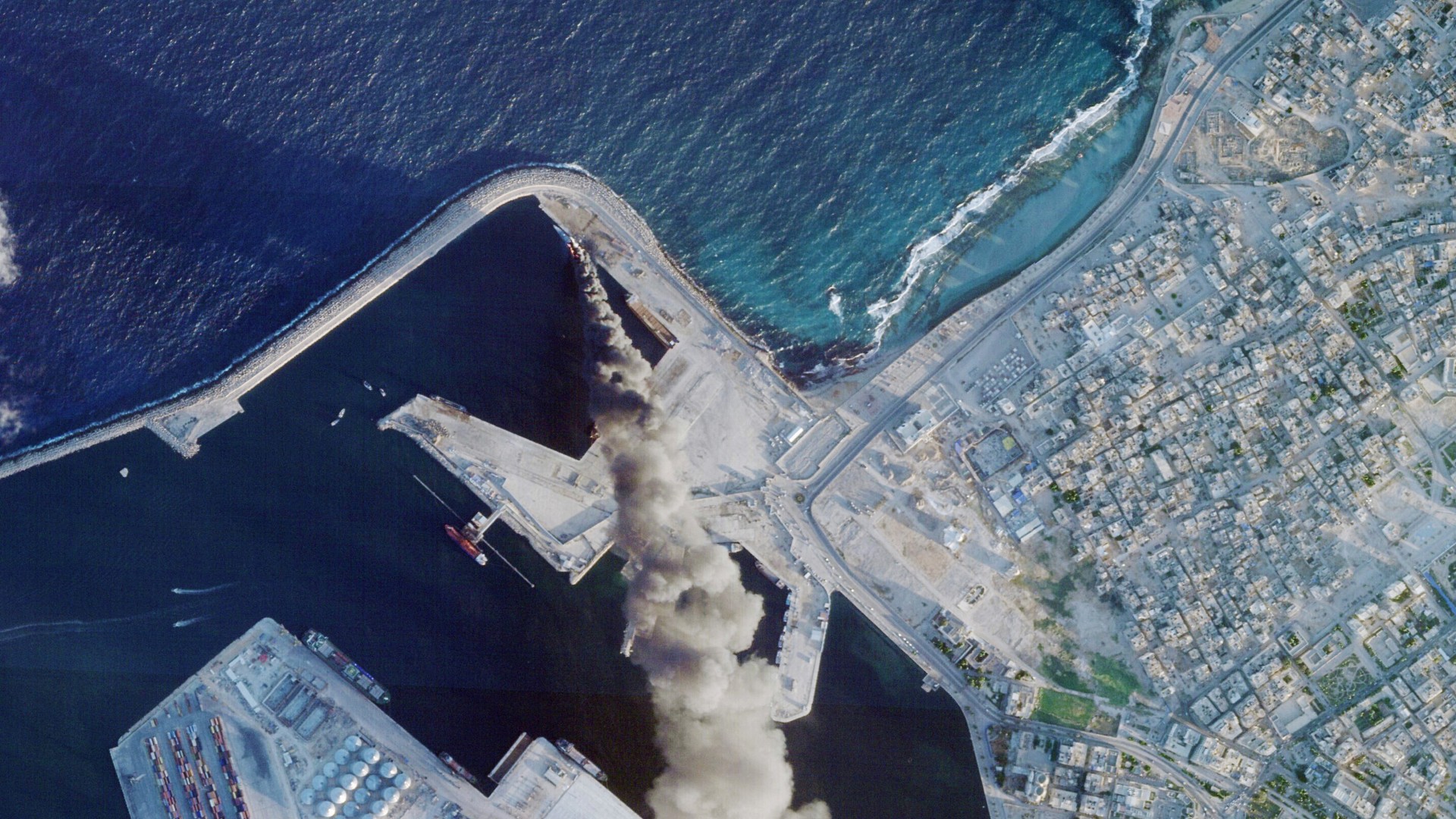
On Monday, hours after Ukraine claimed responsibility for the drone attack that sank Russian warship at Libyan naval base, Ukraine Security Service (SBU) said in a statement that "Russia’s military fleet and its logistics networks have no safe routes even far beyond the Black Sea." The wreckage at Benghazi gave that warning substance. Kyiv says seven Ukrainian naval drones sank the Russian corvette Merkury, destroyed its Ka-27 helicopter and also struck the weapons transport ship MV Angara. Satellite imagery showed the corvette capsized. Commissioned in 2023, Merkury was a modern combatant, designed to fight ships and submarines and defend against air attack. Ukraine - a country deprived of most of its conventional navy as of 2014 following Russia's annexation of Crimea - is extending maritime attrition into Russia’s Mediterranean foothold in 2026. As previously argued in Middle East Eye, maritime denial can defeat a superior navy’s strategic objectives without winning conventional fleet battles. New MEE newsletter: Jerusalem Dispatch Sign up to get the latest insights and analysis on Israel-Palestine, alongside Turkey Unpacked and other MEE newsletters Benghazi is the latest proof. A campaign across seas The 11 named vessels in Ukrainian-claimed or suspected incidents since August 2025 illustrate four overlapping target sets. The first is "sea combatants", exemplified by Merkury. The second is "military transport": Angara was struck near Benghazi while Sparta II was hit in the Gulf of Finland while bound for the Russian exclave of Kaliningrad. Neither a warship nor a naval supply carrier should be casually conflated with an oil tanker or the "shadow fleet". That is a different category. The Caspian gamble: Iran-Ukraine tensions widen the 'geography of instability' Read More » The third is "commercial ships" that carry military cargo. Ukraine’s Special Operations Forces struck Port Olya-4 in August 2025, saying it carried Iranian Shahed components and ammunition through the Caspian corridor. The Russian freighter Lady Mariia was reportedly attacked between Crete and Libya in September. Fourth is the "tanker war": Russian tankers struck include Kairos, Virat and Dashan in the Black Sea, and Qendil in the Mediterranean, alongside suspected operations against the LNG carrier Arctic Metagaz and Mersin off Senegal. This is a minimum illustrative count, not a comprehensive set of confirmed Ukrainian successes. Kyiv’s "long-range sanctions" seek military enforcement against Russia’s military naval assets and sanctions-evading energy trade. The operational objective appears to be cumulative attrition: destroy fighting platforms, interrupt deliveries, and force Russia to disperse scarce protection assets. The strategic test is whether repeated attacks constrain Moscow’s ability to sustain its war and overseas military deployments. A sustained campaign would require repeated replenishment of drones, munitions, fuel and spare parts as well as political access and legitimacy in the form of consent from host governments for any use of their ports, coastal facilities or territorial waters alongside successful strikes. By late October, the Black Sea was called "the world’s deadliest shipping route", with more than 570 vessels struck during 2026 and at least 40 seafarers killed, against 24 killed in Hormuz. Russia’s attacks have again strangled Ukrainian grain exports and compromised international food security, making Kyiv's maritime resistance an economic necessity. The theatre linkage between the Baltic, Black Sea, the Mediterranean and the Gulf recalls Soviet military thinking about mutually supporting fronts, without implying a single formal theatre. Russia’s own 2022 maritime doctrine places Baltic, Black Sea and Mediterranean priorities within its Atlantic regional military direction. For example, since Moscow’s 2015 Syrian intervention, the multi-front pressure in Syria and Ukraine have been interacting. Kyiv is turning that geographical multi-front logic against Russia. Hybrid defence Ukraine’s military intelligence, HUR, operates Magura drones. The V5’s specifications include an 800km range and 320kg payload capacity. HUR says six V5 strikes sank the missile boat Ivanovets in February 2024. The newer V7 carries missiles and has reportedly downed Su-30 fighters. Benghazi’s wider significance lies in how far a weaker navy can now reach - and how much a stronger one must spend to contain it These are evolving combat platforms, alongside expendable explosive boats. Their effect is to make protection more demanding for a larger navy, which must defend its ships against threats above and below the horizon. Benghazi’s drone model remains officially undisclosed at the time of writing. But the sustained distant operations require access, intelligence and replenishment as much as impressive range figures. One successful raid cannot establish that these requirements are permanently secured. Strategically, this is how hybrid defence works: conventional and unconventional means integrated across domains. Ukraine draws on land, sea, air, space, information, electronic and cyber capabilities. The precise combination in Benghazi remains undisclosed. An earlier MEE analysis of Ukraine’s drone revolution stressed that institutional adaptation converts technology into sustained military effectiveness. Crimea: The beginning and the end Russia’s war began in Crimea, and the war is already back in Crimea. It will likely end in Crimea. The peninsula lies roughly 300km across the Black Sea from Turkey’s Sinop and slightly over 1,800km from Benghazi. The latter distance once offered Moscow sanctuary. Iran and the Houthis have reason to study that model closely, with implications for shipping protection from the Strait of Hormuz to the Red Sea Ukraine’ impressive reach is eroding it. Tobruk and Benghazi are possible footholds for Russia amid uncertainty over Syria's Tartus. Hence, striking escorts and transports could raise basing costs, interrupt military deliveries and burden protection forces. Russia’s Africa Corps and Wagner-linked networks connect Libya with conflicts farther south. Twelve ships were accused of providing military deliveries to Africa, including routes from Kaliningrad to Libya. Disrupting these connections will affect Russia’s staying power across several theatres. And Ukraine has concrete national security interests here. Wagner helped devastate Bakhmut, where its late chief Prigozhin acknowledged losing around 20,000 fighters. US sanctions trace illicit gold revenues funding operations in Ukraine (and Africa). Kyiv believes that disrupting that network serves Ukrainian national security and defence. Benghazi is another demonstration of the new and enhanced naval warfare: smaller forces projecting combat power across seas through intelligence, forward access and relatively inexpensive uncrewed systems. The operational test is whether Ukraine can turn distant raids into a sustained campaign that forces Russia to disperse escorts, reinforce ports and reconsider basing arrangements. Iran and the Houthis have reason to study that model closely, with implications for shipping protection from the Strait of Hormuz to the Red Sea. Benghazi’s wider significance lies in how far a weaker navy can now reach - and how much a stronger one must spend to contain it. The views expressed in this article belong to the author and do not necessarily reflect the editorial policy of Middle East Eye.
Benghazi drone attack: Is Ukraine opening a Mediterranean front against Russia?
Full Article
Original Source
Read the full article at Middleeasteye →KhanList aggregates and links to publicly available news content. We do not host full articles from third-party sources. Always verify important information with original sources.