
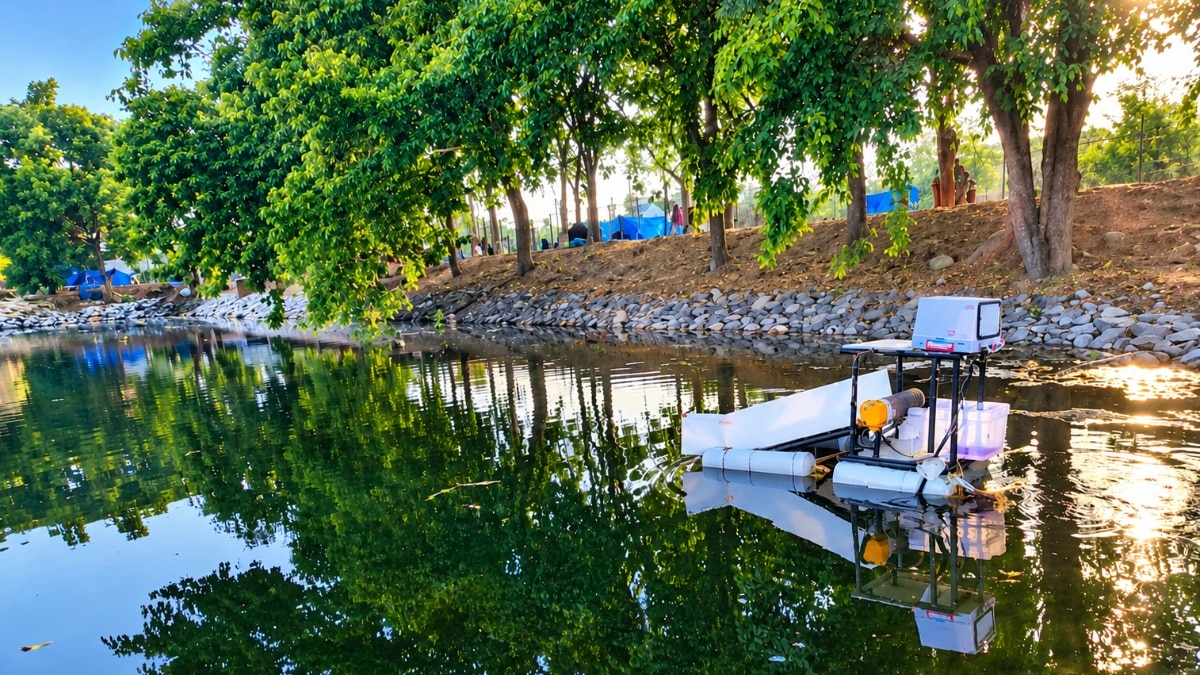
A Bengaluru-based team of young engineers is developing a floating robot to tackle one of the city's persistent environmental problems, one of waste accumulating on lakes.Called SCRUB V2, the robot is being developed by Scrub Robotics, a team incubated at RV College of Engineering.Unlike conventional lake-cleaning machines that use conveyor belts to pull rubbish out of the water, this version uses a simpler design that relies on its movement through water to collect floating debris.The idea is to make waste collection less complicated, easier to maintain and potentially more affordable to deploy across urban water bodies. Out of the lab and into the real world. We just field-tested our autonomous lake-cleaning robot in the waters of Bangalore’s Kengeri Lake. Results: Extracted heavy sludge/debris Validated auto/manual navigation Stable telemetry at 100m range #BuildInPublic #ClimateTech https://t.co/pbKG6ZJOOy— Scrub Robot (@ScrubRobotics) July 12, 2026 HOW DOES THE LAKE-CLEANING ROBOT WORK?The robot's key feature is its conveyor-free waste collection system.As it moves forward, an opening allows floating rubbish to enter. When it reverses, the opening closes, helping retain the collected material. Because the collection mechanism does not require additional motors or powered moving parts, the design could reduce energy use and maintenance needs.The startup team has also tested a predecessor prototype so far.Scrub Robotics has said that its earlier SCRUB V1 platform underwent field-testing at Bengaluru's Kengeri Lake in coordination with the Bruhat Bengaluru Mahanagara Palike (BBMP). An image of the SCRUB V2. (Photo: Scrub Robotics) The team has also demonstrated the collection of floating waste and the monitoring of water quality.SCRUB V2 is a separate design intended to simplify waste collection further. Its real-world performance and ability to operate at scale will need to be established through further testing.WHY BENGALURU NEEDS A LAKE-CLEANING ROBOTIndia's first Census of Water Bodies, released by the government in 2023, counted 69,485 water bodies in urban areas. Many urban lakes face pressure from waste, sewage, encroachment and inadequate maintenance.Bengaluru, once known for its extensive network of lakes and interconnected waterways, has seen many of its water bodies affected by urban expansion and pollution. An image of the Hebbal Lake in Bengaluru. (Photo: X/@sriharikaranth) Cleaning floating rubbish is only one part of restoring a lake.Removing plastic and weeds from the surface cannot, by itself, address untreated sewage, pollution beneath the water or damage to the surrounding ecosystem. Regular monitoring and action against pollution at its source remain essential.WHAT'S THE PLAN AHEAD?The team behind this startup is working towards turning its prototypes into practical solutions for municipal authorities. An image of a polluted Doddabidarakallu Lake. (Photo: X/@ShailajaPartha1) Its broader plans include a floating platform for collecting water-quality data and a separate system designed to intercept waste in rivers and canals, some of the essential parts of its development roadmap.For now, the promise of SCRUB V2 lies in its simpler approach to collecting floating waste.Whether it can make a measurable difference to Bengaluru's lakes will depend on further field trials, reliable operation and adoption by civic authorities.- Ends
Bengaluru startup designs unique robot that can clean dirty lakes, rivers
Full Article
Original Source
Read the full article at Indiatoday →KhanList aggregates and links to publicly available news content. We do not host full articles from third-party sources. Always verify important information with original sources.