
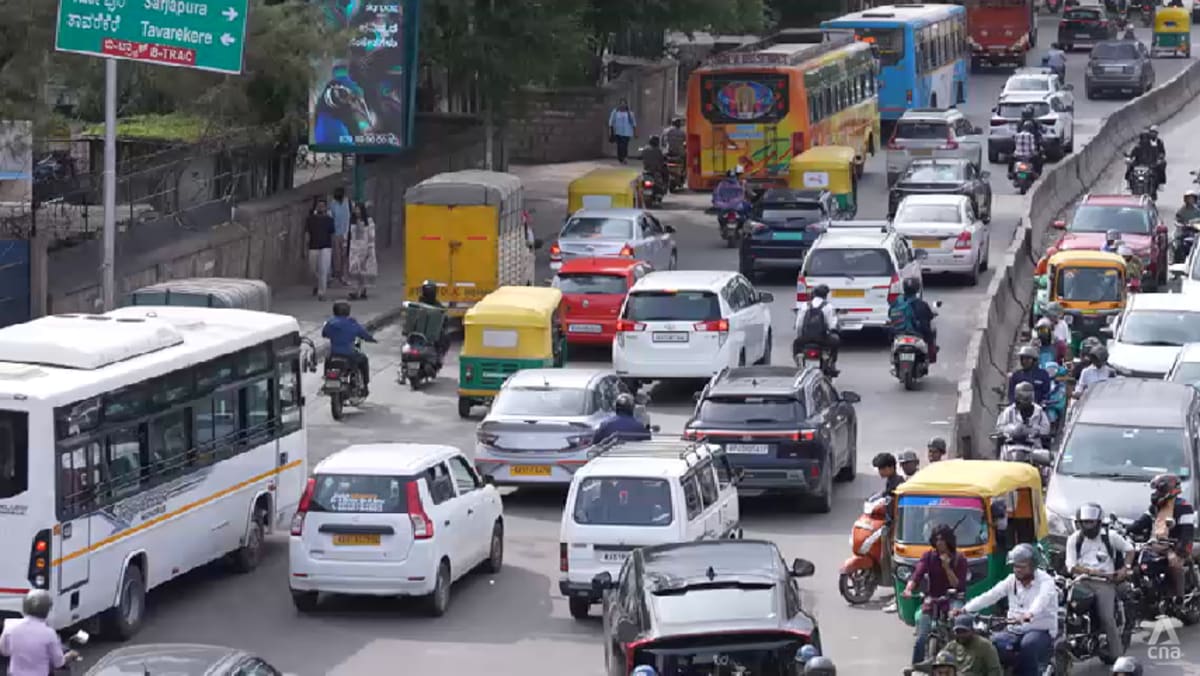
Asia The Indian technology hub is adding metro lines and buses to ease traffic congestion, but gaps in coverage and road safety concerns continue to make private vehicles a more convenient option for many residents. Heavy traffic on a busy road in Bengaluru, India. (Image: CNA) New: You can now listen to articles. This audio is generated by an AI tool. 16 Nov 2026 04:33PM BENGALURU: Despite already owning two cars, finance professional Shireesh Jacobs and his wife Shifrah, a small business owner, are considering buying a third.For the Bengaluru couple, the decision is driven less by a desire to drive than by the lack of convenient public transport and concerns over road safety for their two teenage children."There isn’t really that much good local transport the way you might see overseas where you can walk, (and) within five minutes there is a tube station, you get down and take the metro. That is not the case here," Jacobs told CNA.His workplace is about 30km from home, yet the drive can take between 90 minutes and two hours during peak traffic. Bengaluru residents Shireesh Jacobs (left) and his wife Shifrah speaking to CNA. (Image: CNA) There is no direct metro connection for his commute, while poor pedestrian infrastructure makes walking along some roads unsafe."You can see here that there are no footpaths, completely uneven surface, big ditches,” he said, pointing out the poor road conditions to CNA while driving to work.“There is at least 25 feet (7.6m) that can be developed as a good walking footpath, but people are forced to avoid the ditches, walk closer to the roads, and that makes it very unsafe,” he added. Uneven road surfaces and damaged pavements pose challenges for pedestrians in Bengaluru, India. (Image: CNA) His wife Shifrah said the couple are reluctant to let their teenage children cycle or ride motorbikes."We have two teenagers now, and we are not even okay with them having cycles and bikes because of the lack of safety. We are talking about (whether) we need to buy a third car,” she added.The family's dilemma reflects Bengaluru's struggle to reduce reliance on private vehicles.The Indian technology hub was ranked the world's second most congested city in traffic technology company TomTom's 2025 index, with a 10km journey during the evening rush hour taking more than 45 minutes on average.The city, home to more than 12 million residents, is also the first in India to have more than 2.5 million registered private cars. BRIDGING GAPS IN PUBLIC TRANSPORTBengaluru's metro network now spans about 103.6km, following the inauguration of a 7.5km stretch of the Pink Line by Prime Minister Narendra Modi on Nov 13, but urban planners say expanding rail services alone will not solve the city's transport problems if commuters cannot easily reach them."We don’t have the last-mile connectivity to the public transportation, which includes walkability," said Vijay Narnapatti, founding director of architecture and design firm mayaPRAXIS.He called for improvements to pedestrian infrastructure, non-motorised transport and bus services to be integrated with the metro network. Vehicles pass an elevated metro station in Bengaluru, India. (Image: CNA) One initiative aimed at addressing the problem is a covered walkway at International Tech Park Bangalore, which connects the business park directly to a nearby metro station.Singapore-listed CapitaLand India Trust, which owns the park, worked with Bengaluru's metro operator to build the bridge.The trust's CEO Gauri Shankar Nagabhushanam said about 12,000 people use the connection daily.“Public-private partnership is required … this benefits everyone. It is aligned to sustainability goals as well. So I definitely think some of these projects go a long way in easing traffic and making life much better for employees,” he said. Commuters use a pedestrian link connecting a metro station to International Tech Park Bangalore. (Image: CNA) MORE TRAINS AND BUSES PLANNEDThe Karnataka state government is also investing in public transport, with its budget targeting the completion of 41km of metro rail in the current financial year.Bengaluru has been allocated 4,500 additional electric buses under India's PM E-DRIVE programme, a central government initiative aimed at promoting electric vehicle adoption and expanding electric public transport.The city's transport authority also plans to expand feeder bus services connecting neighbourhoods to metro stations. Greater Bengaluru Authority Chief Commissioner M Maheshwar Rao said the city is taking a multi-pronged approach to easing congestion. Electric buses on a road in Bengaluru, India. (Image: CNA) "The approach is to see that you improve mobility, you invest in public transport, you increase the supply of road space in some way," he said.He added that reducing on-street parking and providing more off-street parking spaces are also part of the strategy to ease congestion.Despite these efforts, private vehicle ownership continues to grow.Government data shows Bengaluru registered more than 116,000 new cars and nearly 330,000 two-wheelers in the first nine months of 2026.As the city expands its transport options, a key test remains making public transport accessible and convenient enough for more residents to leave their vehicles at home.
Bengaluru expands public transport, but poor connectivity keeps residents reliant on cars
Full Article
Original Source
Read the full article at Channelnewsasia →KhanList aggregates and links to publicly available news content. We do not host full articles from third-party sources. Always verify important information with original sources.