
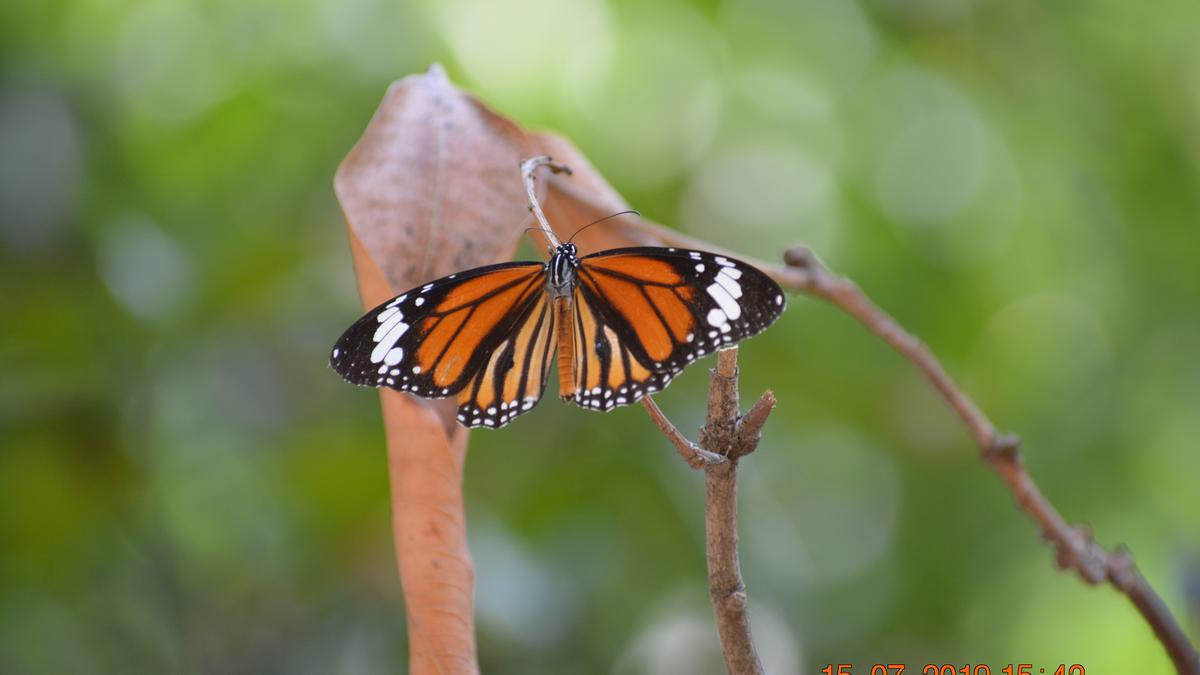
Aswathi Asokan’s journey into the fascinating world of butterflies began in 2019, as a first-year Zoology student at Chennai’s Stella Maris College. “There were a couple of professors in the Zoology Department who were interested in the natural world,” she says, recalling how one of them, Kalpana Jayaraman, was conducting butterfly walks on campus.“So I began joining those,” says the Bengaluru-based nature educator, researcher, and conservationist who has conceptualised Monsoon Wings, a new butterfly migration and life-cycle game.As someone who grew up on the verdant IIT Madras campus, she always loved nature, but “it had never got to the point where I was actively identifying species,” she says. Then, on that first campus walk, the professor gave participants a simple printout of the names and pictures of eight or nine common butterflies.“That made all the difference. Every time I saw a butterfly, I would go back to the printout and try to identify it,” says Aswathi, who developed Monsoon Wings as part of her role as the manager of curriculum development, resources & training at Nature Classrooms, a Bengaluru-based organisation that works with schools and educators to connect learning and the natural world. “I like to think that this was the start of me understanding the power of a tool like that.”She began noticing butterflies a lot more after that, closely observing their life cycles in the plants around her. At around the same time, she became part of the Chennai Young Naturalists’ Network, a group of young naturalists in Chennai.Through this group, she met like-minded people, with whom she would go on to co-author a bilingual field guide, Butterflies of Chennai, in 2023. ”The data used to create the guide came from my friend Vikas Madhav, an experienced young naturalist who did nearly 10 years of butterfly documentation work in Chennai before moving to the US,” says Aswathi, who ended up doing a lot of nature education work in Chennai before going on to pursue a master’s in wildlife conservation action from the Bharati Vidyapeeth Institute of Environment Education and Research, Pune.How it began Blue Tiger butterflies are known for their seasonal migrations, linked to monsoon cycles | Photo Credit: MURALI KUMAR K All the time spent dabbling in resource creation, including field guides, bingos and posters, has played a tremendous role in shaping this new butterfly game, which has been inspired by the ‘Bird Survivor’ game by Early Bird, an initiative by the Education and Public Engagement Programme of the Nature Conservation Foundation. “We were using this game extensively in our Nature Classrooms workshops, and I got familiar with it,” Aswathi says, explaining that this game, in turn, took inspiration from one developed by the Cornell Lab of Ornithology.While working with Nature Classrooms, Aswathi was also actively working with Sunnyside Learning School in Chennai, running biodiversity exploration programmes for its students. “I was trying to plan a session around butterflies for the Sunnyside kids, and since the mechanics are quite similar, I thought I could adapt the bird migration game to a butterfly context and see if it works.”While bird and monarch butterfly migration are well known and widely discussed, butterfly migration in India is so common right around us, yet few people know about it, Aswathi says. “That’s why I wanted to create a resource and incorporate that into the kids’ session.”Aswathi first drafted the game in a text-only format, including both butterfly life cycle and migration details and adding many interesting facts about butterflies. “They go through multiple generations,” she says, adding that a lot of ecological elements of a butterfly’s life were also incorporated into the game. “In school, we learn that a butterfly goes from the egg to larva, pupa and adult stage, but there are so many other things that happen between these stages, too. So, the idea was to bring in those nuances to anyone who played the game.” Aswathi Asokan | Photo Credit: Special Arrangement Aswathi test-drove the game, in that format, with the children she was working with back then. “I worked with elementary school kids in the age group of seven to 12. And it worked really well with them.” The exercise helped Aswathi fine-tune the game because the children came up with new questions, “which informed the later stages of development.” She also realised that the game was more than just trivia about butterflies: it allowed her to segue into getting children to think and learn about more complex phenomena plant diversity, species interactions, animal behaviour and communication.Aswathi then shared the game with the Nature Classrooms team and conducted trial runs of it at the organisation’s educator workshop, realising that “adults enjoyed it as much as the children did.”The final version of the game, which came out in October this year has been illustrated by Ketaki Watve. “She illustrated and designed the whole resource, while we sat down and wrote the whole natural history segment, instruction pages and all that. We wanted it to be as detailed as possible so teachers, educators, or anyone can easily pick it up, read and understand it, and then take it forward.”About the game Some of the cards which form part of the game | Photo Credit: Special Arrangement Featuring four common species of milkweed butterflies —blue tiger, plain tiger, striped tiger and common crow — the game explores the massive monsoon-driven migrations these butterflies undertake annually. “This phenomenon has not been completely understood by researchers yet, but butterflies have been documented to migrate from the Western Ghats to the Eastern Ghats and back,” Aswathi says.According to her, the game can be played by any number of people. All participants will be divided into four groups, with each one representing one of these species. The game is divided into six rounds, each one representing a particular stage of the butterfly’s journey, with different sets of cards corresponding to each round.“If a positive event happens, the butterfly gets to flutter one or two steps forward, while a negative event results in a step back,” Aswathi says, pointing out that the team that moves the farthest forward by the end of the game is the winner. “The fun part is the action that participants get to do while moving: fluttering, laying eggs, dancing.”After the game is over, the facilitator walks the participants through what they have learnt by asking them to describe all that happened on this journey, explains Aswathi, who has seen a huge difference in the understanding of butterfly life cycles and migration before and after the session. “Activities that are gamified really stay with people. Even if they don’t remember the entire concept, they will retain something from the session by remembering the game.” Aswathi facilitating the game with college students | Photo Credit: Special Arrangement Aswathi admits that while she had initially created it as a fun tool to use on a particular group of children, it has become a lot more than that. “It is a great way to communicate natural history to people, especially those who are just starting and learning about these things,” she believes. “Games like this really help them associate a natural history story with a fun experience, bringing in many small bits of learning. If any educator just gets children to stop and watch butterflies around them, while recalling that they migrate from one place to another in great numbers, it is still a big win for me”To know more about Monsoon Wings email info@natureclassrooms.in
Bengaluru-based Nature Classrooms releases new butterfly migration game
Full Article
Original Source
Read the full article at Thehindu →KhanList aggregates and links to publicly available news content. We do not host full articles from third-party sources. Always verify important information with original sources.