
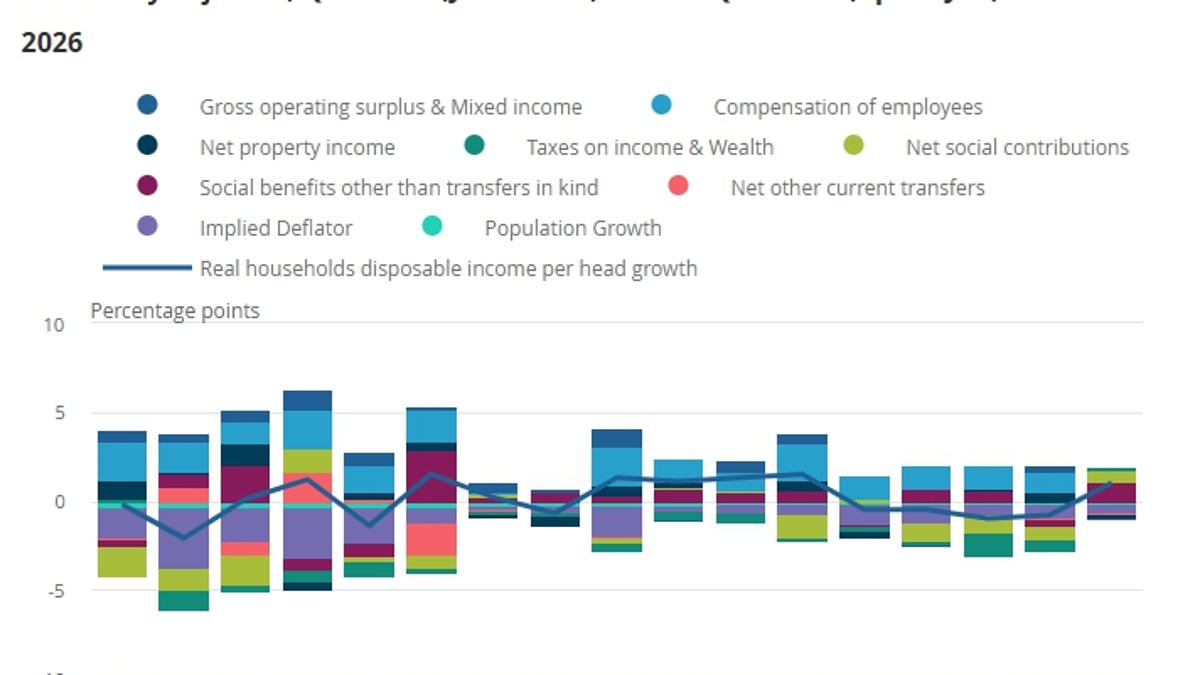
Published: 09:25 EDT, 30 September 2026 | Updated: 09:30 EDT, 30 September 2026 Higher benefits were the only thing that kept household incomes above water in the last throes of Keir Starmer's premiership.The ex-PM had targeted the metric of real household disposable incomes (RHDI) per head growing over the Parliament.RHDI per head is a measure of what is left after taxes and benefits and the effects of inflation.Sir Keir's goal was widely regarded as unambitious, as it has risen in every Parliament for 50 years - and even stayed flat between 2019 and 2024, which was blighted by Covid and the Ukraine war.Official figures released today show that RHDI per head has dropped in four of the last eight quarters, as Brits struggled with huge tax increases and cost pressures.It was equivalent to £6,538 when Labour came to power in the third quarter of 2024, and as of the first quarter of this year had dipped slightly to £6,511. Keir Starmer had targeted the metric of real household disposable incomes (RHDI) per head growing over the ParliamentThe latest Office for National Statistics (ONS) data show that the level rose by 1 per cent to stand at £6,577 in the second quarter.However, the ONS revealed that was accounted for by a 1.1 per cent increase in 'social benefits other than social transfers in kind'.Those are cash payments to support people's incomes, such as the state pension, universal credit or Jobseeker's Allowance.Most benefits were uprated by 3.8 per cent in April in line with inflation, while universal credit had an extra 2.3 per cent boost, and the state pension rose by 4.8 per cent under the 'triple lock'. In contrast, rising wages made no contribution to the rise in RHDI per head, while the impact of taxes was marginal.Despite the stagnating disposable incomes, there was better economic news as the ONS found growth was stronger than first thought in the second quarter.Hot weather and the World Cup were credited with offsetitng Iran war impacts, as GDP rose 0.5 per cent between April and June.That was better than the 0.4 per cent previously estimated thanks to a stronger services sector.It follows growth of 0.6 per cent in the first three months of the year. The latest Office for National Statistics (ONS) data show that RHDI per head rose by 1 per cent to stand at £6,577 in the second quarter However, the ONS revealed that was accounted for by a 1.1 per cent increase in 'social benefits other than social transfers in kind'But revisions to past data also revealed a weaker performance in 2025 as a whole, down from the 1.3 per cent previously recorded to 1.2 per cent.Chancellor John Healey said in a post on X: 'From the cost of living to cost of business, the lasting answer is stronger growth.'I welcome today's upward GDP revision, which means the UK had the fastest G7 growth so far this year.'He acknowledged the building pressures from the Iran war, adding: 'This is fragile with big global pressures, but we'll keep driving for growth in every postcode.'
Benefits the only reason households' disposable incomes stayed afloat in last throes of Starmer's two years in power
Full Article
Original Source
Read the full article at Dailymail →KhanList aggregates and links to publicly available news content. We do not host full articles from third-party sources. Always verify important information with original sources.