
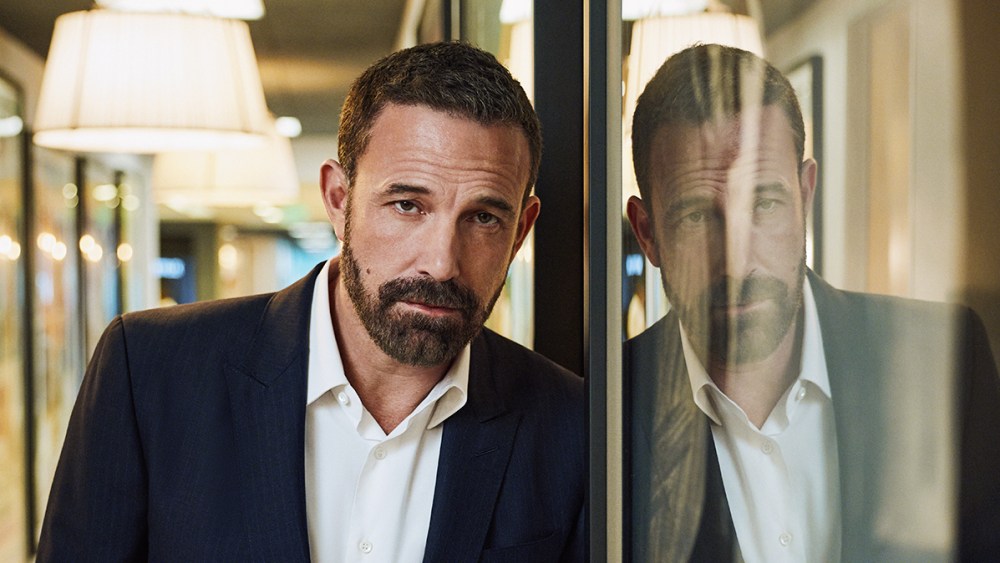
At the offices of Artists Equity, the full-service content company founded four years ago by Ben Affleck and Matt Damon, Batman is the doorman. As you step out of the red-carpeted elevator in a sleek West Hollywood high-rise, the superhero replica greets you with a menacing stare. Affleck played the Caped Crusader in four films between 2016 and 2023. Across from Batman stands a mannequin dressed in the orange NASA costume worn by Damon in the 2015 hit “The Martian.” The display is an effective hype tool, like a version of Jennifer Hudson’s “spirit tunnel” but for bros, as one enters a space rarely open to press. Covering two floors with expansive views of the Hills, the office doubles as a museum for memorabilia that chronicles the adventures of Hollywood’s most consequential childhood besties. Outside Affleck’s office, there’s a credenza housing the Oscars he and Damon won for writing “Good Will Hunting,” the 1997 film that catapulted them to stardom. (Affleck has a second Oscar for producing best picture winner “Argo,” which he also starred in and directed.) Elsewhere, there’s proof that nearly 30 years later, they continue to enjoy the fruits of that early acclaim: A miniature version of a Trojan horse from Damon’s recent blockbuster “The Odyssey” and the Batcycle Affleck rode in the less beloved “The Flash” are also exhibited. Matt Sayles for Variety Affleck, at 54, wants to make clear that this whole enterprise isn’t just a Matt-and-Ben shrine. “The danger is that it looks like building a monument to the self — it’s not,” Affleck says. “I’m in an interesting line of work where you accumulate these physical tokens, and that’s all that’s left. You go spend all this time on a movie, work so hard, and all you get is a little plastic DVD. I always wonder what happens to this stuff. Most people put it in some warehouse in Simi Valley.” The movies commemorated throughout the office — in Affleck’s suite, there’s also the rubber nun mask he wore as a robber in “The Town” and a Tommy gun from “Live by Night” — have little in common besides Affleck and Damon’s talent. Yet they serve as reminders not merely of memories and hard work, but of a model Artists Equity hopes to reshape. After all, Affleck will soon add a memento from “Animals,” the forthcoming abduction thriller that he directed and stars in alongside Kerry Washington, Steven Yeun and Gillian Anderson. It was not made in the legacy studio system, but through Artists Equity’s partnership with Netflix — a first-look deal to produce and distribute films for streaming. The arrangement has made Affleck and Damon’s humble shop the leading outside producer of the company’s original movies — including their onscreen reunion, “The Rip,” which hit the platform in January. (Netflix also acquired Affleck’s AI startup InterPositive in July for nearly $590 million in cash.) For all of Artists Equity’s bona fides, little is known about its inner workings. In 2022, well into the streaming revolution that turned show business economics upside down, Affleck and Damon formed AE with RedBird Capital kingpin Gerry Cardinale (an equity backer in David Ellison’s acquisition of both Paramount and Warner Bros. Discovery). “Matt wants to win Oscars and Ben wants to make money. Together, they’re the perfect person,” Cardinale said. The company’s promise is to give creatives greater access to profits, almost in real time. The company shares all streaming revenue with above the line talent — including screenwriters, directors, actors and producers — in addition to traditional fees. It also negotiated performance-based bonuses with Netflix that pay out the entire crew of a given film. What does this model mean — on its own terms and for the future of the business? For the first time, Affleck pulls back the veil for Variety to explain Artists Equity’s proprietary model, one he hopes other companies will adopt. As he discloses these details, Affleck says he’s apprehensive about doing press about what he and Damon have built. Who can blame him? The spoils of Affleck’s and Damon’s onscreen accomplishments documented in these halls have had peaks and valleys. Affleck’s life as captured by the celebrity press — including a romantic reunion with Jennifer Lopez and a breakup once more in 2024 — has often cast him in a role he wouldn’t have chosen to play. But all that may be in the rear view: Affleck has a business to grow and an industry to shift. Here, he discusses the beauty of a mundane routine and how Artists Equity helped him find balance within himself. This is a wildly uncertain time for the business, but there’s an undeniable revival happening this year at the box office. Is theatrical back? Revenue is almost back. Let’s see what happens with “Dune: Part Three” and “Avengers: Doomsday.” I still think we’ll come in short on attendance numbers. Premium formats are creating a delta there, which addresses a peculiarity of this — uniform pricing. There’s one ticket price. I remember thinking back in the day, “They’re charging the same amount to see ‘Armageddon’ and ‘Chasing Amy,’” even though we shot one in Kevin Smith’s backyard and the other at NASA.” I think theatrical is never going to come back to the place it was when it was the only way to see something. It’s why “Gone With the Wind,” I think, is still the movie that has sold the most tickets in history. It’s also [the reason] it’s harder to become a star now. Why is that? There are fewer people who everyone has heard of. When you were in a movie in the ’80s or ’90s or the aughts, a studio invested a lot of money around marketing you as an actor. We all benefited from that. There was a sense you could confer stardom onto certain people. People ask, where are the stars now? Obviously, you have Tom Holland, Jacob Elordi, Zendaya. A lot of them. But there are fewer that everyone in America has heard of. I remember being a kid reading Premiere magazine about what makes a star. It’s getting the audiences to show up. “Cocktail” and “Sleeping With the Enemy” were easy sells because Tom Cruise and Julia Roberts are huge stars that can sell a great movie. But what if a movie is just OK? Matt Sayles for Variety Artists Equity has been up and running for four years. The elevator pitch is greater access to profits for creatives. You haven’t really explained how that works until now. Why? I’ve spent a lot of my life doing this. Promoting [my work] increasingly feels a bit like a minefield. It’s like, “Don’t say something stupid that’s going to haunt you forever.” I used to have more fun; it’s a little less so now. I’ve been a bit reluctant to talk about [Artists Equity] because I don’t want the perception of what we’re doing to be limited to me and Matt. We’re consciously trying to achieve something bigger. But I’ve been remiss in not being proactive. With “Animals” coming, there’s a context around our partnerships at Netflix and Sony and the performance-based compensation system we work toward. We’ve had success. People got bonuses. The history of this business is full of promises of participation that don’t end up coming true. You read it in Variety, stories that are true or apocryphal, where they say, “We made this movie, it grossed $200 million at the box office, and I haven’t gotten any money.” How does this company remedy that? It’s been a yearslong effort to institutionalize this. Look at the work stoppages from the [Hollywood labor strikes] three years ago. A big part of that was around streaming and how are people being compensated. We did work to facilitate conversations about this, and it ended up that Netflix was willing to share some information about what’s successful on their platform. It’s in their interest to create a united incentive with the people they work with. You’re talking about changing deal structures that date back to the 1940s. I imagine having two movie stars in a room asking for that gives you and Matt Damon some leverage? Part of it is to take advantage of [that]. It’s present, but it’s not a thing you can rely on day-to-day. This is not a business where you get tenure and a gold watch. The phone stops ringing for us all. [Stardom] helps with momentum. It’s impossible to say, “Let’s adopt something new” — people have spent ages navigating the system that exists. Matt and I started this model with “Air” at Amazon, and “The Rip” at Netflix is another good example. We asked them to try it our way. We seek to compensate old-school above the line talent — directors, writers, actors, producers — as if they were investors in a film. It works on the clean, evident construction that those parties are compensated exactly as equity financiers would be. Not in some kind of arcane, separate bonus pool that’s distant from where the revenue comes in. I understand the studio’s point of view. Historically, they’re living in a position where [talent] is treated as cost. They’re getting paid up front; they’re not investors. But we’re trying to create a template that can be widely adopted. To that end, we just closed a deal to start Artists Equity Independent Pictures, an indie theatrical film fund that I’m really excited about. That’s specifically for next-generation filmmakers. Another part of our mission with [this model] is to maintain Los Angeles as an important hub for film. How? Wanting to be here. I’m divorced, I have shared custody, and I don’t want to miss these years. My kids are here, and their life is flying by. I don’t want to have to be in Shreveport or New Mexico in order to work. I know some people don’t have the luxury of making those choices. I’m certainly fortunate, but I know from experience that the best crews in the world are in L.A. With the federal tax incentive coming, and all the promises David Ellison has made with output for his merger, it feels like L.A. has been bailed out. What do you think of Paramount-Warner Bros. combining? [Variety interviewed Affleck a week before Paramount Skydance reached a settlement with state attorneys general to clear a path for the merger to close.] Well, there’s no merger right now. I think people are worried, appropriately, about the Fox-Disney [effect]. Fox sort of went away. What people want is more production, more work and a diversity of offering. Audiences don’t want to see the same thing over and over again. [Paramount] has been clear about their plan to release 30 movies, and that would be amazing. It’s critical for everyone to keep robust production volume. The real shame would be if we essentially lost one of those two studios. This isn’t to slam Disney — they’re people with good intentions who are trying to do good for their shareholders. What I know about David and what he’d say to me is that they’re absolutely committed. I hope that happens. We’ll see. Matt Sayles for Variety Stars are expected to be brands now. You have a branded content and advertising division at Artists Equity that you say helps artists eat. Exactly. Artists should be making money. You see it massively in the music business. People — either tacitly or explicitly — are expected to make money elsewhere. Now you’ve got your social media identity. You work to develop that. I’ve seen both Jennifer Lopez and Jennifer Garner do amazing jobs cultivating and accruing value in those spaces. Don’t think that’s not real work. I couldn’t do it. What am I going to do, unbox something? If you’re getting photographed dragging 10 boxes of Dunkin’ Donuts into your house, you may as well shoot a commercial for them. You have to recognize the value there. That’s the spirit and nature of media and celebrity interaction now. You have to have a sense of humor and be in on the joke with people. Like how I became a meme for “the beleaguered man,” as my daughter calls it. The “Smoking Ben” is my favorite. The photo where you’re standing outside, rolling your eyes into the back of your head. That’s right. That’s how I was feeling. Does anyone have any idea what I had to deal with by 11 a.m. that morning? All of us have moments — you’ve got to be willing to let your guard down about it. It’s about fairness. It’s why we have the word “equity” in the company name. I can’t change the world, but I can change the nature of commerce or the way we work and operate. If you want more control as an artist, you’ve got to be willing to take more responsibility. Even if that means how you’re exploited, on your own terms. To your earlier point, so much of modern stardom is dependent on a social following. Every time I do a movie with young actors, we talk and I get a sense it’s tougher. They feel an enormous pressure to be accruing an online following. Casting directors ask about [social followings] because it’s a meaningful metric. How would you have done if you started today under the same pressure? I would not be good at that. I’d be a terrible influencer. Would Matt Damon be better? No. He’d be worse. He’s even more conservative in that regard. So you don’t have an Instagram account? I got banned from Instagram twice for impersonating myself. I had six followers. It was my kids and some of their friends. It was just an excuse for me to look at [my kids’] social media accounts. There used to be a time when everything you said or did wasn’t on the permanent record. As you get older, you become aware of what that means. I experienced the whole world and had a whole life in private. I have a real sense of how valuable that is. I think Daniel Day-Lewis and Meryl Streep and Viola Davis and Denzel Washington are brilliant actors. It doesn’t help me appreciate their movies to see what they had for lunch. I realize I sound like an old, out-of-touch person, but I believe that as an actor you have to maintain an illusion. That’s interesting, because you’re someone who experienced fame in a different but equally intense time in media: when the weekly celebrity magazines ruled the world. Matt even said during his “Odyssey” press tour that he’s had a similar career trajectory to yours, but hasn’t had to endure the kind of scrutiny. He has plenty that he’s dealt with, but to his credit he deals with it very wisely and gracefully in ways that I sort of careened around. He has had less sensationalistic stuff in his life, and good for him. There are ways in which events in my life, and sometimes my own actions, contributed to fostering some of that. When I was younger, I had my turn in the gossip mill. It’s the exact moment you’re describing, when the weeklies blew up. Us Weekly, which used to be a quasi-People magazine and very friendly, turned into something totally different and gossipy. We discovered there’s a lot more audience for that kind of material. In fact, there weren’t enough celebrities and lives to fill [the pages]. So whole new genres emerged out of that demand — like reality TV stars and other characters engineered for that audience. But I was around for that, and I remember it was really overwhelming because it was unprecedented. You went from seeing an actor on the cover of a magazine or two, five minutes on “Entertainment Tonight.” But then the genre emerged online, Gawker came in, and it was everywhere. Matt Sayles for Variety On that topic, were you aware that an interview you did with Howard Stern in 2021 recently went viral again? You spoke about addiction, and it resonated with a lot of people because you said the only solution to addiction was “suffering.” I do believe that in a lot of ways. I wish it weren’t the case, but it is in my experience — and the experience of people I know. When addiction starts to really take hold, it’s not enough to have it in your front brain and say, “This is something I want to change. This isn’t good for me.” Something has to click on an amygdala level. That’s where the “rock bottom” cliché comes from. It’s the same thing: You’ve got to suffer enough to have something at stake you don’t want to lose. Long-term sobriety, the gift of it is that it just gets easier. It seemed to me that part of it is you’ve got to run up against something difficult and painful enough. But the good news is that’s different for everybody — you’ve got to understand what you can control and what you can’t. Like, both of my parents passed away this year. I’m very sorry. One of the things you grapple with at my age when parents die is there’s a comfort and awareness in knowing this is how it’s supposed to go. When I go, it will be hard for my children, but none of us want it any other way. My mom said to me at the end of her life: “God, I thought 84 years would seem longer.” And I thought, “I bet, because I thought 54 would seem longer.” That’s what we get. We get this much time, and it’s a reminder not to put anything off or fix it later. It’s more about how you show up every day with everybody else. I’m lucky my mom didn’t pass away younger of something more painful. Did you say what you needed to? My gosh, yeah. She’s an amazing woman. Going through her stuff, you see this woman lived an entire lifetime that had nothing to do with me. We got to have this nice adult relationship; we were really honest, and I was [able] to have discussions with her that I didn’t even imagine I would be able to when I was younger. She had this cancer diagnosis, and a great lesson was the proactive way she said, “I’m going to make a decision about how much treatment I want to do and how that’s going to impact my life.” She made her choices. She wanted to see her friends. She really committed to being a great grandmother. [We tried] to get her to move to L.A. She had her friends and her thing. She shoveled her own walk. But she would get on a plane for any of her five grandkids. Do those realizations change your outlook at home or as a leader at work? In all the ways we just discussed. You know, I have nothing salacious or all that interesting in my life. I work hard, and then I go home and pick up the kids from school. We have dinner if they agree to hang out with me. They’re with me for a week, then with their mom for a week. They have a great thing with their mom, for whom I’m also really, really grateful. I know things will come up that are hard, and I don’t want to jinx that, but this time in my life as a human being is really wonderful. What we’re doing [at Artists Equity] — to do something new that is needed and valuable is amazing. To be able to say yes to financing movies of a certain scale is a gift. We’ve got great partners, a robust unscripted division, and our brand studio and advertising operation has been really successful. I’m doing a spot for Ford on Monday with Jon Bernthal. It’s fun, because I miss directing when I’m not doing it. Commercials are lovely because they’re shorter. Let’s talk about “Animals.” You direct and star in this with Kerry Washington. One of the most surprising things about the film is how frank it is in confronting social issues. You play a white L.A. mayoral candidate married to a Black woman and raising a biracial son. Class issues are there; so is immigration. And what a shitshow L.A. is. Our goal is to force the audience to recalibrate what they think of the characters and the movie as it goes along. It’s about two things to me. One is about the difference between the way that we live our lives performatively and when no one is watching. [The other] is an interesting question about marriage. There’s a lot more to marriage and relationships than having a house and kids together. Whether you’re straight, gay, whatever — we’ve invested in sharing because it’s easier and better and wiser for us to live in a partnership. Old-fashioned economics and the rules of commitment and love. But then you realize this guy’s a slob, or this one snores? At what point in a relationship are you able to say, “This is who I am”? Neither of our characters are able to tell the fundamental truth about each other, even to themselves. It’s interesting to see how brave these characters get when they think they’ve lost everything. You seem pretty convincing in those onscreen stump speeches for mayor. Would you ever consider public office? I just think that’s enormously — I don’t know, man, that seems terrible. There’s a reason why political stories are often chosen as parables for moral compromise. You really get thrust up into the contrast between the ideal version of us and how we should be in our lives and the way it is. It’s a very depressing world, in my opinion. Tawdry. And that has no appeal to me. You’re an Angeleno. Who are you backing in the upcoming mayoral election? I haven’t thought about being asked that. I don’t know if, given this movie, my endorsement harms or helps anybody. I should stay agnostic, at least until the movie comes out. You’ve said this film was meant to star Matt and Jennifer Garner, and when he dropped out and you came in, you didn’t think it wise to have Garner play your wife. Too many people would project onto the real thing. Yes. In a movie, the illusion has to be the thing. And I still want to find something to do with her. You were a producer for “Kiss of the Spider Woman” with Jennifer Lopez. I don’t think she got her due for that performance, nor the Oscar nomination she should’ve had for “Hustlers.” Why does she get overlooked? I’m biased. I have an enormous amount of respect and admiration for what she can do. What I’ve found with awards is that sometimes the degree of commercial success for things doesn’t always correlate to my taste. It’s a part of this weird, subjective business that people bring a lot of their own stuff to. I don’t always think the right person won the right award. But guess what? I don’t think you die and go to heaven, and God says, “This was the actual best picture in 1986.” At the end of the day, it’s just a bunch of people voting on movie prizes. I passed a Batsuit and a Batcycle on my way in here. You’re going to have to talk about playing Batman until you die. Are you glad you did it? Yeah. I really liked doing “Batman v Superman.” That was really fun. “Justice League” had a lot of issues, and that wasn’t that much fun, frankly. I was glad that Zack [Snyder] was able to get his vision for how he wanted that movie to be out there. That was rewarding. But there was a sense of “Oh, the movie was a little bit too dark or scary, and it lost some of the younger audience.” It seems to be an ongoing question, and I don’t know the answer: Do you go all the way to a hard-R rating like “Joker”? Or do it like Marvel, which does something broad, unless you’re talking about “Deadpool & Wolverine”? The interesting thing with the DC characters [comes down] to the legacy of Frank Miller. There seems to be more tension between “Are we doing the grown-up version or the one that’s open to kids?” There’s a risk of being a feathered fish. It’s something they’re still navigating at DC. But I have to say, Kevin Feige is a kind of genius. I can’t think of any producer in the world who can say, “This is what the audience wants,” and be right, except for him. So I lost a bet at the office and have to ask you this. There is some debate about “Gone Girl,” about whether you wore a prosthetic for your shower scene with Rosamund Pike. What’s the truth? I wore no prosthesis. I’ve only worn one in one film, “Hollywoodland.” It was a nose. Grooming: Torsten Witte
Ben Affleck Explains It All: Artists Equity, the Death of Movie Stars and the Dilemma With Comic Book Movies
Full Article
Original Source
Read the full article at Variety →KhanList aggregates and links to publicly available news content. We do not host full articles from third-party sources. Always verify important information with original sources.