
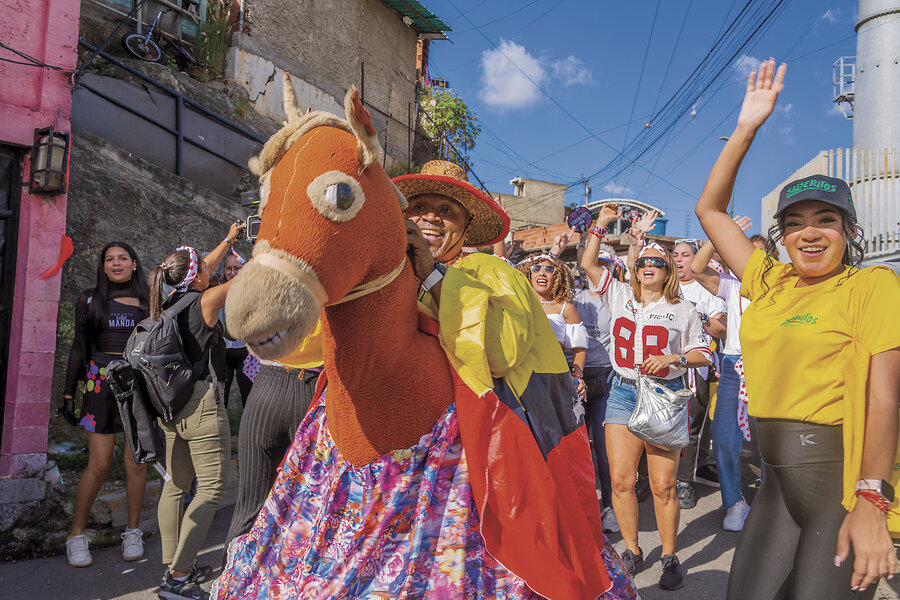
Editor’s note: This story was published in the Monitor’s weekly magazine before Venezuela was hit by magnitude 7.2 and 7.5 earthquakes on June 24. The capital and surrounding areas are dealing with widespread destruction and mistrust for the government; it will be a long road toward recovery.But the quakes also exposed a sense of solidarity, as neighbors were forced to rely on one another in the immediate aftermath. We’re sharing this story, despite the bulk of it being reported before this devastating natural disaster, because it gives a glimpse into how citizens in Caracas were already working to understand one another and to build bridges into parts of their own city they had long avoided due to sometimes trumped-up stereotypes about poverty and violence.˜By midnight on a spring Saturday, the low-income Caracas neighborhood of San Agustín had transformed into a dance floor.A live band played salsa in the middle of the street. Neighbors peeked, smiling from doorways. Visitors – mostly from the capital’s wealthier east side – who had spent the evening riding the cable car over the hillside and stopping at neighborhood bars, murals, and food stands, now danced with locals under the open sky.This scene would have been impossible to imagine just a decade ago. For generations, whole swaths of Caracas were places people knew by reputation more than experience. San Agustín, a neighborhood with a rich artistic history – as well as a record of violence – was one of them.Nearly six months after the U.S. capture of former leader Nicolás Maduro, many Venezuelans are starting to allow themselves to imagine change. That sense of possibility has coincided with a yearslong decline in violent crime in Caracas, where residents say they are moving through the city with a freedom that once felt out of reach.The San Agustín tours predate this political change, and many of the capital’s old boundaries and inequalities still hold. But as Venezuelans look for ways to reconnect with their country after years of crisis and migration, places such as San Agustín are becoming unlikely meeting points. Reinaldo Mijares directs tour company 100% San Agustín, and says tours help spark local pride. “In San Agustín, we assume the night as a right,” says Reinaldo Mijares, director of 100% San Agustín, who organized that day’s tour. Similar initiatives are bringing visitors into other parts of Caracas that were long seen as off-limits, including the barrios of Petare and Cota 905.For decades, Caracas has been divided along an “imaginary barrier” between the eastern and western sides of the city, says Diego Vallenilla, a photographer from Chacao, in eastern Caracas. People from the west side rarely go east, he says, and vice versa.But, he says after participating on this day’s tour, initiatives like this could slowly weaken that line.A complicated calmMaría Morado, a Caracas local who rarely ventured outside eastern parts of the city in the past, says she’s come to San Agustín because she perceives Caracas feels safer and wants a more “authentic” view of her hometown.“Before, you couldn’t walk around with a cellphone in your hand,” she says. “Now, you can do that even at night. Insecurity has definitely decreased.”Violence rates have fallen dramatically from their peak years in the mid-2010s, according to the Venezuelan Observatory on Violence, an independent research group. Crime statistics have been restricted by the government for nearly three decades, leaving groups such as this one to fill the gaps in tracking lethal violence.In 2016, Venezuela had 28,479 homicides – a rate of 92 homicides per 100,000 inhabitants – then the second-highest in Latin America. By 2023, the last year for which data is available, that rate had fallen by about 70%. But, the drop should not be mistaken for a clear-cut security success story, warns Roberto Briceño-León, a Venezuelan sociologist. Outsiders have long associated the hillside barrio of San Agustín with violence, but cultural tours centered on music and food are showing a different side. “The decline in crime rates is real,” he says, but it hasn’t disappeared. Instead, Venezuela has experienced a shift: less street crime, less opportunistic violence, but more organized, higher-value criminal activity, including that coming from state actors.Venezuela’s economic collapse starting around 2014 made street crime less profitable, says Dr. Briceño-León. Suddenly, fewer people carried cash, kidnapping became harder to monetize, and millions of people left the country, including young Venezuelans who might have been either victims or perpetrators of violence.Police crackdowns also played a role in the fall in street-level crimes. Security forces, including the now-defunct FAES special police unit, carried out operations that human rights groups have linked to extrajudicial killings. Human Rights Watch says that between 2016 and 2019, Venezuelan police and security forces killed more than 19,000 people, often claiming “resistance to authority.”Mr. Vallenilla, who is a travel photographer, says there are many police checkpoints across Venezuela, and abusive security forces that still make people feel vulnerable. And there’s no guarantee the current calm will last. Mr. Briceño-León warns that if the economy improves, and more people return from abroad, a city with more cash, investment, and movement could once again become attractive to criminals.But for now, the decline in street crime is offering Caraqueños an opportunity to pop self-imposed bubbles and discover their own city.Reclaiming the nightAndreina Seijas, a Venezuelan researcher who specializes in nighttime urbanism, says that, while growing up in Caracas in the late 1990s and early 2000s, she felt like the night was “forbidden territory.”As a young woman, she says, darkness carried a warning. Families developed self-imposed curfews, no matter the neighborhood. And that, in turn, changed the culture of the capital. Caracas has pleasant weather year-round, but social life moved indoors, into cars, guarded buildings, and shopping malls.“The night is where young people socialize and have fun. But in Caracas, insecurity interrupted that,” says Dr. Seijas.In the recent resurgence of nighttime gatherings in public spaces, she says she sees an opportunity to rebuild trust.Marcy Alejandra Rangel, who recently moved back to Caracas after nine years abroad, sees trust-building playing out in real time. She was surprised to find public life returning to places she remembered as nighttime no-go zones, including Plaza La Candelaria, where evening activities such as exercise classes, dancing, and community gatherings have recently drawn people back to the square. Scenes like these make public space feel shared and more secure, says Ms. Rangel. Visitors and residents dance in San Agustín during a nighttime cultural tour. The routes have become part of a broader effort to invite Caraqueños to cross social and geographic boundaries within their own city. A city still dividedCaracas’ old divisions haven’t disappeared, despite lower crime rates. That’s because the capital’s segregation isn’t just about security or income, says Teresa García Alcaraz, an architect and researcher who has studied Caracas for more than a decade. It is also about how people have historically moved through their city, she says.And much of that goes back to a 1989 uprising and crackdown known as El Caracazo. As poor residents poured into the streets in the wake of government austerity measures, the state responded with lethal force. Existing class divisions became linked to images of disorder, danger, and social rupture. Those perceptions informed how generations of Caraqueños traveled the city – and which places they avoided.Cultural tours can challenge those perceptions, Dr. García Alcaraz says, by giving visitors direct experience of a place they might have known only through warnings. But she cautions against romanticizing what a tour can do: Art and culture don’t erase inequality on their own.The tours are curated, with planned stops, and a price of about $50 to $60 – beyond the reach of many Venezuelans. Mr. Mijares, the organizer, acknowledges that visitors tend to be people with disposable incomes, but says the model brings resources into the neighborhood. Just as important, he says, is what it does for the barrio’s self-image: Residents see outsiders choosing to come, pay, eat, dance, and stay late in a place long defined by its stigma. “It sends the message that our barrio has value,” Mr. Mijares says.After years of mass migration, many Venezuelans have had to learn how to explain who they are – as a people – to others. It reframed stereotypes around music and food, he says, “like redefining their identity.”Because of that, Mr. Mijares points out, some visitors arrive in San Agustín looking for a barrio, but leave recognizing a piece of home.
Before the quakes: Building trust and branching out in Venezuela
Full Article
Original Source
Read the full article at Csmonitor →KhanList aggregates and links to publicly available news content. We do not host full articles from third-party sources. Always verify important information with original sources.