
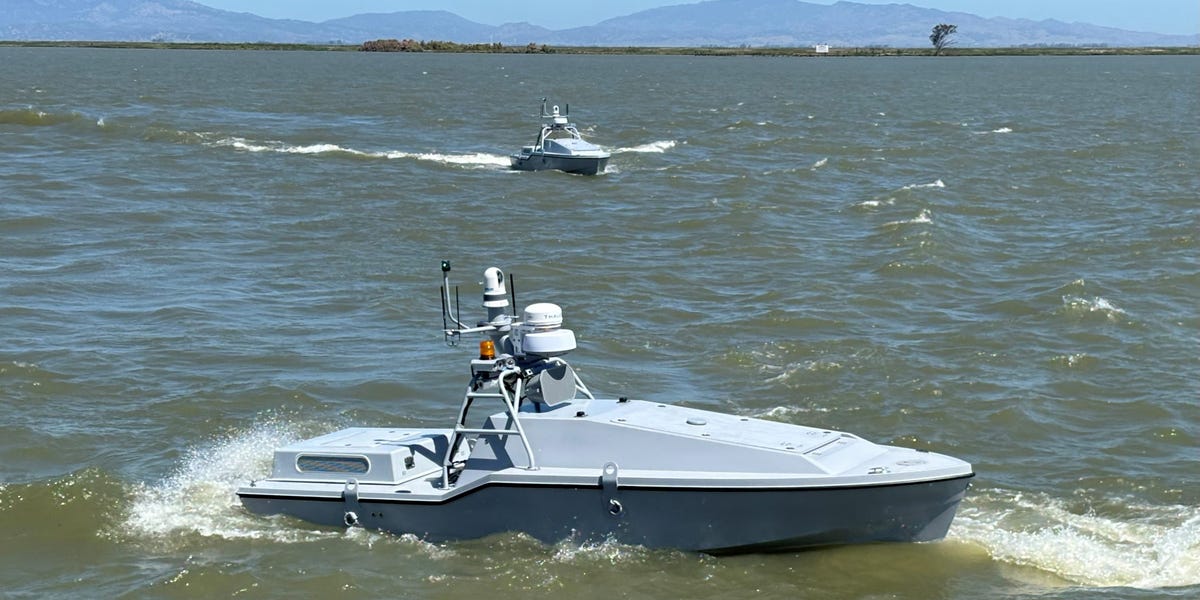
Before the naval drones rescued downed airmen in the Strait of Hormuz, the US Army put them to work doing port security Jennifer DeHaan/DEVCOM Ground Vehicle Systems Center The Corsair drones have seen action in Iran, rescuing downed helicopter crew members and blowing up Iranian targets. Before they were rescuing downed airmen in the Middle East or detonating in Iranian ports, the US Army was looking at Saronic Corsair naval drones as a port security solution, the service said Thursday.Earlier this year, the Army's DEVCOM Ground Vehicle Systems Center carried out evaluations of the Corsair drone at the East Coast Military Ocean Terminal in Sunny Point, North Carolina, and the West Coast Military Ocean Terminal in Concord, California, both of which are key Army shipping points for military equipment and ammunition.GVSC explores how commercial products can be used in the Army, looking at whether they represent an emerging capability for soldiers or offer a faster and cheaper solution to a problem while meeting program requirements.During the demonstrations, operators remotely sailed the drones around the terminals, relying on their onboard radars and cameras to get a 360-degree view of the drone's surroundings. The Corsair systems are GPS- and satellite-enabled to maintain a connection with their operators.With each mission, the systems' autonomous capabilities learn more. "They're adding reliability each and every time they're out operating," Marco Schoener, a GVSC mechanical engineer, said in an Army release. The demonstration saw the naval drones conduct port security at both terminals. Jennifer DeHaan/DEVCOM Ground Vehicle Systems Center The drones also offered the additional benefit of reducing the burden on crewed vessels, which can come under strain. "They had issues with their boats breaking down often," Schoener said. "The idea was to supplement with something autonomous to survey and detect any surface threats on the water."Feedback from the demos will inform the potential broader use of uncrewed systems, as well as whether Corsair systems can be employed for other Army needs.The Corsair — a 24-foot-long surface drone developed by Texas-based Saronic Technologies — made headlines in June when it helped rescue two Army AH-64 Apache crew members off the coast of Oman after their helicopter went down during patrols. The soldiers were rescued within roughly two hours.The vessel was operated by Task Force 59, a Navy unit focused on integrating drones and artificial intelligence into naval operations in the Middle East. US forces had practiced using sea drones for water rescue missions for years prior to the incident. GVSC's test of the Corsair drones for port security occurred prior to the June rescue mission. According to the Army release, the Middle East operation provided a real-world example of how uncrewed technologies can support various maritime missions.Corsair drones were also involved in attacks in July against an Iranian submarine and ship maintenance facility. Video footage from US Central Command showed three of the systems maneuvering into the port area before hitting their targets and exploding. Read next Business Insider tells the innovative stories you want to know Business Insider tells the innovative stories you want to know Business Insider tells the innovative stories you want to know Business Insider tells the innovative stories you want to know Chris Panella is a defense reporter for Business Insider. He covers technological transformations in the US military with focuses on US military modernization, US Army transformation, and emerging technologies like artificial intelligence and drones. Globally, Panella reports on China's military and Taiwan. Panella has embedded with the Army in Alaska, interviewed special operators learning to fly drones, and flown with US Coast Guard helicopters practicing drug interdictions. If you have a tip related to these areas or broader defense coverage, Panella can be reached at cpanella@businessinsider.com or on Signal at cpanella.85.Sign up for Business Insider's Defense Flash newsletter. Defense Iran
Before the naval drones rescued downed airmen in the Strait of Hormuz, the US Army put them to work doing port security
Full Article
Original Source
Read the full article at Businessinsider →KhanList aggregates and links to publicly available news content. We do not host full articles from third-party sources. Always verify important information with original sources.