
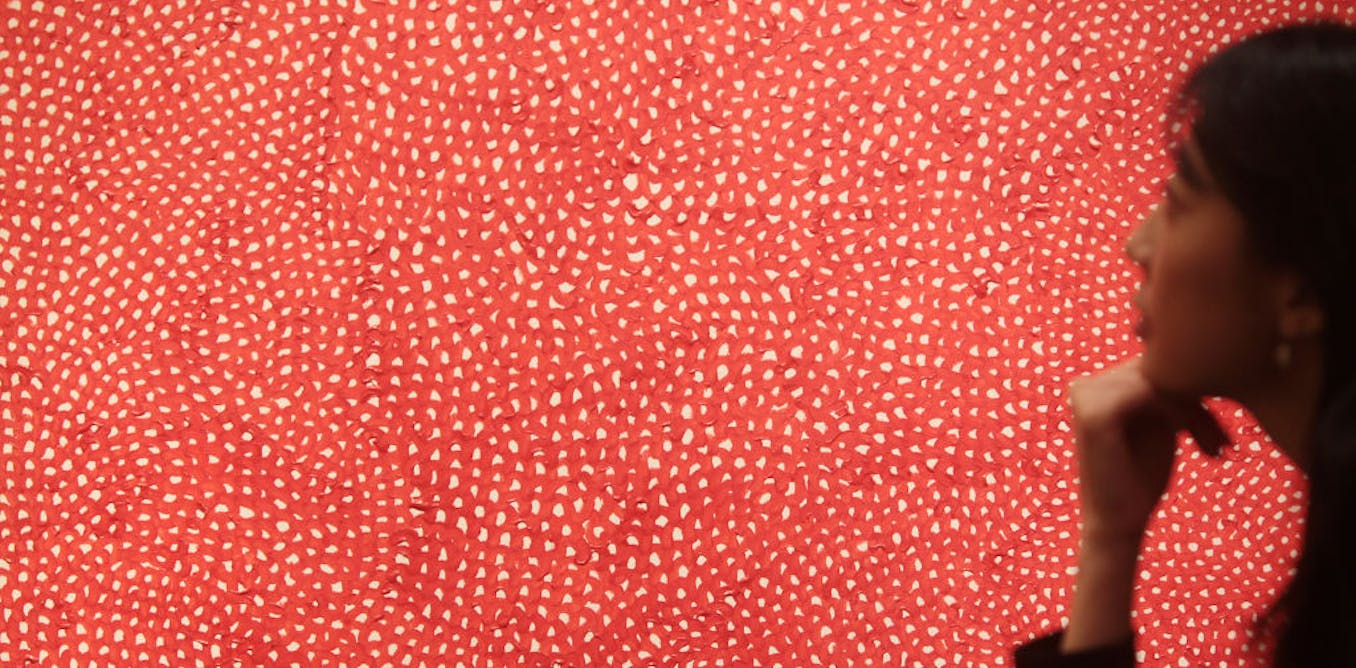
Stories of Yayoi Kusama’s life often begin after she moved to New York City from Japan in 1958 and found near-overnight success with her abstract infinity net paintings. These evolved into the infinity rooms and polka-dotted pumpkins that became social media phenomena decades later and the focus of her legacy after her death on Aug. 14, 2026. Yet, this timeline misses a crucial first step in how she became one of the art world’s most famous international superstars: A year earlier in 1957, before her move, she journeyed over the Pacific Ocean to show her work in the United States for the first time in a hopeful first step toward her dreams. Yayoi Kusama is well known for her infinity rooms. Jim Dyson/Getty Images As an art historian who specializes in the exchanges between Asian and American modern art, I believe it is important to consider not only her life after she hit it big in the New York art scene, but also how she got there from Japan. Crossing the ocean Viewers familiar with Kusama’s flashy polka dots may be surprised to see her bright color schemes in a painting she named “The Pacific Ocean,” which looks more like fire than water. This 1958 painting shares a glimpse into her state of mind looking out an airplane window as she flew from Japan to her first American exhibition the year before. At the time, she didn’t know that she would finally achieve her goal of making a permanent move the next year. Reflecting back on this uncertain era from her new home in New York City, she painted many works named after the Pacific, the transition space between Japan and the U.S. The pulsing red patterns are ambiguous. Is it sunrise? Sunset? Or a purely imaginary view? The paint glows with potential energy like a forge where Kusama could remake herself. Before leaving for America, she burned most of her old art, wanting to leave her old self behind. Crossing the ocean became another transformative step toward an uncertain future. Like the water’s surface, the painting’s swirling waves and currents draw the viewer in without revealing what is underneath its shadowy depths. Painting infinity Kusama’s lifelong struggle with her mental health is the most well-known explanation for her quest to paint “infinity,” which she famously called “self-obliteration.” She embraced the stories that fascinated people, including anecdotes about her childhood nightmares and hallucinations that compelled her to paint patterns into the real world so she could exorcise them from her mind. However, early paintings such as “Pacific Ocean” reveal other sources of inspiration that have been overshadowed by her larger-than-life persona and psychiatric struggles. An artist’s origin story can turn her into a myth, but “Pacific Ocean” is a window onto a quieter, human moment, before Kusama became a global icon. It reveals how her relationship to the concept of infinity was also shaped by feelings of anxiety and awe in face of the enormous Pacific Ocean and her unclear future. Yayoi Kusama created several paintings titled ‘The Pacific Ocean.’ Alexi Rosenfeld/Getty Images By repeating patterns that stretch and dance across the painting, Kusama suggests that this rhythm and pattern can go on indefinitely beyond the edges of the canvas. Even though neither the human eye nor a single artwork can contain the vastness of the ocean, the painting can capture a snapshot for a moment. In this case, creating multiple paintings of the Pacific Ocean helped Kusama reflect on experiences larger than any single painting can encapsulate. Reflecting on a life Research on Kusama’s early life illuminates her as a complex figure who was constantly searching for ways to make a name for herself. In 1957, before leaving Japan, she was motivated by hopes and dreams, but also plagued with fears: How would she get a visa? How could she get a job to support herself? Her first trip was disappointing because it ended without either. In these early years, before she achieved the global success and popular recognition she hoped for, she was just a young girl looking out the window on her first international flight, uncertain of where her future would take her.
Before the infinity nets, there was ‘The Pacific Ocean’ – what origin stories focusing on Yayoi Kusama’s mental illness miss about her art
Full Article
Original Source
Read the full article at Theconversation →KhanList aggregates and links to publicly available news content. We do not host full articles from third-party sources. Always verify important information with original sources.