
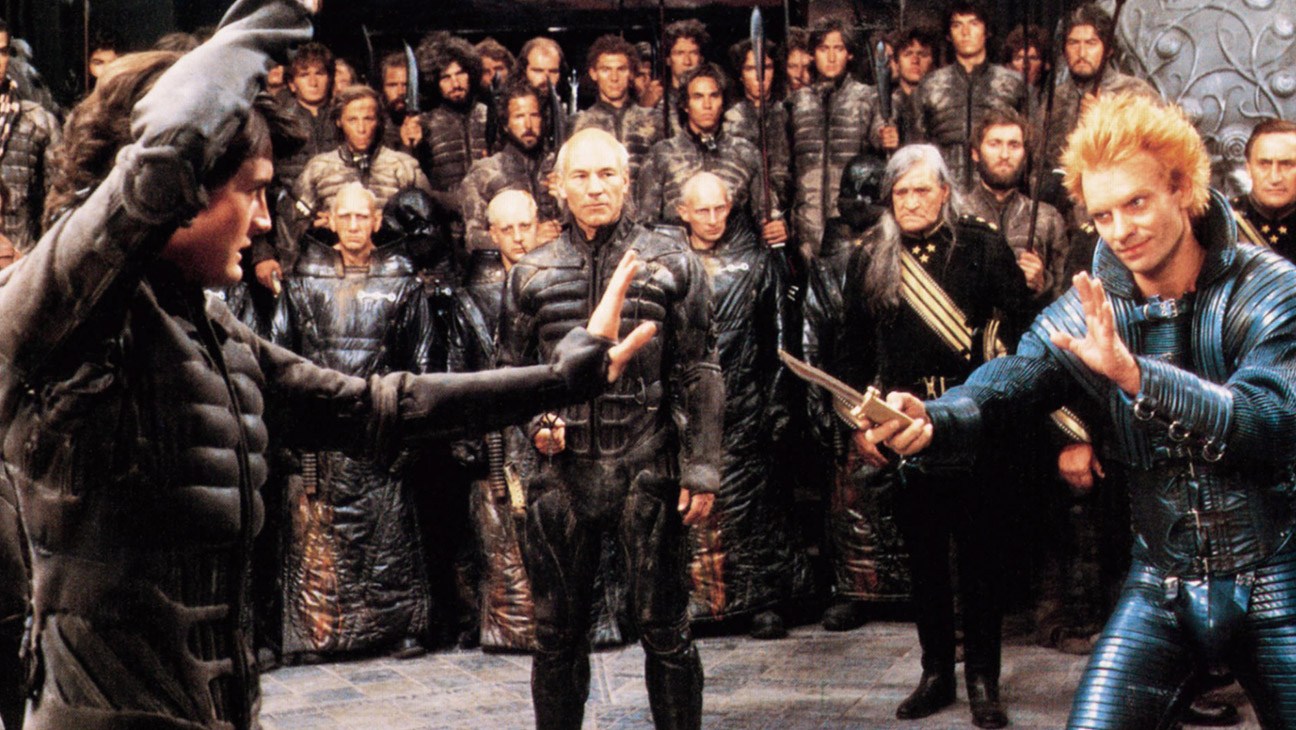
Before there was Jean-Luc Picard, there was Gurney Halleck. Several years before Star Trek: The Next Generation sent his career into the cosmos, Sir Patrick Stewart played Halleck, the Warmaster of House Atreides in David Lynch’s Dune in 1984. Stewart, who died this week at age 86, was then a seasoned stage veteran in his native England, but Dune was merely his third film. It was also his introduction to science fiction, a precursor to his career-defining role as Picard. He imbued his character with the kind of presence and dignity that only classical stagecraft can summon — much as his English forebear Alec Guinness had in Star Wars. In his new memoir, Fictional Selves (recently excerpted in The Hollywood Reporter) actor Kyle Maclachlan, recalled the surreal, formative experience of shooting Dune in the Mexican desert alongside Stewart. “The first thing I noticed when I met Patrick was his voice,” writes MacLachlan, who was 24 at the time and, like Stewart, new to film. “I went to school for three years to learn how to speak onstage, but I’ll never sound like him. Coming from the prestigious Royal Shakespeare Company, Patrick has the most mellifluous tones, regal and elegant. No one can make the line ‘Behold, as a wild ass in the desert go I forth to my work’ sound correct except for him. He is Gurney Halleck, master swordsman and troubadour. And because he’s also Patrick Stewart, he’s suave and debonair about it. When he puts on the Atreides battle jacket or the Fremen stillsuit, it’s like he’s lived in it all his life. He also has the most marvelously shaped head of any human I’ve ever seen, and I tell him so. He gives me a ‘thank you, I think’ kind of look.” A longtime fan of Frank Herbert’s Dune franchise, MacLachlan writes that he knew more about the works than most of the people involved in the film, including Lynch. As such, he became something of an authority on the subject matter. Stewart came to rely on MacLachlan’s expertise in order to get deeper into his character. “Patrick is a mix of stately confidence and thoughtful inquiry. He regularly leans over and, sotto voce, asks me questions about what’s going on,” writes MacLachlan. “Though he presents a very cool and collected mien, he is just trying to figure shit out like me. We connect on our theater background — I did Shakespeare the previous summer — and laugh at the exponential difference between simple theater productions and … whatever this is. The size and scope of the film often leave us speechless, and I feel less alone with him beside me.” The following passage from Maclachlan’s memoir well illustrates Stewart’s refusal to treat popular entertainment with any less seriousness than Shakespeare, a trait that would serve him well throughout his career. On his first day of shooting, he and I took our seats in a half-built “ornithopter,” which is like a giant, multifaceted bee that flies over the desert. We were seated in front of a gigantic blue screen, where the landscape would be matted in later. I could feel Patrick’s nervousness as we prepared to “fly” over the shield wall and the Great Desert of Arrakis. He leaned forward and quietly asked, ‘Kyle, what are we looking at here?’ I leaned back and spoke in an undertone: “There’s a sandworm down there bigger than a tractor trailer.” “Aha. And there?” he asked, pointing lower down. “It’s swallowing one of the harvesters.” “Harvester?” he asked. “It’s like a large metal factory on wheels.” “Seems like a risky mission,” he said, a trace of somber gravitas. “Tremendous risk,” I said quietly.Patrick’s key line in the scene is “The worm is eight minutes away, sire.” After the first take, he had a question. “Pardon, David?” “YES, PATRICK,” David said in his distinctive honk. “How exactly would I know how far out the worm is?” I’m impressed that Patrick exists deeply enough within his character to ask such a thing. David stopped, re-calculating in his mind. “EXCELLENT QUESTION, PATRICK,” he said, like a supportive teacher. “THANK YOU.” He then dispatched a propman to construct a gauge, with analog hands to be inserted later.The above quotes are from FICTIONAL SELVES: A Memoir by Kyle MacLachlan. Copyright © 2026 by Kyle MacLachlan. Published in the United States by Crown, an imprint of the Crown Publishing Group, a division of Penguin Random House LLC. All rights reserved.
Before ‘Star Trek,’ Patrick Stewart Proved His Sci-Fi Chops in ‘Dune’
Full Article
Original Source
Read the full article at Hollywoodreporter →KhanList aggregates and links to publicly available news content. We do not host full articles from third-party sources. Always verify important information with original sources.