
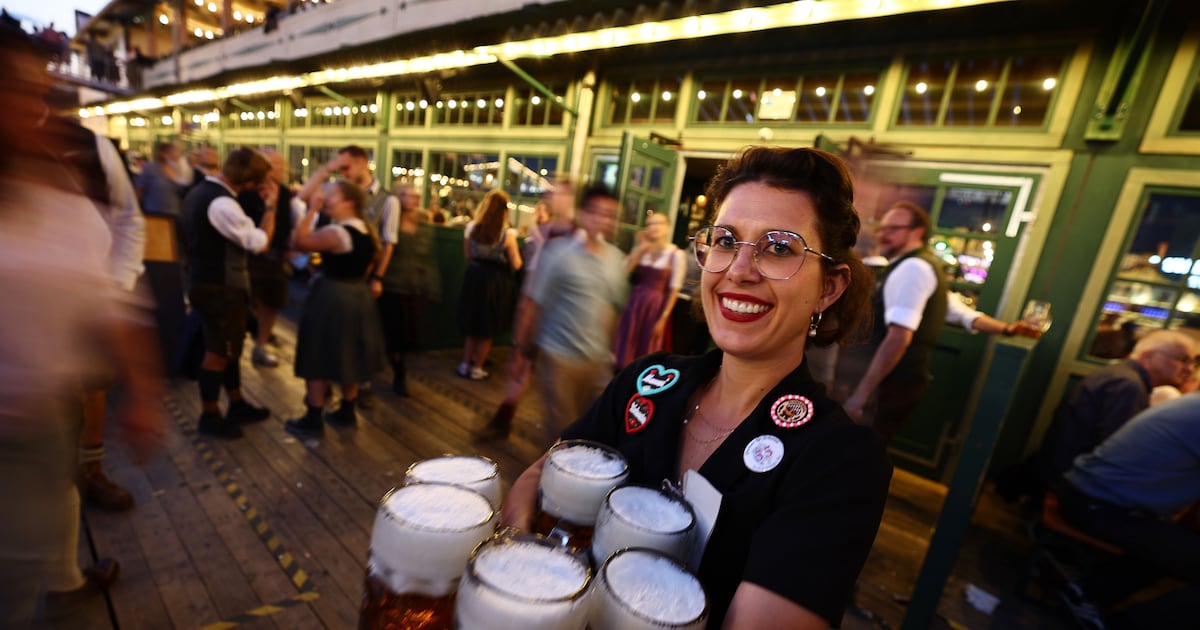
Every four years you have the summer Olympics and the winter Olympics, but every year the German city of Munich hosts the “drink olympics”.Also known as Oktoberfest, the 191st annual edition of the festival set new records this year after 16 well-lubricated days in the Bavarian capital. And, in the interests of accurate reporting, your tireless Irish Times correspondent was one of the record 7.4 million visitors at the fairground.It was a high-risk mission that began with a civilised sausage-and-pretzel breakfast, was kept going by litres of Augustiner beer and concluded in a heaving tent with 5,000 lederhosen-clad revellers singing Take Me Home, Country Roads.Dancing on a bench beside me, local man Basti said Oktoberfest was a sacrifice worth making.READ MORE“Every year I think, ‘Oh, not this again’, but you go along and the atmosphere just grabs you,” he shouts. As the band strikes up Sweet Caroline, he says: “There’s nothing quite like this.”That much is clear as soon as you enter the sprawling Theresienwiese festival site. It’s four times the size of St Stephen’s Green and holds a garish mix of lights and smells, from old-fashioned carnival carousels to newer pneumatic rides that fling screaming visitors to infinity and beyond.You can toss balls, shoot targets, pluck candyfloss or duck into the Schichtl variety tent which, since 1871, has offered goggle-eyed visitors theatrical executions by guillotine.Revellers celebrate the end of the 191st Oktoberfest beer festival in Munich, Germany. Photograph: Anna Szilagyi/EPA Waiters and waitresses celebrate the final evening at Oktoberfest. Photograph: Anna Szilagyi/EPA Not all attractions have lasted that long. Just once, in 1880, visitors were reportedly delighted by a family of Astrakhan Spitz dogs who could not just play cards and dance, but could also recognise Europe’s crowned heads from photographs.Today’s longest-lasting attractions are its simplest. In the Teufelsrad (Devil’s Wheel), guests seated on a polished spinning disc do battle with centrifugal forces (and, for women this year, a rise in upskirting).Another highlight is the Toboggan, where sober and semi-sober visitors try to remain standing on a long conveyor belt that rises at a steep incline at speed. Watching people lose their balance in public is therapeutic in our modern health-and-safety tyranny.Oktoberfest has its roots in monarchy: a citywide booze-up in October 1810 to celebrate the marriage of Crown Prince Ludwig, later King Ludwig I.He was later chased from the throne after a dalliance with a Sligo woman, but his wedding festivities concluded with a horse race on a Munich meadow. It was subsequently renamed Theresienwiese in honour of his bride, Princess Therese. While locals call the festival “the Wiesn”, today’s horses are clad in elaborate leather-and-steel outfits with a medieval look and a Morris dancer jingle. Each brewery has its own fleet who pull carts laden with wooden beer kegs to the cathedral-like beer tents. There are 35 in total across the festival grounds, some with a capacity of up to 8,000 people.All are miracles of engineering – both spacious and cosy – and logistical miracles that pop out food and beer with the efficiency of an airport luggage facility.Without doubt the greatest miracle, however, is convincing people who complain about €2-a-litre petrol to pay nearly €16 for a litre of beer.Even with these super-premium prices, beer sales were up nearly 3 per cent to a record this year of 6.7 million litres.The trick is to win over visitors with a twinkling smile. That, at least was the approach of Munich’s new Green mayor Dominik Krause. As the first gay man in the role, Krause faced particular pressure with an opening day tradition, when he took up a wooden mallet to knock a beer tap into the first keg.Oktoberfest is worth about €1.5bn to the Bavarian capital. Photograph: Anna Szilagyi/EPA Relief was palpable on Krause’s face after he managed it with just two taps, securing himself a place in the premier league of Munich mayors rather than the hall of shame: a predecessor in 1950 succeeded only after 17 wallops.In the beer buzz it is easy to forget how many Oktoberfest traditions are triumphs of cultural appropriation. In particular the traditional dress – women’s dirndls and men’s lederhosen – achieved popularity when Munich’s 19th-century upper-classes thought it would be a lark to dress like peasants.While the popularity of such costumes rises and falls over the years, constants this year included 92 tonnes of rubbish and 4,000 lost property items.This year’s treasure trove included 700 wallets, a pair of crutches, someone’s false teeth and an alcohol tester.Oktoberfest organisers said the visitor record was boosted by good weather and a new security plan including crowd-management steered by artificial intelligence. On Sunday evening, Mayor Krause raised his glass to a peaceful and profitable Oktoberfest – worth about €1.5 billion to the Bavarian capital. For anyone who missed out, the drink Olympics return next September 18th.Bavarian traditional gunners get ready to fire their salute at the festival. Photograph: Anna Szilagyi/EPA More than seven million visitors attended the Oktoberfest. Photograph: Anna Szilagyi/EPA
Beer at €16 a litre? Oktoberfest drinkers cannot get enough
Full Article
Original Source
Read the full article at Irishtimes →KhanList aggregates and links to publicly available news content. We do not host full articles from third-party sources. Always verify important information with original sources.