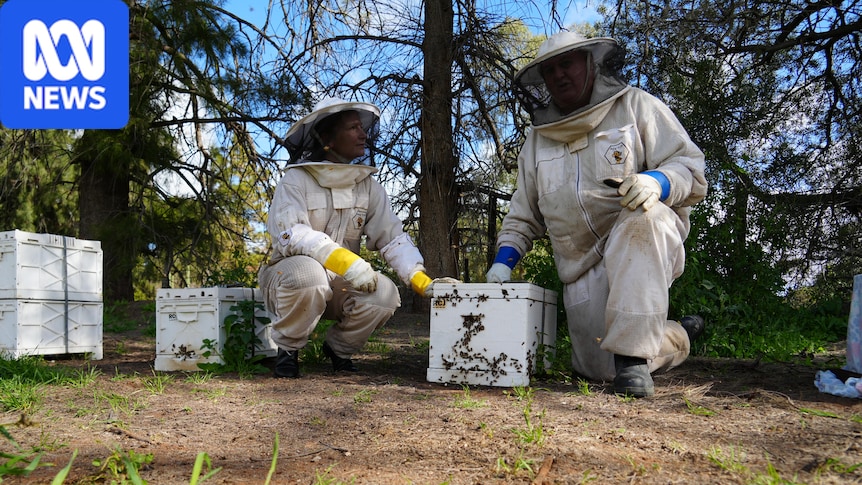
Beekeepers in South Australia are pleading for increased access to organic treatments for varroa mite.The small, red mite is known as the "world's worst" honey bee parasite and was first discovered in SA in September 2025.Mites feed and reproduce on honey bee larvae and pupae, leading to malformations.The call from beekeepers comes after a commercial almond grower in SA, who remains anonymous, reportedly forked out more than $2.3 million to have 7,500 healthy beehives transported from Western Australia to help pollinate crops.Beekeeper Ian Cass manages 400 hives of his own at Loxton in the state's Riverland region.Ian Cass has been a beekeeper for eight years after previously working as a dryland farmer. (ABC Riverland: Jackson Byrne)Mr Cass said he made and mixed his own organic treatments to avoid the cost of repeating the treatments becoming prohibitive."We can make it for a fraction of the price of what we've got to buy it for," he said.Mr Cass said beekeepers were only sanctioned to use organic treatments, even homemade batches, once a year.And while organic treatments were a more drastic, and potentially dangerous, option compared to the synthetic alternative, Mr Cass said the varroa mite crisis necessitated an overhaul to the current regulations."You've got to use organic treatments very safely; you have to wear gas masks, but do it right and it's a fraction of the cost, which is the thing that kills us," he said."Even if you were allowed to use [commercial organic treatments] more than once a year, we're looking at 10-plus dollars a treatment."Four-hundred hives times 10, that adds up pretty quick."What happens if we lose our honey bees?Mr Cass said bees in Queensland and New South Wales were already "building a resistance" to synthetic treatments for varroa mite currently sanctioned by the Australian Pesticides and Veterinary Medicines Authority (APVMA)."It's the almond industry, the cherry industry, canola, lucerne seed and so many other industries that are affected," he said.Beekeepers say there were billions of dollars on the line for the agriculture sector if crops were not pollinated. (ABC Riverland: Jackson Byrne)"This is going to increase the cost of all your staple goods because most of them are pollinated."If you take those hives out of the game, suddenly no crops will grow."The Australian Honey Bee Industry Council (AHBIC) estimates honey bees contribute an estimated $14.2 billion to the Australian economy every year.CEO Danny Le Feuvre said he was not surprised to hear of growers in varroa-infested states spending millions on importing bees from other regions given what was at stake.Danny Le Feuvre says action needs to be taken quickly. (ABC News: Tayla Larsen)Varroa mite was first detected in June 2022 in NSW, and has since been found in Victoria, South Australia, the Australian Capital Territory and Queensland."We know if growers can't get bees on their almond crops, it costs them millions of dollars," Mr Le Feuvre said."There's going to be a shortage of colonies over August, September to fulfil that pollination demand."The almond industry needs bees to pollinate crops. (ABC Rural: Eliza Berlage)The Almond Board of Australia's chief executive Tim Jackson said South Australia could expect up to 60,000 beehives to arrive from interstate to help pollinate almonds over the coming months.He said it was something the industry would have to get used to, with Australia's wild honey bee colonies on the brink of collapse."It's estimated that one in three things you eat requires a bee," Mr Jackson said.Tim Jackson remains optimistic about the future of the almond industry, despite growing concerns Australia will soon be without any wild honey bees. (ABC News: Matt Roberts)"We have a national crisis looming around pollination security given the spread of varroa and a lot of crops that have relied on feral honey bees."In the not-too-distant future we won't have those feral honey bees due to varroa wiping them out."Why can't beekeepers use organic treatments more often?There are currently eight products approved for controlling varroa in Australia, each with strict usage instructions based on their respective permits.Synthetic treatments are applied by contact strips, described as being easy to use and initially very effective, killing well over 90 per cent of mites.The downside? Varroa mites can quickly become resistant.Varroa mite was first detected in South Australia in its Riverland region in 2025. (ABC Riverland: Jackson Byrne)The APVMA said access to treatments "continues to expand", with Australian suppliers being added to existing permits. It said it has received several applications for permits to provide access to further treatment options and is "currently evaluating applications" and working with applicants to "progress them as quickly as possible".A federal government spokesperson said the ongoing management of varroa, including treatment decisions, was "the responsibility of state and territory governments".They also said $100 million had been committed to the national varroa mite response program by all levels of government and industry.South Australia's Department of Primary Industries and Regions was contacted for comment.The federal government says it continues to invest in the management of varroa mite. (ABC Riverland: Amelia Walters)Mr Le Feuvre said the AHBIC would continue to monitor the latest research into organic treatments."One of the benefits of organic treatments is that the mites really struggle to develop resistance," he said."Right now there's not a lot of regulatory data behind to support it."We're aware this is not providing as great a [level of] flexibility as we'd like, and we're in support of gaining as much access to as many products as we can."
Beekeepers plead for better access to varroa mite treatments
Full Article
Original Source
Read the full article at Abc →KhanList aggregates and links to publicly available news content. We do not host full articles from third-party sources. Always verify important information with original sources.