
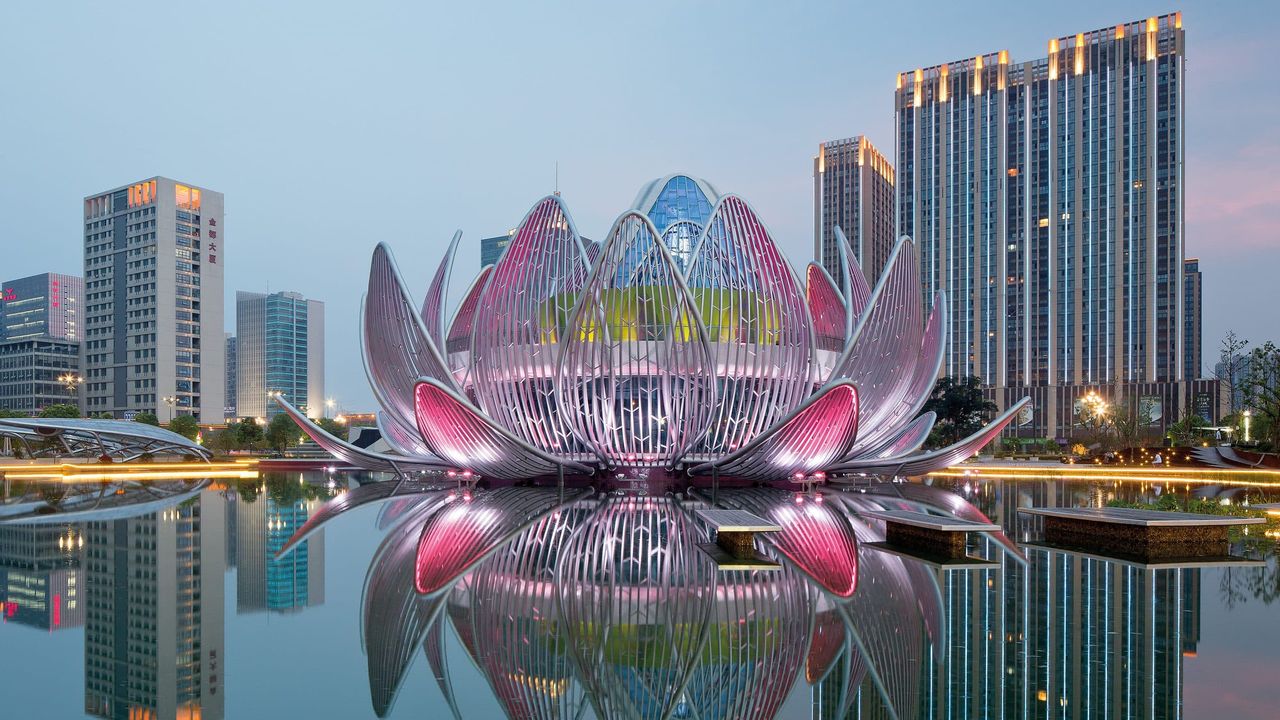
While flower-inspired buildings look unmistakably modern, architecture has long borrowed from the garden. Legend has it that, in Ancient Greece, the acanthus leaf inspired the sculptor Callimachus to carve the first Corinthian capital, bringing nature into classical stonework. In Egypt, lotus blossoms crowned temples as symbols of rebirth, while in the Islamic world, marble arabesques bloomed across mosques to evoke paradise. Centuries later, Art Nouveau revived nature’s patterns once again, bending iron and glass into curling stems and petals. Across eras, flowers have offered architects a universal language, one that continues to evolve today, as blossoms reappear in structures around the world.Today, architects continue to design flower-inspired buildings that celebrate the beauty of blooms while grounding their presence in shape and purpose. In these structures, petals become façades that filter light, temper heat, and turn ornament into performance. Below, a tour of some of the world’s most striking flower‑inspired buildings.Burj Khalifa, Dubai, UAEVia Instagram: @goaerialsIt might not be noticeable to the naked eye, but the Burj Khalifa’s record-breaking height hides a delicate muse: the spider lily (Hymenocallis). At 2,716 feet, the world’s tallest tower echoes the flower’s radial in its Y-shaped footprint and hexagonal core. Each “petal” of the plan buttresses the central core, allowing the building to taper gracefully as it rises and mitigating wind loads on the structure. The biomimetic strategy marries engineering and aesthetics; by echoing the spider lily’s radial symmetry, architect Adrian Smith and engineer Bill Baker created a form that is both beautiful and structurally efficient. The tower’s shimmering façade and setback terraces may draw the eye upward, but its elegance is rooted in a flower found in the local landscape.Wujin Lotus Conference Center, Wujin, ChinaPhoto: Courtesy Lotus Conference CenterFloating like a blossom on an artificial lake in Wujin, the Lotus Building by Melbourne-based Studio505 reimagines civic architecture as an inhabitable sculpture. Conceived as an extension to a subterranean municipal facility, the structure houses exhibition halls, meeting rooms, and a planning bureau beneath petal-like volumes. Once inside, visitors descend into a vaulted, cathedral-style interior where a graded color scheme on the ribs of each petal creates an uplifting atmosphere. Hand-laid hexagonal mosaic tiles in white, beige and stainless steel cover both the interior and exterior, uniting the spaces in a seamless, shimmering skin. By night, the petals glow, their colors cycling through programmed sequences.Here, sustainability is as important as the spectacle; 2,500 geothermal piles beneath the lake pre-cool and pre-warm the building, while evaporative cooling from the water drives a thermal chimney within the main pod.National Museum of Qatar, Doha, QatarChristopher Pike/GettyImagesAt first glance, the National Museum of Qatar’s form is anything but floral. Jean Nouvel’s otherworldly collection of interlocking disks seems born of geometry and desert winds rather than petals. Yet its inspiration lies in the desert rose, a mineral formation that crystallizes beneath salt basins into flat plates resembling rose petals. The museum’s disks tilt and intersect to form galleries, shaded courtyards, and overhangs; they also shelter the restored palace of Sheikh Abdullah bin Jassim Al Thani, integrating Qatar’s past with its future. Covering roughly 430,556 square feet of galleries and surrounded by a 1,205,557 square foot park, the building narrates the nation’s geology, pearl-trading heritage, and rapid modernization through immersive exhibits.Colombo Lotus Tower, Colombo, Sri LankaXinhua News Agency/Getty ImagesRising over Beira Lake, Colombo Lotus Tower in South Asia ascends 1,168 feet and is designed to resemble a blooming lotus, a symbol of purity and renewal in Sri Lankan culture. Construction began in 2012, and the tower opened to the public on September 15, 2022. The “tower house” portion, which includes eight floors of hospitality spaces, a revolving restaurant and an observation deck, is shaped to evoke the petals of a lotus blossom. The vivid green stem and magenta bloom contain radio and television transmission facilities as well as entertainment venues and a digital art museum.La Tulipe, Geneva, SwitzerlandPhoto: HolyshotIn a city better known for restrained modernism, La Tulipe is a playful bouquet of concrete and colored glass. Hidden in a Geneva car park between a children’s hospital and a micro-forest, Jack Vicajee Bertoli’s La Tulipe (1975–76) unfurls like a brutalist blossom. The research facility’s faceted concrete stem “sprouts” from the ground and then opens up like a surreal flower. The core is protected by tapering concrete ribs, while sheets of candy-colored glass in pink, blue and orange fill the spaces between them, creating petal-like windows. A scientific shrine masked as a bloom, the tulip’s tinted petals house laboratories and offices across three floors, while the enigmatic bronze entrance door hints at secrets within.Sheikh Zayed Grand Mosque, Abu Dhabi, UAEPhoto: GIUSEPPE CACACE/Getty ImagesKnown colloquially as the Flower Mosque, the Sheikh Zayed Grand Mosque in Abu Dhabi draws its botanical inspiration not from its overall form but from its sumptuous ornamentation. Artisans filled the 188,368-square-foot courtyard with a marble mosaic depicting gigantic native blooms alongside irises, tulips, lilies and roses. Floral motifs appear throughout the mosque’s floors and walls, while columns rise like flower stems, each inlaid with mother-of-pearl and semi-precious stones that climb toward capitals shaped like palm fronds. Inside the prayer hall, the world’s largest hand-knotted carpet unfurls with swirling floral patterns, and chandeliers echo date palms and blossoms. Inspired by Qur’anic descriptions of paradise, Sheikh Zayed’s vision was to bring a garden into marble and light.ArtScience Museum, SingaporePhoto: John Harper/Getty ImagesPerched on the edge of Marina Bay, Moshe Safdie’s ArtScience Museum embodies the intersection of art and science through the metaphor of a lotus. The building comprises two principal elements: a base embedded in the earth and surrounded by water, including a lily pond; and a flower-like structure of ten petals formed from spheroids of varying radii that seem to float above the pond. The petals rise to different heights, each capped by a skylight that draws daylight deep into the galleries below. Rainwater collected on the roof drains through the central oculus in a controlled waterfall, underscoring the museum’s environmental agenda. Safdie refers to the building as Singapore’s “welcoming hand,” yet its profile unmistakably reads as a lotus emerging from water, anchoring the waterfront of the Marina Bay Sands complex.Qizhong Forest Sports City Arena, Shanghai, ChinaHandout/Getty ImagesShanghai’s Qizhong Forest Sports City Arena is a lesson in kinetic architecture. Built in 2005 for the ATP World Tour Finals, the 15,000-seat tennis venue features a fragmented steel roof that opens and closes to suit indoor or outdoor play. Eight sliding petal-shaped panels rotate in a spiral pattern, taking eight minutes to fully open or close and forming the silhouette of a blooming magnolia, Shanghai’s city flower. The petals not only dramatize the arena’s profile; they also provide shade and ventilation when partially open. By translating the magnolia into a mechanism, architect Mitsuru Senda created a sports venue that blooms on cue.Lotus Temple, New Delhi, IndiaSoumenNath/Getty ImagesCompleted in 1986 and designed by Iranian-American architect Fariborz Sahba, the Bahá’í House of Worship in New Delhi, better known as the Lotus Temple, is one of the most recognisable examples of flower-inspired architecture. The structure’s 27 gleaming marble petals rise in clusters of three to form nine sides, creating a perfectly symmetrical bloom that appears to float above a series of nine reflecting pools. Each petal serves both structural and aesthetic purposes, enclosing a vast central hall that can accommodate up to 2,500 worshippers. Its design also subtly addresses Delhi’s climate: the surrounding pools and open ventilation promote passive cooling, while the marble cladding reflects intense sunlight.Okan Tower, Miami, USACourtesy: Okan TowerCourtesy: Okan TowerSet to pierce Miami’s skyline at 70 stories, Okan Tower pays homage to the national flower of Turkey, as the project has Turkish developer. Designed by Behar Font & Partners, the building’s curving silhouette and glass façade evoke the slender form of a tulip blossom. Described as a “tulip-shaped mixed-use tower,” it will contain a Hilton hotel, 236 condo-hotel units, 163 luxury residences and office space. A sky-deck with a rooftop pool crowns the structure, while the gently rippling glass exterior culminates in a tapering summit reminiscent of a flower bud. By translating the contours of a tulip into concrete and steel, the tower nods to the cultural roots of its developer while adding a sculptural flourish to Miami’s evolving skyline.Ceramic Museum and Mosaic Park, Jinzhou, ChinaCourtesy: Casanova + Hernandez ArchitectureJinzhou’s Ceramic Museum and Mosaic Park merge landscape, art and architecture into a crackled mosaic carpet. Casanova + Hernández Architects drew inspiration from the glaze of Chinese porcelain and the Roman tradition of mosaic, creating a three-dimensional topography of 884 irregular planes. In the park, the designers combined four species of flowers with broken pieces of local pottery to form a polychromatic mosaic that weaves together vegetation and craft. The museum itself is conceived as an extension of this landscape; its geometry continues the crackled pattern, and its façade mixes the same ceramic tiles with glazed openings to blur the boundary between hardscape and softscape. The result is a colorful hybrid where flowers, ceramics, and community converge.
Beautiful Flower-Inspired Buildings Across the Globe—and One Is in the United States
Full Article
Original Source
Read the full article at Architecturaldigest →KhanList aggregates and links to publicly available news content. We do not host full articles from third-party sources. Always verify important information with original sources.