
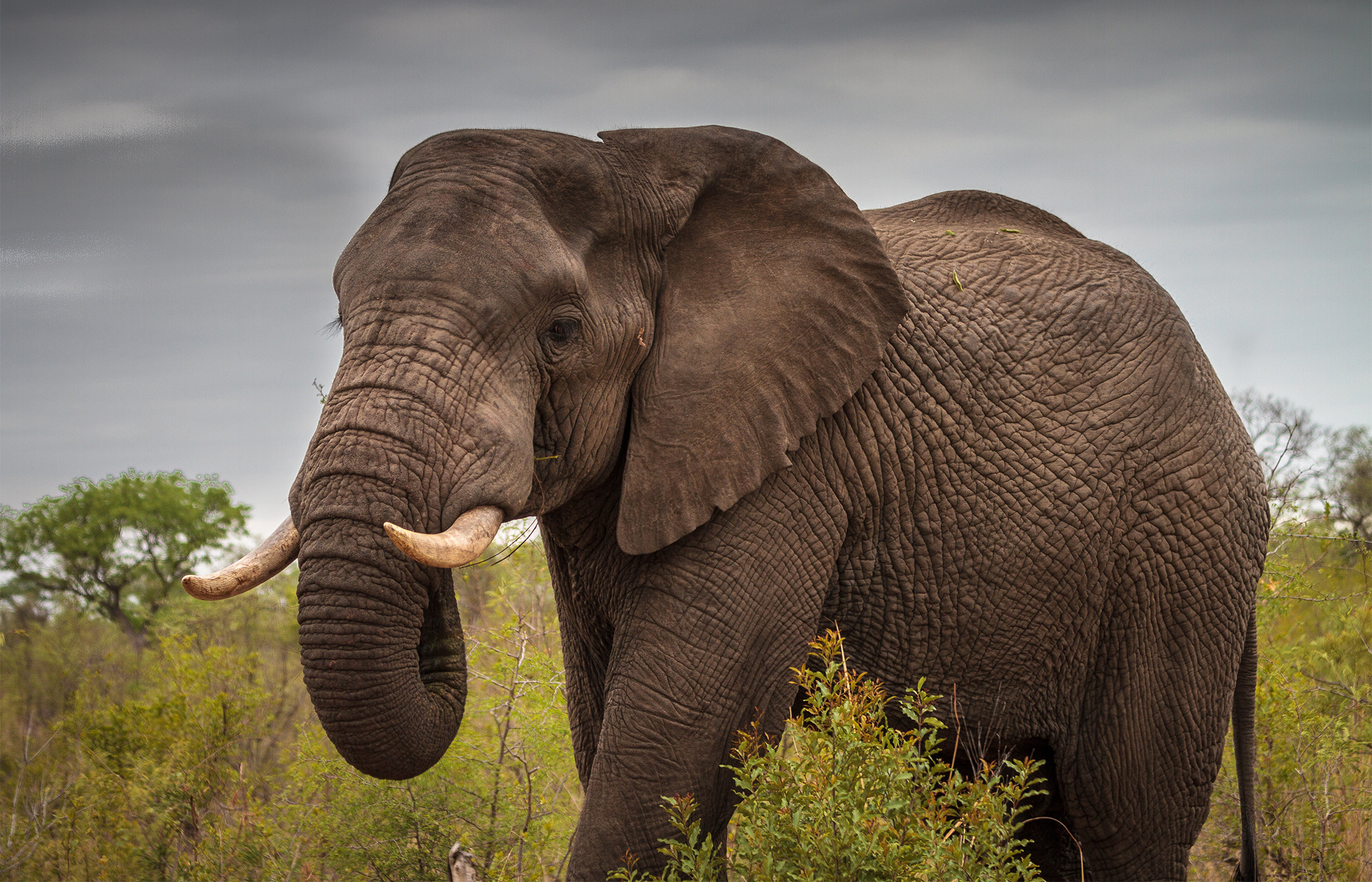
At Den Staat farm in South Africa, farmers are using drumming, fire and other creative methods to deter wild elephants from their crops.The farm sits within the Greater Mapungubwe landscape, a wildlife corridor where elephants move across the borders of South Africa, Zimbabwe and Botswana.Elephants can swiftly destroy farmers’ crops, which are their primary source of income.Larger commercial farms use fences around their crops, which smallholder farmers cannot afford; instead, they use household items such as metal tins and plastic containers to scare the elephants away. “Last night we had a very big fight with an elephant in our tomato field,” said Joeman Moyo, a farmer at Den Staat farm in South Africa’s Limpopo region. “We used a torch … to make a fire. The elephant would go away but return when I put out the torch. I also burned a tire, but this did not scare it away for long. It kept coming back when the fire died down.” Moyo, who looks after a 5-hectare (12.4-acre) plot, described an experience reflecting the challenges facing Den Staat’s smallholder farmers, as elephants enter their fields at night and threaten crops that provide an income. Farmers use several creative methods to deter the animals, including beating metal tins, hanging empty white plastic containers on wires and lighting fires. The history of this land is important background for understanding the situation today. Den Staat is land reclaimed by a community whose members and ancestors were affected by forced removals under apartheid. The farm was returned to the Machete community in 2010, and it is now held collectively through a Community Property Association (CPA). (Left) Joeman Moyo showing one of the areas where an elephant destroyed his tomatoes the previous night. (Right) Moyo, where he burned tires the previous night to scare away elephants. Images by Bernard Chiguvare. Today, more than 160 people live on the farm where they often face encounters with elephants, which residents say are their biggest concern because they are the most destructive. However, elephants are not the only raiders. Farmers also lose produce to baboons, warthogs, zebras and wildebeests. Den Staat is part of the Greater Mapungubwe landscape, where elephants move across the borders of South Africa, Zimbabwe and Botswana. It is also adjacent to the Mapungubwe National Park. Den Staat’s position as a wildlife corridor places its crops and homesteads directly in the path of these movements. The animals live in surrounding woodlands and enter farm fields at night, according to the farmers, who also say elephant numbers are increasing. A 2026 study analyzing elephant population data from 1991 to 2021 estimated the latest Mapungubwe National Park elephant population to be 243, with a reported annual population growth rate of 18% over the previous five years (although the larger area shows a decreasing population in recent years). These findings indicate an increasing population trend in the park, although the estimate is based on historical data rather than a new census. Wildebeest and zebras are some of the wild animals found around Den Staat farm. Image by Bernard Chiguvare. Defending crops against elephants Mongabay visited Den Staat in late October and spoke to farmers who said elephants are disrupting crop production, which is their main source of income. Masolo Saul Sematha, one of the farmers, said elephants regularly entered the area, damaging crops despite efforts to keep them away. It’s the continuation of a longstanding problem. Locals say they don’t lose hope, and when one deterrent fails, they resort to another. “One of the methods we use to scare away elephants is drumming on small tins. Yes, they sometimes turn away, but they learn that there is no harm and forcefully raid the fields, destroying the crops,” Sematha said. Research shows that sound can be an elephant deterrent. A study in Malaysia found that Asian elephants retreated when researchers played recordings of tiger roars and buzzing bees. Research in Kenya also found that African elephants can detect human-made ground vibrations and move away, which may help explain why drumming works. But elephants can become accustomed to repeated sounds, so farmers often rotate methods. Masolo Saul Sematha showing how he protects elephants from invading his yard. Image by Bernard Chiguvare. Josia Sematha, who has eyesight challenges, described how elephants keep coming for the crops. Image by Bernard Chiguvare. Sematha pointed to a banana tree in his yard that he said elephants had damaged about three years ago. “Instead of drumming, I resorted to using white plastic containers. This also scares them away,” he said, explaining that he ties the containers to a strand of wire, spacing them a short distance apart. When the wind blows, the containers create movement that scares the elephants away from the fields. Josiah Sematha, another farmer, said he relied on noise to deter elephants, sometimes asking his children to beat tins to make a ruckus. But it only works for so long. “We do not continually use drumming. We also buy toy guns to make noise and scare them away,” he said. Masolo Sematha said he learned the drumming method during a visit to Zimbabwe. The farmers’ experiences suggest that no single deterrent works reliably, so they try different approaches when elephants stop responding to one method. Elephant damage can affect an entire season’s harvest. Sematha said that in 2024, he expected to harvest about 10 truckloads of tomatoes for the year, but he harvested only eight after elephants damaged his crop. Globally, elephants are among the most destructive crop-raiding wildlife, capable of wiping out a season’s harvest in a single night. According to a 2018 University of Venda study, elephant incursions onto irrigated farms in South Africa’s Greater Mapungubwe area cause annual losses of an estimated 30,000-50,000 rand ($1,800-3,000) in less severe cases and more than 100,000 rand ($6,000) where damage is extensive. Masilo Hemelton Monyai and Masolo Saul Sematha at a place they had hung up white plastic containers to scare the elephants from their homestead. The elephants at times walk into their yard searching for bananas. Image by Bernard Chiguvare. Rey Thakhuli, South African National Parks’ general manager for communications, said it is difficult for rangers to be deployed to chase elephants off the farm because the animals move across the border from different areas of Botswana. He said a commercial crop farmer had managed to fence off a section of the farm used for crops, while community vegetable farmers could not do so because of a lack of funding. Locals say a fence put up around a 12-acre plot costs roughly 100,000 rand ($6,000), a price that smallholder farmers cannot afford. Thakhuli suggested the best mitigation measure would be for the community to receive external funding to protect their crops. Thakhuli recommended contacting the Limpopo Department of Economic Development and Environmental Tourism for further information, but Mongabay had not received a response by the time of publication. Meanwhile, local farmers keep responding to elephants, trying one inexpensive solution after another — with limited success. Banner image: An elephant in Kruger National Park, South Africa. Image by Andy Price via Flickr (CC BY-NC-SA 2.0). As elephants return in eastern Zambia, communities adapt to coexistence Corridors, not culls, offer solution to Southern Africa’s growing elephant population Citations: Kuiper, T., Child, M., Selier, J., Olivier, P., Mole, M., Purdon, A., & Altwegg, R. (2026). Thirty‐year elephant population trends across 93 South African reserves and the implications for conservation management. Conservation Science and Practice, 8(9). doi:10.1111/csp2.70386 Norasmah Basari, Mohamad Firdaus Abd Sata, Nor Zalipah Mohamed, Fatin Nursyafiqah Zamri, Haslina Samsudin, Mohd Faizol Shamrie, … Aisyah Humairah Mohd Zaidi. (2025). Threatening sounds as an alternative mitigation method to deter elephant: A study in elephant conservation centre, kuala Gandah, Pahang, Malaysia. Tropical Life Sciences Research, 36(1), 43-56. doi:10.21315/tlsr2025.36.1.3 Mortimer, B., Walker, J. A., Lolchuragi, D. S., Reinwald, M., & Daballen, D. (2021). Noise matters: Elephants show risk-avoidance behaviour in response to human-generated seismic cues. Proceedings of the Royal Society B: Biological Sciences, 288(1953). doi:10.1098/rspb.2021.0774 Credits Topics
Beat it: Den Staat farmers in South Africa use drumming and fire to deter elephants
Full Article
Original Source
Read the full article at News →KhanList aggregates and links to publicly available news content. We do not host full articles from third-party sources. Always verify important information with original sources.