
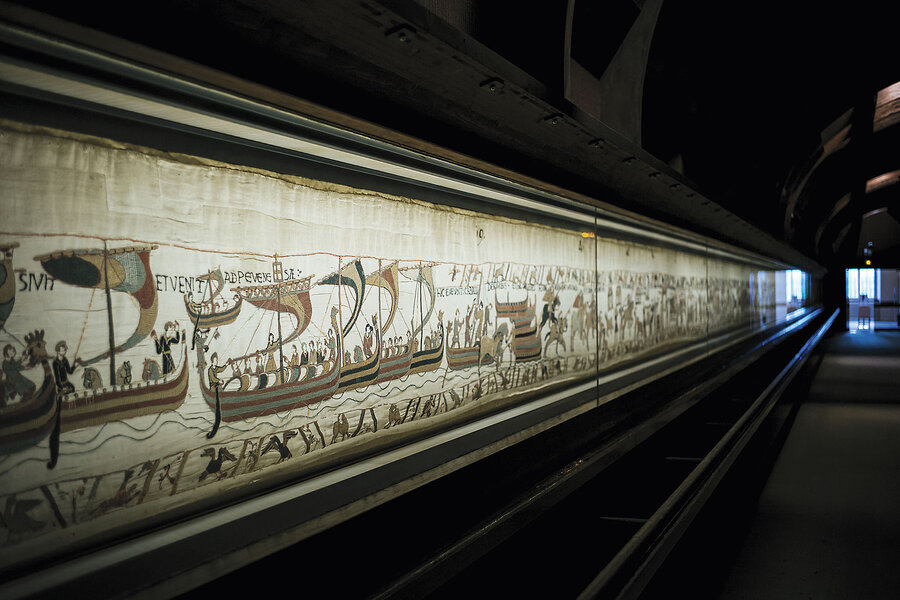
When Peter Blunn went online to get tickets to see the Bayeux Tapestry, he found that 20,000 people had gotten there before him.It made for a lengthy wait, five or six hours altogether. But that is nothing. People in England have been waiting nearly 1,000 years for the iconic medieval artwork to return to the country whose foundation story it tells.In London’s most eagerly anticipated exhibition of the year – or perhaps even the millennium – the tapestry goes on display at the British Museum on Sept. 10. Why We Wrote This The Bayeux Tapestry tells the story of the last invasion of England, almost 1,000 years ago. On loan for the first time from France to the U.K., it tells of a key time in England’s foundation which could also have a relevance for today. Hundreds of thousands of people will file past the ancient 70-meter (230-foot) embroidery, taking in its 600 human characters and 58 scenes that relate the events of 1066 – the last time England was successfully overrun by an invading force.It’s a story that every Briton learns about in primary school: the aged Anglo-Saxon king, Edward the Confessor, dying heirless; the plucky nobleman Harold Godwinson seizing his opportunity and being crowned; William, the Duke of Normandy, claiming the throne was rightfully his and sailing from northern France to defeat King Harold (who supposedly died in battle from an arrow to the eye) at Hastings. The year 1066 is as foundational to British schoolchildren as 1776 is to Americans.“I was at school in the 1960s, and that’s where we learned about it,” enthuses Mr. Blunn. Hélène Tréheux-Duchêne, France’s ambassador to the United Kingdom (from left), stands with Nicholas Cullinan, the director of the British Museum, and George Osborne, the chair of the British Museum, in London’s Piccadilly Circus, at an event promoting the exhibition, Feb. 26, 2026. But there are not one but two tapestry stories. The first tells the tale of 1066. The second concerns the protracted effort to secure its temporary return to Britain for the first time since it was created.And it’s relevant in a modern Britain that is grappling with some age-old issues of trust: leadership and governance, and the welcoming of newcomers.It’s coming homeNo one knows for sure who did the painstaking needlework to create the tapestry, but it is presumed to have been made by English seamstresses at the behest of the Normans. It was created soon after the victory that would make William, forever known as “the Conqueror,” the first Norman king of England.In fact, the Bayeux Tapestry is poorly named, for it almost certainly was not created in Bayeux, and it isn’t actually a tapestry. It is an embroidered work of wool on linen, with four different dye colors, five different types of stitch, and nine linen panels making up the 68-meter storyboard.It disappeared into obscurity, and there are virtually no records of it until the 18th century, when it resurfaced at the Bayeux Cathedral, 136 miles or so northwest of Paris. Despite revolution, invasion, war, and occupation, the artifact somehow survived the most tumultuous decades of French history.By the 1980s, it was safely installed in the Bayeux Museum. Britain has long coveted a chance to show it off in the United Kingdom, viewing it as far more central to British history than French. Workers and volunteers prepare to pack the Bayeux Tapestry ahead of a planned transfer to the British Museum, at the Bayeux Tapestry Museum in northwestern France, Sept. 18, 2025. “The tapestry is remembered because it is the climactic source that documents this hinge moment in English history,” says Peter Jones, a British medieval expert. “The battle was a coin toss; it could have gone either way. The tapestry captures this so well. It’s a wonderfully complicated source.”For years, French cultural authorities and historians argued that the tapestry could not withstand a long journey to Britain. But British Museum curators say the closure of the Bayeux Museum for refurbishment provided the opportunity for the work to travel on loan.The only problem was that Bayeux is about 250 miles by road from London. And the fabric is delicate. So, experts designed a special crate suspended in a metal cage to keep the object steady and cool in the back of a truck. Trial runs were executed to ensure nothing unforeseen would happen.The cargo was eventually transported via the Channel Tunnel to the British Museum earlier this summer, where it arrived in the dead of night under police guard.Recreating the artwork, scene by sceneTickets went on sale on July 1. “100,000 were sold in 24 hours,” a British Museum spokesperson told The Christian Science Monitor in an email. “The museum raised over £2.4 million (about $3.2 million), the largest day of ticket sales in the museum’s history.”The $40 entrance fee will give viewers just 40 minutes to file past the artwork. Mia Hansson, a seamstress and artist, pauses work on her copy of the Bayeux Tapestry at her home in eastern England. But one woman who didn’t have to pay – and won’t have to stand in line – is Mia Hansson, a seamstress who was rewarded with free tickets because of her own rather unique contribution to tapestry lore.Ms. Hansson is re-creating the artwork scene by scene and character by character at her home in eastern England. (And before you say, “How eccentrically British!” Ms. Hansson is Swedish).For 10 years, she has spent two or three hours a day – and sometimes a lot more – marking, measuring, drawing, and stitching. She has completed about 60 of the nearly 70 meters, and hopes to finish next year, before the 1,000th anniversary of William’s birth.“It’s very laborious – you have to concentrate,” Ms. Hansson says. “When the outlines are drawn, I stitch mainly with a stem stitch and some chain stitches. When the outline’s done, I do the inner stitches.” Red is the most common color, she says, closely followed by yellow.“They will never have enough legs”As such, Ms. Hansson might know the detail of the tapestry better than most: the animals, the battlefield decapitations, the curious scenes in the margins with elements of Aesop’s Fables and occasional random nudes.And the mistakes. Yes, mistakes.“If there are four or more horses in a scene, they will never have enough legs,” she says. Ditto humans. “One of the men going into church with Harold has his hand at an impossible angle,” she adds, “and in another scene there are two horse heads and three horse bottoms.”According to Professor Jones, the tapestry gives us not just a story of a proud, self-regarding, opportunistic man (Harold) who overstretches himself. It is also a story of who the people of these islands were – and are. Britain has always been shaped by outsiders and newcomers. “It reminds us how complex English history is,” he says.Curators say the priceless treasure will return to France late in 2027, to a newly built museum in Bayeux.
Bayeux Tapestry: Early threads of English history go on display in London
Full Article
Original Source
Read the full article at Csmonitor →KhanList aggregates and links to publicly available news content. We do not host full articles from third-party sources. Always verify important information with original sources.