
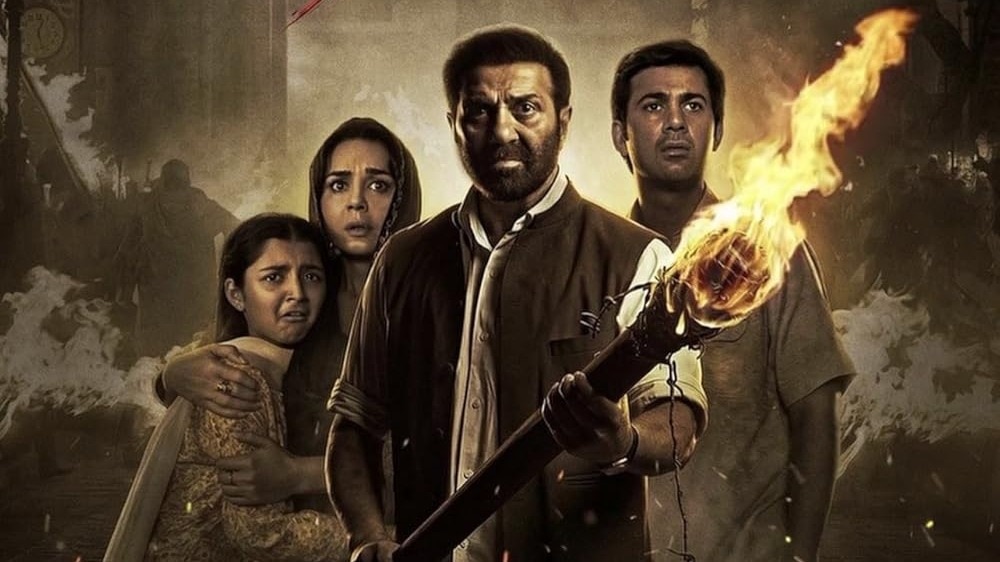
Two months ago, the world witnessed one of the most tender takes on the horrifying India-Pakistan partition through Imtiaz Ali’s Main Vaapas Aaunga. Now, Rajkumar Santoshi’s Batwara 1947 arrives with a similarly ambitious premise. At its core, the film holds a strong, beautiful belief: people of different faiths can live together without one religion threatening the other, and protecting another person’s right to practise their faith does not diminish your own. Sadly, the execution and subpar performances make it a disappointing watch.Batwara 1947 begins on Independence Day, as Sikandar Mirza (Sunny Deol), an honest man, is celebrating the birth of a new nation when he is informed that the partition has changed everything. As terror reaches his doorstep, he leaves for Pakistan, but his son is left behind. But crossing the border does not end his troubles either. Living in a relief camp, Mirza fights from pillar to post for something as basic as a home.His fortunes change when he meets Habib (Ali Fazal), a poet who looks like he is the cousin of Professor Snape, with long, silky hair and a black kurta. Habib helps him find a house; however, there is one complication: Shabana Azmi’s character, a Hindu woman, already lives there.She performs her puja without hesitation and has no qualms about living alongside Muslims. Mirza and his family initially try to get rid of her, even calling her 'budhiya' with disgust and attempting to deceive her into leaving. But what begins as an attempt to evict her slowly turns into a bond of brotherhood, with Mirza eventually fighting an entire world to protect a woman of another faith. This is where Batwara 1947 has its strongest idea. The house becomes a metaphor for the India we keep talking about but increasingly struggle to imagine. Hindus and Muslims can share a home, celebrate each other’s festivals and protect each other’s faith without either religion becoming smaller.The film is at its sharpest when it talks about religion itself. When a cleric says, “Zulm ko zulm se khatam nahi karte,” the point is simple: violence cannot be defeated by more violence. Sunny Deol’s character also invokes the Quran while speaking about brotherhood and the right of people of other faiths to worship freely. There is an irony in watching self-proclaimed protectors of religion remain clueless about what their own religion teaches. Unfortunately, what works beautifully on paper rarely works with the same force on screen. The biggest problem is the relationship between Mirza’s family and Shabana’s character. Their initial hostility suddenly transforms into affection, but the transition is barely developed. One minute they are trying to throw her out; the next, they are an inseparable family. A relationship this important needs time, conversations and small moments of understanding. Instead, the film simply announces that the bond exists -- you see it, but don’t feel it. And that emotional disconnect runs through the film.Sunny Deol is, well, Sunny Deol. He gets thunderous dialogues and obligatory moments where one man takes on an entire gang. The villain, played by Abhimanyu Singh, arrives in an almost caricaturish avatar, complete with a gang of eccentric henchmen. It feels less like a portrait of partition-era violence and more like a familiar Bollywood template. Karan Deol gets a promising arc but never quite manages to build on it. He does get his father’s familiar “seedha ghuske maarenge” dialoguebaazi, but struggles to hold his own against his screen presence.Ali Fazal plays Habib as the quintessential shayar, while Preity Zinta, like much of the cast, often seems to be waiting for the next cue rather than living through the scene. Her character is dealing with the absence of her son, but the devastation rarely registers on her face. Shabana Azmi, despite her stature, is reduced to playing a perpetually sad elderly woman. The pain is written into the screenplay, but doesn’t make its way into the performances. It's almost frustrating that the entire film's weight is expected to be carried by Sunny Deol and his 'dhai kilo ka haath'.Watch the trailer here: The film repeatedly tells us that hatred leads to destruction, that both communities had perpetrators and victims, and that humanity should come before religious identity. A Diwali sequence, where the family comes together despite their differences, captures this beautifully. The climax goes further, putting secularism, solidarity and standing up for one another at its centre. These are important messages, especially today. But the film keeps telling us what to feel instead of making us feel it.There is also a particularly awkward line where Preity Zinta’s daughter asks why the country was divided, and she responds, “Apne papa se poocho, kyunki yeh saare decision mard humse poochhe bina lete hain.” It feels less like organic dialogue and more like a contemporary talking point inserted into a historical setting. Even the sets look so made-up that it becomes difficult to believe you are watching a story set during partition. The director fails to create a lived-in world, and that artificiality only adds to the emotional distance the film struggles to overcome.The irony is that Batwara 1947 is terrific as a text. Adapted from the play Jis Lahore Nai Vekhya, O Jamya E Nai, the writing has ideas, the conversations have weight, and the central metaphor is powerful. But cinema needs emotional texture, lived-in relationships and performances that make you believe in the people on screen. It has all the right things to say but doesn't know how to, and that makes this potentially moving story feel surprisingly cold.- EndsPublished By: shweta keshriPublished On: Aug 14, 2026 13:12 IST
Batwara 1947 review: Sunny Deol is no Tara Singh in underwhelming partition tale
Full Article
Original Source
Read the full article at Indiatoday →KhanList aggregates and links to publicly available news content. We do not host full articles from third-party sources. Always verify important information with original sources.