
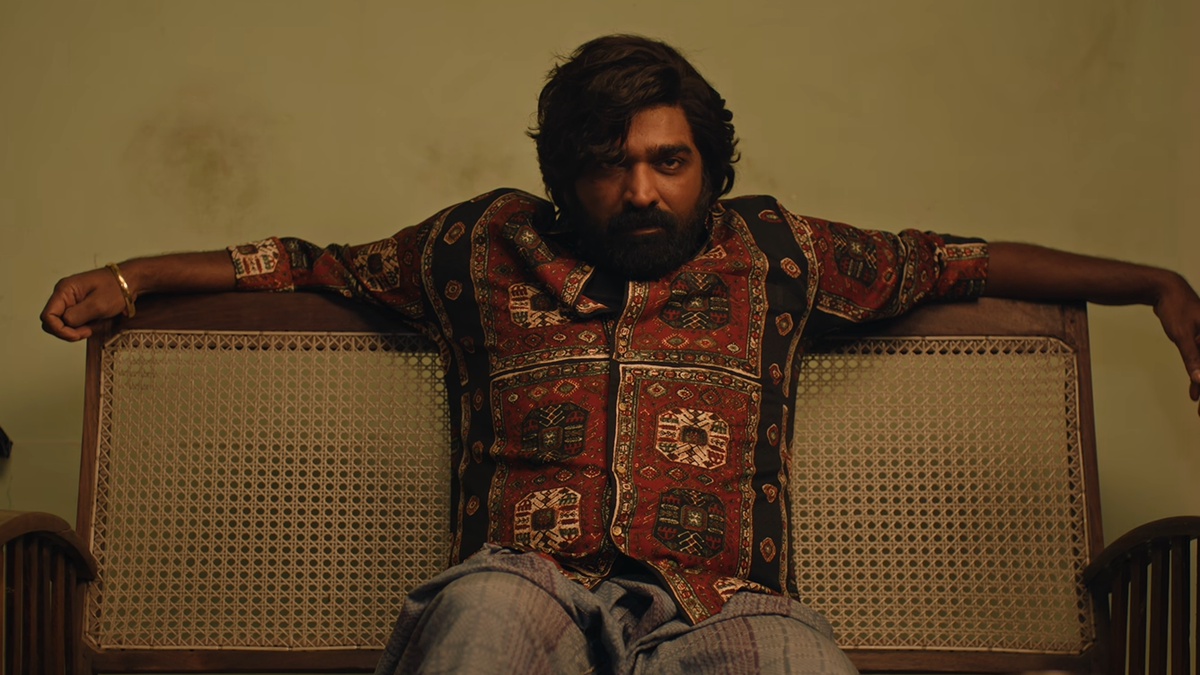
Who are we when we no longer perform the role society forced upon us? In life, we may never realise what we have repressed that led us to put on that mask, all the while causing that rust in others. In Baththa, director Balaji Tharaneetharan’s first theatrical release in eight years, a dreaded don, the titular Baththa (Vijay Sethupathi), remembers who he truly is when he inadvertently crosses paths with a schoolboy.Set in 1986, the seed of Balaji Tharaneetharan’s story is something many of us can easily relate to. When I was studying in a primary school in Thiruvottiyur, Chennai, a particularly difficult classmate terrorised our class, claiming to be a relative of a local gangster. That gangster’s reputation was well-known. One rumour had it that he bit off an enemy’s ear before swallowing it whole. In Baththa, Sabari (a wonderful Sai Prithvi Raj) experiences an event that shakes him to his core — a much-feared don named Baththa thrashes a bloodied man in the middle of the street. When he narrates it to his mates, they all come up with stories they heard of the gangster: “Baththa has a pet lion in a cage,” “Baththa once broke through a jail cell with just sheer strength,” “Baththa once heard a man slander his name from miles away,” and so on. Baththa can do this. Baththa can do that. Baththa is The Undertaker of this world, who we all know has seven lives.Baththa (Tamil)Director: Balaji TharaneetharanCast: Vijay Sethupathi, Lijomol Jose, Sai Prithvi Raj, Sahasra, Arjun ChidambaramRuntime: 159 minutesStoryline: A dreaded don rediscovers the child within him when an unlikely encounter forces him to confront the person he has buried beneath the mask of fearBut the Baththa we first see is just a local ruffian who has graced our screens. He is a brute who instils fear among the locals, loiters around with his yes-men, and though he adores his daughter, Thenmozhi (Sahasra Shree), and wife, Kanimaa (Lijomol Jose), his domestic life also has moments of outbursts. But to Sabari, who lives with his doting mother (Santhy Balachandran) and father (Hari Krishnan), Baththa is a merciless animal in human form. What happens when Sabari and Baththa cross paths at an unfortunate event that will forever change their lives?The first half of the film sails smoothly, thanks to the period setting and Vijay Sethupathi returning to a zone he long mastered through films like Idharkuthane Aasaipattai Balakumara and Kadhalum Kadandhu Pogum. But Baththa, which starts as any other gangster drama, truly comes to life during this unique, darkly comical twist involving Sabari and Baththa.In a pre-release chat with The Hindu, Balaji revealed that Baththa was inspired by events he witnessed in his own childhood in Triplicane, and Sabari reminds us what it was like to be a child. He is a naive but secretly street-smart kid, and Balaji beautifully makes you sit shotgun in a car driven by the child who is only partly in control of his situation.Moreover, the plight that befalls Baththa taps into a fear so primal that those who grew up in the pre-mobile phone era would instinctively remember how that fear manifested many times behind closed doors. But in a typical Balaji Tharaneetharan manner, the screenplay makes you both cry and laugh at Baththa.Interestingly, the writer-director could have gone a different way — he could have made it a whodunit by portraying Baththa’s many enemies, like Jyoti (Arjun Chidambaram), as the culprits. We could have learned much later how Baththa landed in his misfortunes. This could have been a story where Baththa was the protagonist and not the kid. But Balaji doesn’t complicate his film; he takes you through Sabari’s perspective as he tells the story and finds ample opportunity to infuse truly hilarious ideas, like one involving powdered rusk.Even when the momentum dips in the second half, something in Balaji’s screenplay commands your attention or makes you chuckle.The period setting also works largely in favour of this simple and sweet story, which would lose much of its essence in today’s world, where we are so busy looking at our mobile phones and making decisions in a split second. But what Balaji conveys through this story is relevant, and in a way, a film like Baththa is necessary today.ALSO READ: ‘Dorothy’ movie review: Karthik Subbaraj’s most audacious, disruptive film yet is a crowning achievementYou might have seen a woman and a child like Kannima and Thenmozhi sitting outside the police station waiting for a loved one who has gone missing. You would have stolen a few rupees from your dad’s pocket to buy snacks in a roadside shop. That annoying uncle in your neighbourhood would have taken you with his family to shop in T Nagar, and I am very sure you were dressed up as a cop or a freedom fighter. You would have attended a wedding or a party where a man would be happily singing out of tune on stage, while wearing a mirror-fitted costume that could blind you. And I am very sure you would have been too attached to a toy that disappeared someday.As Balaji described in our interview, “those were the golden days,” and Baththa, apart from being a simple, moving film about the goodness in us, is also a tribute to those golden days. As Baththa says in a pivotal moment, “You realise the value of certain things only when it nears the end.”Baththa is currently running in theatres
‘Baththa’ movie review: Balaji Tharaneetharan returns with a delightfully funny, moving comedy-drama
Full Article
Original Source
Read the full article at Thehindu →KhanList aggregates and links to publicly available news content. We do not host full articles from third-party sources. Always verify important information with original sources.