
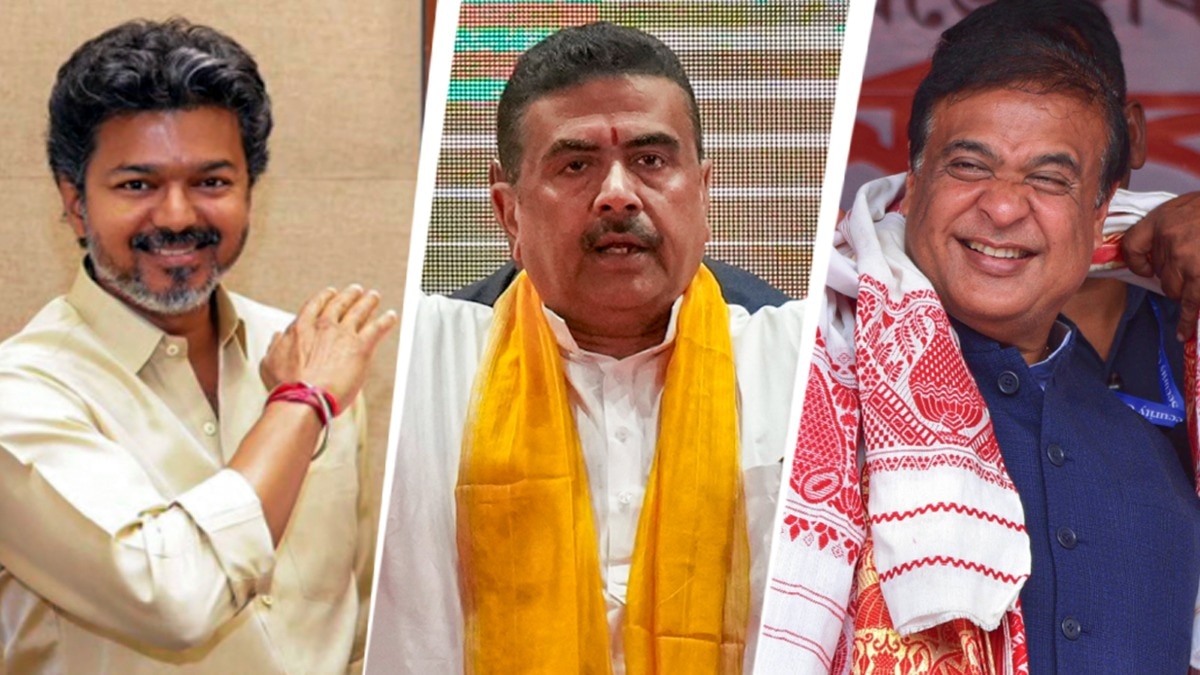
How did the BJP pull off a stunning win in Muslim-majority seats in Bengal and Assam? Can the Congress still count on minority voters, and is Vijay's TVK gaining ground at the AIADMK's expense or riding on the strength of defectors? The bypoll results offer clues to shifting voter loyalties, fractured Oppositions and the political battles ahead.Vijay, Suvendu Adhikari, Himanta Biswa SarmaNew Delhi,Oct 9, 2026 22:17 ISTSix bypolls across three states and one Union Territory have delivered a striking verdict: political fortresses are falling. In Bengal and Assam, the BJP has breached Congress bastions in Muslim-majority seats. In Tamil Nadu, Vijay’s TVK has scored an encore after its blockbuster Assembly debut in April, winning two seats it failed to capture then. The bypolls also marked the first electoral test for the new ruling parties in Tamil Nadu and Bengal, both of which came out on top.The results point to a churn in established political equations. How did these bastions fall, and what drove the shift? We take a state-by-state look at the contests and the forces that shaped their outcomes.HOW BJP BREACHED A MUSLIM-MAJORITY SEAT IN BENGALThe Nandigram Assembly bypoll in Bengal was a foregone conclusion. The only question was the margin of victory in Chief Minister Suvendu Adhikari’s bastion -- the one that did not fall.Adhikari had vacated Nandigram, which he won in May, to retain Bhabanipur in Kolkata. His target was a record victory margin of 1.20 lakh votes. BJP candidate Hasirani Rath surpassed it, winning Nandigram by nearly 1.23 lakh votes. But the biggest surprise came from Rejinagar in Murshidabad, where nearly 70% of the electorate is Muslim -- a constituency where the BJP had struggled to make inroads.Congress held the seat in 2011 and 2016, before the Trinamool Congress won it in 2021. In May 2026, Humayun Kabir, who had won Rejinagar for Congress in 2011 before joining the TMC and later founding the Aam Janata Unnayan Party (AJUP), wrested it for his new party by 58,876 votes. Kabir ran a polarising campaign, with his call to build a Babri Masjid in Rejinagar emerging as a key issue. The result was a resounding victory.But less than six months later, the constituency delivered a dramatic reversal. The BJP's Shankharavh Sarkar won the bypoll by 75,816 votes, defeating Kabir's son, Golam Nabi Azad, after Kabir vacated the seat to retain Nowda.How did a constituency that had given Kabir such a decisive mandate swing so sharply towards the BJP? What changed in Rejinagar in just a few months?For Chief Minister Suvendu Adhikari, the verdict was a rejection of communal politics in favour of development. After the results, he said Rejinagar's voters had rejected communal overtures and extended a hand of friendship to his government.For the Opposition, the result exposed a divided house. Mamata Banerjee's Trinamool Congress is no longer under her control, at least for now. The Election Commission is yet to decide the dispute over the party's name and symbol. The decision could take months. With the TMC factions divided, Kabir and his AJUP appeared to pose the biggest challenge to the BJP. But that challenge fell short.Both Kabir and the Congress questioned whether the election was free and fair. On polling day, Kabir clashed with the police. He accused them of acting as agents of the ruling government and questioned the Election Commission's role. He was detained and released later that evening. The next day, an emotional Kabir announced that he would quit politics.Adhikari, meanwhile, credited his government's welfare outreach. He said the BJP could not have made inroads without winning over women and their families through the Annapurna scheme. The scheme had reached around 35,000 beneficiaries in the constituency in recent months, he said.For Kabir, the result was a sharp reversal. His Babri Masjid pitch had helped him win in May. This time, it failed to secure the seat for his son. Several of his workers were arrested ahead of polling. Kabir alleged that pressure from the state machinery had influenced the outcome.Adhikari saw the result as a clear mandate for development over communal politics.NAGAON: CAN CONGRESS STILL COUNT ON MUSLIM VOTERS?The story of Rejinagar has an echo in Assam, though the political circumstances are different. In Nagaon, a Lok Sabha seat with more than 55% Muslim voters, the BJP was headed for a sweeping victory. The Congress, which had held the constituency in both 2019 and 2024, was pushed to third place behind the BJP and the AIUDF. The result dealt a blow to the Congress in a seat where it might have expected minority support to work in its favour. It also turned Assam Chief Minister Himanta Biswa Sarma’s prediction upside down, as he had expected the BJP to finish second.The defeat also exposed the cost of a divided Opposition. The Congress had parted ways with Akhil Gogoi's Raijor Dal in September after months of friction over leadership and seat-sharing. Despite the split, Gogoi chose not to field a candidate in Nagaon. Yet the Congress failed to hold on to the seat. Gogoi called the result a historic setback for anti-BJP forces and demanded the resignation of Assam Congress chief Gaurav Gogoi. He also claimed that the Congress's minority vote share had fallen sharply.That is the larger question confronting the Congress: can it still assume that minority voters will rally behind it as the principal challenger to the BJP? Nagaon suggests that such support cannot be taken for granted. But the result also had a local context. The AIUDF's Badruddin Ajmal was in the fray, offering voters another option, while the rupture between the Congress and Raijor Dal weakened the Opposition's broader political front.As in Rejinagar, the BJP's victory was clear. What remains less clear is whether it signals a lasting shift in voter loyalties or reflects the particular mix of rivalries, candidates and fractured opposition in these contests.TVK BREAKS THROUGH, BUT ON BORROWED STRENGTHThe results are a setback for the AIADMK, which has now lost two seats won by its candidates in April. Already grappling with factionalism and defections to Vijay’s TVK, the party could face further internal churn. Both Maragatham Kumaravel and P Sathyabama, who represented Madurantakam and Dharapuram respectively, resigned as AIADMK MLAs, joined TVK and won their seats under Vijay’s banner barely six months after their previous victories.But the results come with an important qualification: TVK did not test its appeal through fresh candidates. It retained the two legislators, whose local networks and electoral support predated their switch to Vijay’s party. The AIADMK also retained a substantial vote base, finishing third in both constituencies.Vijay has already begun targeting AIADMK voters, accusing the party of betraying MGR’s legacy by joining hands with the DMK, the very party MGR broke away from to form the AIADMK. Whether that pitch helps Vijay pull more AIADMK leaders and voters into his camp, and pushes the faction-ridden party into a deeper crisis, is something to watch in the months ahead.- Ends
Bastions fall, equations shift: What BJP's Bengal, Assam gains and Vijay's wins say
Full Article
Original Source
Read the full article at Indiatoday →KhanList aggregates and links to publicly available news content. We do not host full articles from third-party sources. Always verify important information with original sources.