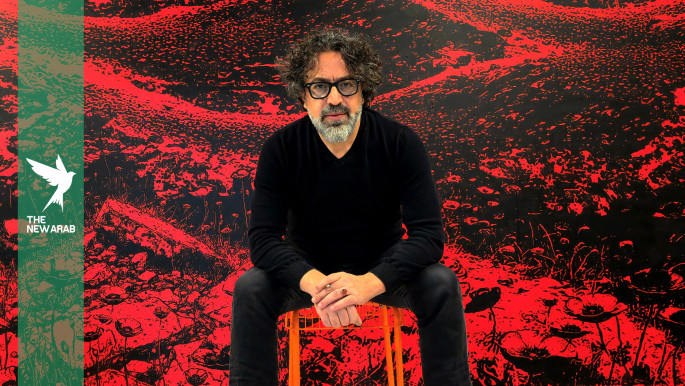
A dramatic blend of blood-red and deep black engulfs a tapestry of cultivated fields, gently rising hills, and blossoming wildflowers. What was once a peaceful and familiar Palestinian landscape is now a terrain scarred by death and destruction. This is one of the paintings that emerge from Palestinian artist Bashar Alhroub's latest body of work, Resurrection. Curated by Italian researcher and cultural practitioner Fortunata Calabró, the exhibition will run until 28 August and is a powerful exploration of the enduring trauma of war and the shared human experience of suffering. Created over 2.5 years, the exhibition comprises 15 acrylic-on-canvas paintings that drift between figuration and abstraction. Collectively, the works signal Bashar's response to the latest iteration of the ongoing Palestinian tragedy, particularly Israel's genocide in Gaza that has unfolded since October 2023. "I spent the first months [of the genocide] in a state of shock. The question of what I could do as an artist was beyond the limits of my thinking at the time. The sheer scale of death and destruction was too immense for me to comprehend," Bashar, a Ramallah-based Palestinian multidisciplinary artist, tells The New Arab. Bashar explains how he grappled with the immensity of the unfolding war, initially feeling that art had little place in the face of such brutality. But in early 2024, he turned to painting in search of healing. "It was an escape," Bashar continues. "I needed something to occupy my time and help me distance myself from the media. So, I turned to the canvas, this expansive field of white. I needed to pour out what I had been carrying inside and let it out on canvas." 'Resurrection' is a solo exhibition by Palestinian artist Bashar Alhroub, curated by Fortunata Calabró [Photo courtesy of Bashar Alhroub] Red, black and the language of loss In Resurrection, human and animal figures occupy Bashar's canvas. They emerge in a sharp red-and-black palette. Enmeshed in scenes of destruction, their fragility is almost tangible, but so too is their resilience. Whether it is a child standing amid the rubble or a horse amid a devastated landscape, their presence becomes an assertion of survival in the face of erasure. Conceiving of the genocide as an unfathomable catastrophe informed many of Bashar's artistic choices on Resurrection, most notably his use of monumental canvases with the aim of completely consuming the viewers. "With the first painting and just as I realised I was caught up in a project much bigger than I had imagined, I recognised that a large-scale canvas was an absolute necessity," he explains. 'Resurrection' will run at the P21 Gallery in London until the 28 August [Photo courtesy of Bashar Alhroub] "After all, I was responding to a massacre, a genocide, so I was very determined to give this event a central presence within the artwork." Bashar further reinforced this theme by intentionally using an all-red-and-black palette across the paintings. Black came to signify mourning, while red evoked both violence and resistance. As for the deliberate omission of green, it marked the absence of hope during the ongoing Palestinian genocide. "I am talking about a cause, so experimenting with colour felt like a luxury. The stark contrast between black and red was itself a statement, because in war there are no shades of grey. When people are dying, there is no hiding behind the word 'complexity'," he explains. Bringing together a new series of paintings created in response to the genocide, the exhibition explores themes of memory, trauma, loss and survival [Photo courtesy of Bashar Alhroub] 'There's nothing left' As the genocide intensified, so too did the blood red that occupies Bashar's paintings. "In the first painting, you see a huge amount of destruction. But the buildings are still there. But if you look at the very last painting, it's all red," he shares. "The land is scarred by destruction, and there are red anemones, which in Palestinian tradition are believed to bloom from the blood of martyrs. The land is all red. There's nothing left." Beyond his choices of colour and scale, Bashar further articulated the catastrophe through the visual logic of tatreez, the centuries-old tradition of Palestinian embroidery. "The idea was to spend as much time as possible on the canvas. This is perhaps why I turned to tatreez as a practice. The meticulous nature of tatreez requires time. I was painting as if I were stitching the canvas," Bashar explains. Rather than borrowing tatreez as a visual motif, Bashar drew on the internal logic of its process, which rests on a triad of "repetition, accumulation, and memory." By painting "through layers, textures, and gestures," Bashar metaphorically stitched together a world fragmented by war. By choosing to engage with tatreez, a form of protest art and a vivid reflection of Palestinian women's resistance, Bashar was also emphasising the importance of creating art amid devastation. Though anchored in the Palestinian experience, Resurrection ultimately speaks to something universal: the ongoing cycles of violence and loss, the fortitude that emerges in their wake, and art's capacity to circumvent desolation. "The works emerge from Palestine, but through them I try to speak to universal human experiences," Bashar asserts, explaining that the works draw connections across global histories of violence, from the bombed cities of the Second World War to contemporary refugee crises. As the genocide intensified, so too did the blood red that occupies Bashar’s paintings [Photo courtesy of Bashar Alhroub] Tracing hope At its core, Resurrection reflects on the tension between destruction and rebirth in times of war, giving a visual form to the cumulative trauma of prolonged human suffering. It is ultimately about remaining alive in the face of persistent devastation — where endurance becomes both an act of survival and a form of resistance. "I tried to play on the meanings of resurrection, as well as catastrophe and destruction. You can still trace hope in these paintings. Whether it is an enduring tree, or a child or an animal that is still alive," Bashar says. "There is also the idea of resurrection, despite everything that has happened: that one day these humans will be resurrected. Just like many other peoples who endured genocide and were able to rise again." 'Resurrection' will debut at the P21 Gallery in London on 25 July, where it will run until 28 August. Nourhan Tewfik is a London-based arts journalist specialising in the Middle East. She is also an Arabic TV/film consultant and researcher. Follow her on Instagram: @nourhantewfik
Bashar Alhroub's Resurrection arrives at London's P21 gallery
Full Article
Original Source
Read the full article at Newarab →KhanList aggregates and links to publicly available news content. We do not host full articles from third-party sources. Always verify important information with original sources.