
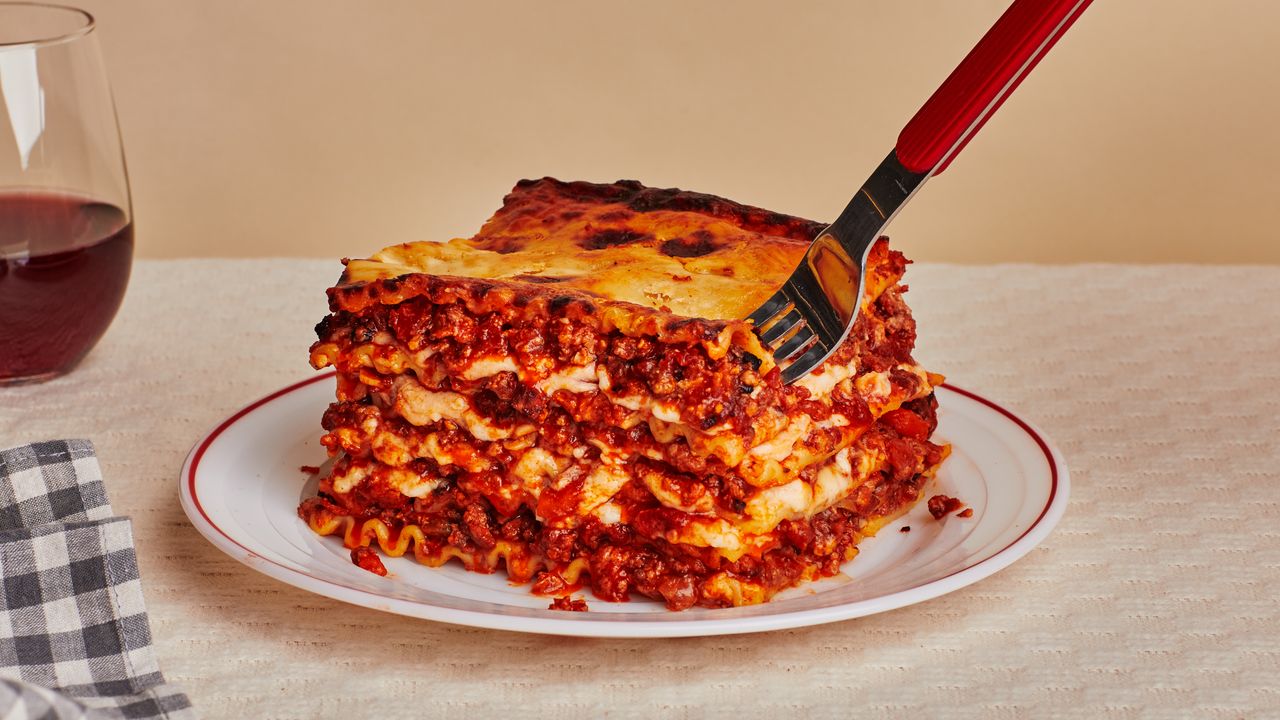
This lasagna recipe has “rainy Sunday cooking project” written all over it. Layers of slow-cooked pork-and-beef ragù, silky Parmesan béchamel, and pasta bake into a rich, creamy lasagna Bolognese with a browned top and crisp edges. Make the sauces ahead to break up the work, or settle in for a day of very good kitchen smells.The secret weapon is the meat sauce. Why make meatballs only to break them apart? Searing the meat in large balls leaves room for moisture to escape, so you get deep browning instead of a potful of steam. After a long, gentle braise, a potato masher turns them into ragù. Whole canned tomatoes, crushed by hand, give you control over the sauce’s chunky texture.One step you can skip: boiling the noodles. In side-by-side retests, regular dried lasagna noodles (not no-boil!) produced similar results whether parboiled or layered straight from the box. The ragù and béchamel provide enough moisture to cook the pasta in the oven—as long as every noodle is covered. Spread the sauces to the edges, leaving no dry patches, and making sure the sauce totally covers the top layer of noodles before baking. Round it out with homemade garlic bread and a Caesar salad.Do I need to buy no-boil lasagna noodles?No—use regular dried lasagna noodles, preferably De Cecco. Skipping the boiling step isn’t the same as using noodles labeled “no-boil.” In our original tests, those absorbed too much sauce, leaving the finished lasagna drier than we wanted.De Cecco Lasagne No.1 Pasta, 16-oz.Why doesn’t this lasagna have ricotta or mozzarella?This is a lasagna Bolognese, built around meat ragù and Parmesan-enriched béchamel rather than a separate cheese filling. The béchamel supplies the creaminess, while Parmesan brings salty, nutty flavor. For a less involved version with a cheese filling, try our Cottage Cheese Lasagna.What’s the best way to split up the work?Make the ragù one day, then tackle the béchamel, assembly, and baking the next. For an even lighter second day, make both sauces ahead and refrigerate them separately; rewarm the béchamel just enough to loosen it before layering. The ragù can be refrigerated for up to 4 days or frozen for up to 3 months, while the béchamel can be refrigerated for 1 day.Watch Chris make BA’s Best LasagnaSaving this cooking project for another day? We tasted nine brands to find the best frozen lasagna.Recipe informationTotal Time5 hours 45 minutesIngredientsRagù Bolognese2lb. ground pork1lb. ground beef chuck (20% fat)Kosher salt, freshly ground black pepper2Tbsp. extra-virgin olive oil2oz. pancetta (Italian bacon) or slab bacon, chopped1medium onion, finely chopped1celery stalk, finely chopped1medium carrot, peeled, finely chopped6garlic cloves, sliced2Tbsp. tomato paste¾cup dry white wine128-oz. can whole peeled tomatoes1cup low-sodium chicken broth1cup whole milkBéchamel and Assembly7Tbsp. unsalted butter¼cup plus 3 Tbsp. all-purpose flour6cups whole milk4oz. Parmesan cheese, coarsely grated (about 1 cup)Pinch of cayenne pepperPinch of ground nutmegKosher salt, freshly ground black pepper1¼lb. dried lasagna noodles (preferably De Cecco)Extra-virgin olive oil (for greasing)Need to make a substitution?PreparationRagù BologneseStep 1Preheat oven to 225°. Mix 2 lb. ground pork and 1 lb. ground beef chuck (20% fat) with your hands in a large bowl; season generously with kosher salt and freshly ground black pepper, then mix again. Form into about 18 large meatballs (they don’t need to be perfect—you’ll be mashing them later).Step 2Warm 2 Tbsp. extra-virgin olive oil in a large Dutch oven or other heavy pot over medium-high heat. Working in 2 batches, cook meatballs, turning occasionally and reducing heat if bottom of pot looks in danger of scorching, until browned all over, about 6 minutes per batch. Transfer to a rimmed baking sheet as they’re done.Step 3Reduce heat to medium. Add 2 oz. pancetta (Italian bacon) or slab bacon, chopped, to pot and cook, stirring often, until lightly browned and beginning to crisp, about 5 minutes. Add 1 medium onion, finely chopped, 1 celery stalk, finely chopped, 1 medium carrot, peeled, finely chopped, and 6 garlic cloves, sliced, and cook, stirring occasionally, until vegetables are softened, 6–8 minutes. Add 2 Tbsp. tomato paste and cook, stirring constantly, until paste is darkened in color, about 2 minutes.Step 4Add ¾ cup dry white wine and cook, stirring occasionally, until almost completely evaporated, about 5 minutes. Add one 28-oz. can whole peeled tomatoes, crushing with your hands, and increase heat to medium-high. Cook, stirring occasionally, until liquid is jammy and reduced by about half, 8–10 minutes. Add 1 cup low-sodium chicken broth and 1 cup whole milk, then return meatballs to pot. Bring to a simmer. Cover pot partially with a lid, transfer to oven, and cook, checking every hour or so to ensure liquid is at a low simmer and adjusting oven temperature as needed, until meatballs are falling-apart tender, 3–4 hours.Step 5Using a potato masher, break meatballs apart and incorporate into liquid (you should have about 8 cups ragù; transfer pot to stovetop and simmer gently to reduce if needed). Taste and season with more salt and black pepper if needed.Do ahead: Ragù can be made 4 days ahead. Let cool; cover and chill, or freeze up to 3 months.Béchamel and AssemblyStep 6Melt 7 Tbsp. unsalted butter in a large saucepan over medium heat. Whisk in ¼ cup plus 3 Tbsp. all-purpose flour and cook, whisking occasionally, until mixture smells slightly nutty, about 4 minutes. Whisking constantly, add 6 cups whole milk. Increase heat to medium-high and continue whisking until mixture comes to a simmer. Reduce heat to maintain a simmer and cook, whisking occasionally, until béchamel thickens, about 4 minutes. Continue cooking, whisking occasionally and adjusting heat as needed to maintain a gentle simmer, until béchamel is smooth and velvety, 8–10 minutes more. Remove from heat and whisk in 4 oz. Parmesan cheese, coarsely grated (about 1 cup), a pinch of cayenne pepper, and a pinch of ground nutmeg. (You should have about 6 cups béchamel.) Season with kosher salt and freshly ground black pepper. Transfer to a large bowl and press plastic wrap directly onto surface; let cool slightly.Step 7Preheat oven to 325°.Note: You can skip the following boiling step (and save yourself a pot to wash!). In side-by-side retests, the BA Test Kitchen found that regular dried lasagna noodles (not no-boil) produced similar results whether parboiled or layered straight from the box. To use them uncooked, spread the ragù and béchamel all the way to the edges, covering every noodle completely, and make sure the sauce blankets the top layer of noodles before baking.If parboiling: Cook 1¼ lb. dried lasagna noodles in a large pot of boiling salted water, stirring occasionally and separating them so they don’t stick together, until just starting to soften but still snap in half rather than bend when folded; 3 minutes is the magic number. The noodles will be so firm it will just seem all wrong. Using tongs, transfer noodles to a large bowl of cold water to cool. Drain and lay flat in a single layer on a rimmed baking sheet, separated by parchment or wax paper.Step 8Lightly coat a 13x9", 4–6-qt. glass or ceramic baking dish with extra-virgin olive oil. Spread 1½ cups ragù in dish. Lay a single layer of noodles over ragù (cut or break noodles as needed to fill any gaps). Spoon 1¼ cups béchamel over noodles, spreading in an even layer with a small offset spatula. Top béchamel with 1½ cups of meat sauce. Repeat layering noodles, béchamel, and ragù 3 more times. Top with a fifth layer of noodles and the remaining 1 cup béchamel.Note: For more pasta in every bite, build six layers instead of five. Start with the same 1½ cups ragù on the bottom of the dish, but use 1 cup béchamel and 1¼ cups ragù between the pasta layers. Finish with a sixth layer of pasta and the remaining 1 cup béchamel.Step 9Cover with a lightly oiled piece of aluminum foil and set lasagna pan on a rimmed baking sheet (just to catch drips). Bake lasagna until bubbling gently around the edges, about 1 hour. Remove from oven. Increase oven temperature to 425° and carefully place rack in top of oven. Remove foil from lasagna and continue to bake until top is browned and crisp around the edges, 10–15 minutes longer. Let sit 10 minutes before serving.Do ahead: Béchamel can be made 1 day ahead; keep chilled. Rewarm just enough to loosen before using. Lasagna can be assembled 1 month ahead; let cool, then cover with plastic and freeze. Let frozen lasagna thaw overnight in fridge before baking. Editor’s note: This recipe first appeared in our February 2018 issue as part of BA’s Best, our vault of the Test Kitchen’s definitive takes on iconic dishes. It has been updated with clearer assembly instructions and guidance from additional BA Test Kitchen testing, including the option to skip parboiling regular dried lasagna noodles. Head this way for more of our comfort food favorites →Recipe notesBack to topTriangle
BA's Best Lasagna
Full Article
Original Source
Read the full article at Bonappetit →KhanList aggregates and links to publicly available news content. We do not host full articles from third-party sources. Always verify important information with original sources.