
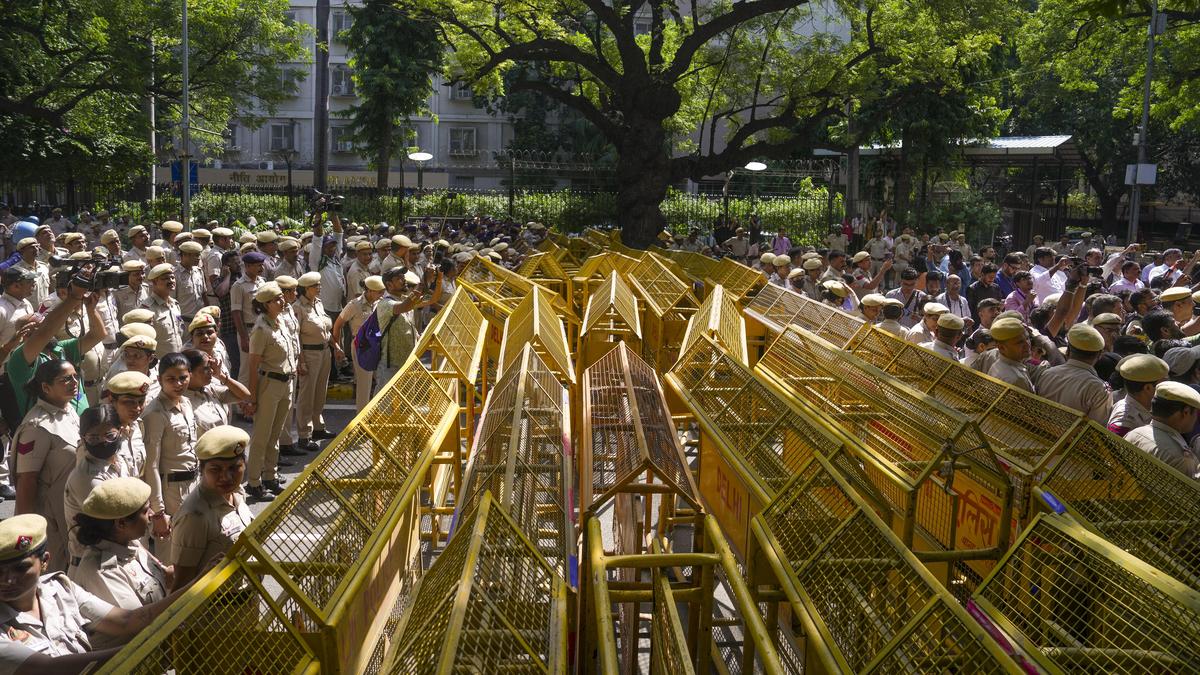
The past few months have seen considerable action at the barricades of Jantar Mantar. A recent media investigation on happenings in the Election Commission of India (ECI) sparked a new wave of protests, this time against the Chief Election Commissioner (CEC) Gyanesh Kumar. The demand for Mr. Kumar’s resignation has become a demand for electoral integrity itself. On October 2, 2026, prohibitory orders under Section 163 were imposed across the New Delhi district ahead of the protest against the CEC at Jantar Mantar. A number of Metro stations were closed, and major traffic restrictions were announced.These measures did not deter protesters, but the mass detentions and restrictions imposed by the Delhi Police raise difficult questions that await answers: Whose capital is this? Whose streets are these? In July 2026, Jantar Mantar, the capital’s designated protest site, witnessed one of the biggest youth protests of the year, which eventually culminated in a major victory for the protesters. Since the July 20 NEET protests, the Delhi Police have substantially increased barricading in the area. Closing of the streets and manipulation of the ballot are two sides of the same coin. To protest against the government, citizens must first seek the government’s permission. At Jantar Mantar, the Delhi Police have reportedly made it mandatory to submit applications 10 days in advance. The oppressed are allowed to speak against the oppressor only when the oppressor allows it.The erasure of protest geographyThe history of Delhi’s protest geography is slowly being erased. The Boat Club was once the designated site for demonstrations before they were shifted to Jantar Mantar. Although Jantar Mantar remains the designated protest site, it is routinely blocked on the pretext of “permission denied”. Until the COVID-19 lockdown, the customary rally route ran from Mandi House to Jantar Mantar or the Parliament Street Police Station. Large rallies often began at Ramlila Maidan and culminated on Parliament Street. Since the lockdown, barring a few exceptions, almost no permissions have been granted. Parliament Street was where people symbolically expressed their dissent before their elected representatives.The legal instrument enabling these blockades is Section 163 of the Bharatiya Nagarik Suraksha Sanhita (BNSS), which replaced Section 144 of the Code of Criminal Procedure. Repeated prohibitory orders have raised concerns about whether restrictions intended to regulate demonstrations are, in practice, preventing them altogether, and unchecked discretion to deny permission for demonstrations challenging the government or its policies.In its 2018 judgment in Mazdoor Kisan Shakti Sangathan vs Union of India, the Supreme Court recognised peaceful protest as a fundamental right and directed the authorities to formulate guidelines permitting regulated demonstrations at Jantar Mantar. Before that, in the Ramlila Maidan case of 2012, the Court affirmed the same principle.It is not just Delhi. In Bengaluru, protests once held at Town Hall were moved to Freedom Park, only to face restrictions there as well. In 2022, the Karnataka High Court confined demonstrations to Freedom Park. In December 2025, the park was closed entirely for “redevelopment”, with electricity and water supplies cut off. In Hyderabad, protests are permitted only at Dharna Chowk. Farmers marching to Delhi in early 2024 faced barricades, barbed wire, tear gas and even trenches along the Haryana border. Preventive detentions, prohibitory orders targeting workers’ strikes and student marches, and Internet shutdowns have become standard responses across States. The Bharatiya Janata Party (BJP) is the main driver of this national pattern: protests are first relocated, then confined, and finally banned.Dissent cannot be containedHistory shows that whenever those in power curb, restrict or seal the public sphere, the masses always find a way around. The 2011 Tahrir Square movement, Occupy Wall Street, the Paris Commune and the Petrograd Soviets are some examples.India, too, has witnessed major protests in recent years, including the historic Shaheen Bagh sit-in against the Citizenship (Amendment) Act (CAA) and the National Register of Citizens (NRC), the 2020-21 farmers’ protests on Delhi’s borders, and Left-led workers’ and peasants’ mobilisations such as the Mahapadav and the Kisan Long March. The Mahapadav of November 2023 brought workers and farmers onto the streets of State capitals across the country for a three-day sit-in.Spaces are produced through struggle. When the state seals the formal public sphere, resistance creates new spaces at borders, on highways and campuses, across digital networks and in mohallas. Repression creates the conditions for such resistance. Every barricade becomes a symbol of dissent and a rallying point. Mohan Bhagwat, Narendra Modi and Amit Shah must understand that dissent cannot be abolished by decree. Internet shutdowns, Metro closures, preventive detentions and imprisonment have not ended people’s democratic aspirations. As Pablo Neruda said, they can cut all the flowers, but they cannot prevent spring from arriving. Authoritarian confidence is brittle, and repression is often a sign of political insecurity.On electoral exclusionThe fight for space is part of a larger fight to defend the Constitution and democratic institutions. The Special Intensive Revision (SIR) of electoral rolls threatens mass disenfranchisement of the poor, migrants, minorities, and women. The ECI’s data shows that vulnerable sections including short-term migrants, illiterate voters and married women risk being deleted from the rolls. The 2023 Act on the appointment of Election Commissioners removed the Chief Justice of India from the selection panel and gave control to the executive. The Act gives total lifelong protection to the Election Commissioner from civil and criminal prosecution. Even the President of India has protection only as long as he or she is holding office.By blocking dissent in public and tampering with rolls in private, the BJP regime is hollowing out our democratic republic from both ends. The democratic and secular forces need to link the street, the court, and the ballot into a single democratic offensive. The right to protest is the people’s inherent right, won through the freedom struggle and enshrined in Article 19. We demand the restoration of the right to assemble and march at Jantar Mantar and along Parliament Street, and an end to the blanket, permanent use of Section 163 of the BNSS in New Delhi. The government must stop detentions and the violent suppression of peaceful protests. If the authorities barricade Jantar Mantar, we will not only defy those barricades but also, as the people of India, create countless Jantar Mantars in every nook and corner of the country.Democracy can only be defended when it is practised, and our task is to build the broadest struggle to practise it.Spring will come.M.A. Baby is General Secretary, Communist Party of India (Marxist)
Barricades cannot silence the voice of democracy
Full Article
Original Source
Read the full article at Thehindu →KhanList aggregates and links to publicly available news content. We do not host full articles from third-party sources. Always verify important information with original sources.