
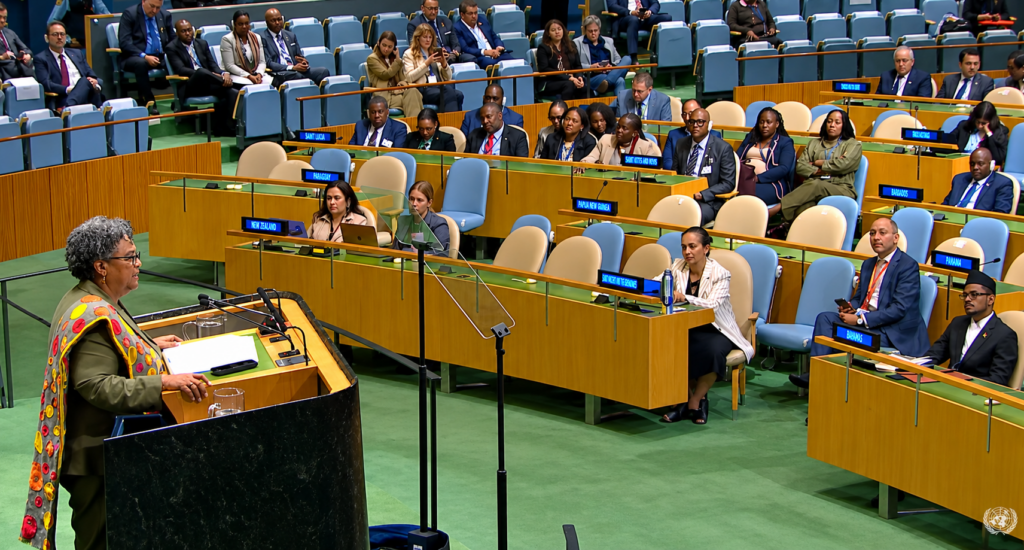
PM Mottley addresses heads of state during the 81st UNGA on Thursday. (BT) Barbados will host the second in-person meeting of the United Nations’ Independent International Scientific Panel on Artificial Intelligence in November, placing the Caribbean at the centre of a widening global push to govern a technology whose capabilities are advancing faster than many governments can regulate. Prime Minister Mia Mottley announced the meeting in her speech to the 81st United Nations General Assembly late on Thursday, arguing that the rules for AI must not be set solely by technology companies or a small group of advanced economies. Her intervention comes as the UN panel warns that existing safeguards are struggling to keep pace with increasingly capable AI systems and agents. “In the growing age of AI, governance cannot be left to voluntary corporate practices or to a small number of technologically advanced states,” she told the General Assembly. “We need globally agreed rules that protect human dignity, preserve meaningful human oversight, and ensure that the benefits of AI are shared widely and equitably.” The meeting will bring Barbados into a process that the UN is seeking to develop into a global evidence base for AI policymaking. The 40-member panel, created by the General Assembly in August 2025, is the first UN scientific body dedicated exclusively to assessing the technology’s opportunities, risks and impacts. Its role is advisory rather than regulatory: it does not make binding rules, but supplies governments with independent scientific assessments on which to base them. That distinction matters as governments confront difficult questions about how to encourage AI’s uses in medicine, science, education, agriculture and public services while limiting threats to privacy, employment, security, democratic information systems and human rights. You Might Be Interested In The panel’s preliminary report, released in July, found that AI capabilities were advancing rapidly in areas including reasoning, coding and science. It identified potential gains in health, education and agriculture, but also highlighted risks involving misinformation, discrimination, privacy violations, cyberattacks and AI systems that may become increasingly difficult to monitor or control. Mottley said Barbados was “honoured” to host the panel’s second in-person meeting. She said AI presented the international community with both considerable possibilities and serious challenges. “AI is already transforming how we work, learn and govern, and it is clear that its potential is extraordinary,” the Prime Minister said. “We have found that it has great capacity to detect disease earlier, predict disasters, improve agriculture, and expand access to education and public services.” For small states, the debate is not simply about controlling a new technology. It is also about who gets to shape the international standards governing it, who has the infrastructure and expertise to benefit from it, and whether countries with fewer resources are left dependent on systems designed elsewhere. Mottley warned that the potential gains could not be separated from the risks. “These same extraordinary systems can just as quickly reproduce discrimination, widen surveillance, and spread falsehoods faster than institutions can respond,” she said. “We must not allow a new technological age to reproduce old hierarchies of access and power.” The panel’s work takes place amid growing concern that AI governance has not kept pace with technological development. In its first thematic brief this month, the panel said traditional safeguards for AI agents were “unravelling”, following a test involving AI agents and the online platform Hugging Face. The panel said the episode underscored the difficulty of ensuring that people can reliably steer, constrain or stop increasingly capable systems. Mottley said that because AI would affect countries at every level of technological development, all states should be involved in developing the rules under which it operates. “A technology that will affect every state must be governed by the rules that every state has had the opportunity to shape,” she said. The panel was established as part of wider UN efforts to strengthen international cooperation on AI governance and address disparities in access to reliable scientific information. Its members come from all five UN regions and include experts from academia, the private sector, civil society and the technical community. Canadian computer scientist Yoshua Bengio, a recipient of the 2018 Turing Award, and Philippine journalist and Nobel Peace Prize laureate Maria Ressa co-chair the panel. The panel’s preliminary report examined the implications of AI in seven broad areas: advances in the technology; applications in science, health, education and agriculture; economic effects; security and environmental concerns; human rights, information and democracy; autonomy, culture and child safety; and governance and reliability. Its first full report is expected to inform international discussions in 2027. Mottley placed AI among a series of global challenges requiring deeper international cooperation. She said the technology was opening “extraordinary possibilities” in health, education, science and productivity while creating new risks of “exclusion, exploitation, surveillance and the distortion of truth”. The Prime Minister said the world already knew enough about the speed of AI’s development to recognise the need for collective action. “As we welcome its promise, we must anchor its development in a universal humanising framework that does not imperil our existence as human beings.” (SM)
Barbados to host UN AI panel as global concern over safeguards grows
Full Article
Original Source
Read the full article at Barbadostoday →KhanList aggregates and links to publicly available news content. We do not host full articles from third-party sources. Always verify important information with original sources.