
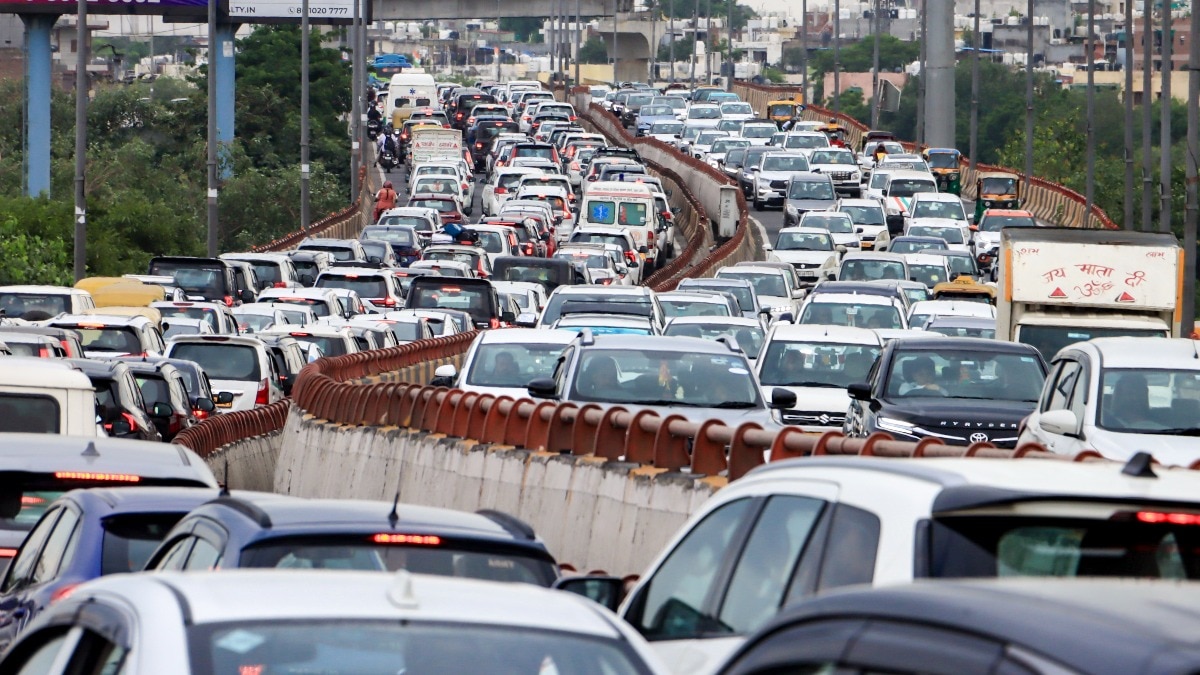
Delhi Traffic Police has asked the PWD to redesign the Barapullah Phase-III merger near Sundial Park after severe congestion surfaced days after opening. The lane mismatch and sharp alignment have created a recurring choke point, while officials have also blamed inaccurate Google Maps updates for worsening traffic.Vehicles move through a traffic congestion on Barapullah flyover. (Image: PTI)New Delhi,Oct 7, 2026 12:18 ISTInaugurated after 12 years of delay, Delhi's much awaited Barapullah Phase-III flyover within days of its opening has become the centre of a traffic mess, with now the Delhi Traffic Police blaming Google Maps for directing commuters towards congestion caliming that the Google Maps issue has effectively amplified an existing infrastructure problem.The immediate trigger, according to the Delhi Traffic Police, is that congestion on the newly opened Barapullah Phase-III stretch is not being reflected on Google Maps. With the app not showing the traffic situation accurately, commuters have continued to choose the route, adding to the volume of vehicles approaching Barapullah Junction.The result has been heavy and slow-moving traffic towards Barapullah and Ring Road. Police have diverted traffic from Phase-III towards NH-24/DND and advised commuters to use alternate routes.GOOGLE MAPS' RESPONSE ON TRAFFIC UPDATEAccording to the information provided by the Google Maps official, a new road may take two to three weeks to see the full extent of changes in Maps. The changes may start becoming visible after two to three days, while search features and navigation may take up to a week to stabilise. THE BIGGER ISSUE: MORE LANES FEEDING INTO FEWER LANESThe design of the merger near Sundial Park creates a basic capacity problem. The newly opened Phase-III flyover has three lanes. But where it meets the existing Barapullah corridor, the road ahead narrows to two lanes.The additional traffic capacity created by the new flyover does not continue downstream at the same capacity. Three lanes of traffic from the Phase-III flyover approach the merger. At the same point, another three lanes coming from the Sundial side towards Sarai Kale Khan and Ring Road merge into the corridor. Three more lanes carrying traffic from the Ashram and DND side also join the existing Barapullah corridor.The multiple traffic streams are being funnelled into a section where the existing flyover has only two lanes.A joint inspection by traffic police and PWD officials on October 1 identified the problem, while a drone survey showed multiple traffic streams converging within a limited road width.FLYOVER'S GEOMETRY ALSO A PROBLEMThe lane reduction is compounded by the physical design of the junction.According to the traffic police, the new flyover meets the existing Barapullah flyover near Sundial through a relatively sharp or rectangular alignment instead of a smooth curve. This creates an abrupt merging movement rather than allowing traffic to merge gradually.The traffic police has asked the PWD to redesign the merger rather than relying only on traffic enforcement and diversions.TRAVEL TIME NOW TAKING OVER AN HOURThe Barapullah Phase-III flyover was inaugurated on September 29 after several years of delays. It connects Mayur Vihar Phase-I on the Noida Link Road with Sarai Kale Khan and merges with the existing Barapullah network to create a continuous 10-km, signal-free stretch towards the AIIMS roundabout.The project was intended to reduce pressure on the Delhi-Noida Direct Flyway and Akshardham stretches and improve connectivity between East and South Delhi.However, the traffic deteriorated soon after the opening. By Thursday evening, commuters travelling the nearly 8-km stretch between Safdarjung Hospital and Sarai Kale Khan were taking more than an hour to complete the journey.The 3.5-km, four-lane elevated Phase-III corridor was designed to improve connectivity between Mayur Vihar Phase-I and Sarai Kale Khan and provide a direct link towards the existing Barapullah corridor.For commuters heading towards AIIMS, the journey was expected to fall from around 35-40 minutes to nearly 15 minutes because of the elevated, largely signal-free route and its connection with the existing network.The revised cost of the project is around Rs 1,635 crore.- Ends
Barapullah double whammy: Design flaw, Google Maps make flyover traffic nightmare
Full Article
Original Source
Read the full article at Indiatoday →KhanList aggregates and links to publicly available news content. We do not host full articles from third-party sources. Always verify important information with original sources.