
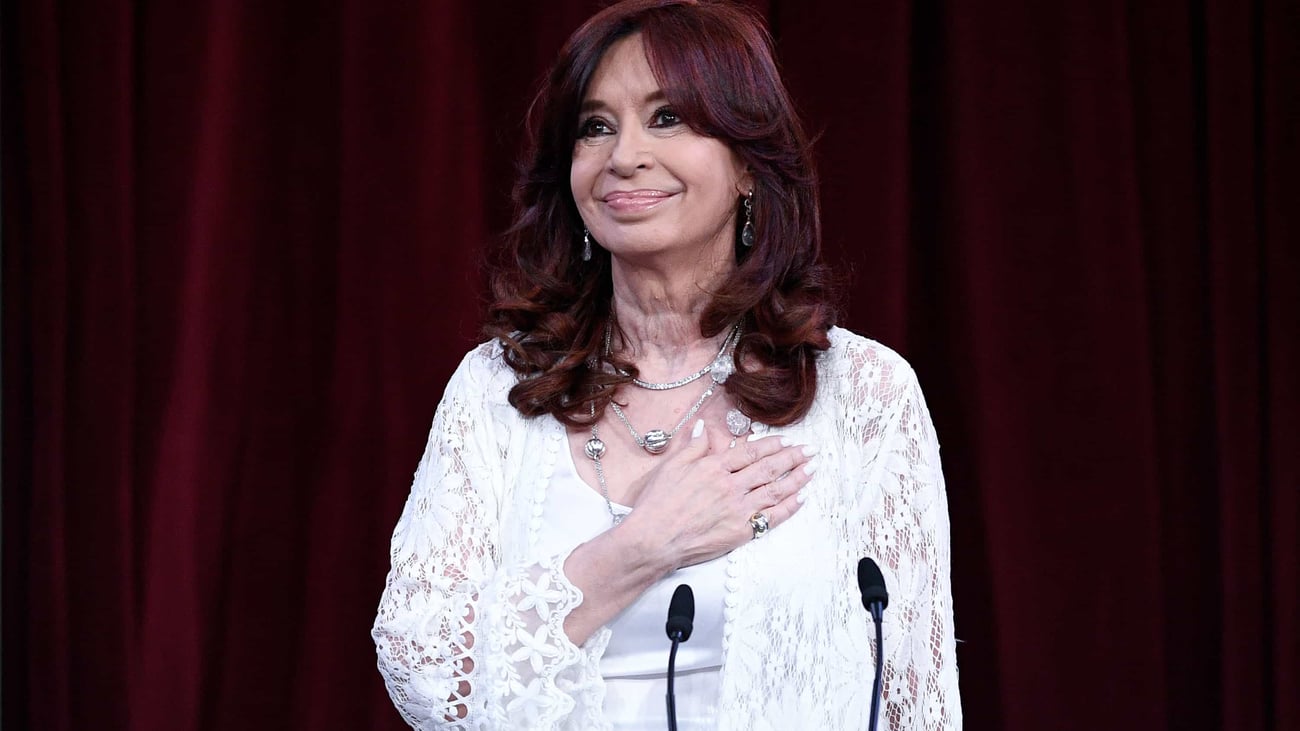
BUENOS AIRES (CN) — Cristina Fernández de Kirchner, Argentina’s two-term president serving house arrest after being convicted of corruption, will bring her case to the United Nations Human Rights Committee, claiming violations of her rights in the proceedings that led to her conviction.The request comes after the exhaustion of all legal proceedings within Argentina, after the Supreme Court upheld her sentence of six years of house arrest and a lifelong disqualification from holding public office in June 2025.While Fernández de Kirchner serves her sentence in a Buenos Aires apartment, her team is moving toward the international legal sphere to seek a revision of her conviction — especially her ban from public office, which would prevent her from running for elected office again. She is widely considered the main opposition leader to President Javier Milei, whose term is set to end in 2027.“The attacks against me are not directed at one person, but at a political project and, above all, at the sovereign will of the Argentine people,” Fernández de Kirchner wrote in a public letter announcing her legal team’s upcoming steps.In her presentation before the committee, which is expected to consider the petition at its October session, the former president says she was denied a fair trial — and a full defense — by judges and prosecutors who lacked impartiality.The case, known locally as the “Vialidad” case, found Fernández de Kirchner guilty of fraudulent administration for her role in a scheme that prosecutors said steered public road construction contracts in the Patagonian province of Santa Cruz to companies owned by businessman Lázaro Báez, a longtime associate of her family. Prosecutors argued the contracts were systematically overpriced, improperly awarded and frequently left unfinished, resulting in significant losses to the state.The case stretched across more than a decade and became one of the most closely watched corruption trials in Argentine history. Originally filed in 2008, it returned to the federal courts during the presidency of Mauricio Macri, Fernández de Kirchner’s political rival. During the proceedings, political tensions intensified. In September 2022, a man pointed a loaded handgun at Fernández de Kirchner outside her Buenos Aires home, but the weapon failed to fire.With the Supreme Court rejecting her final appeal, Fernández de Kirchner has exhausted her domestic legal options and subsequently taken her case to international human rights bodies, maintaining that her conviction represents political persecution rather than impartial justice.“Every single arbitrary act committed against me has one objective — to permanently bar me from political life,” Fernández de Kirchner wrote in her letter.Having exhausted her legal avenues in Argentina, she is seeking to dispute her ban outside of Argentina. Her legal strategy draws on Luiz Inácio Lula da Silva’s case, where the U.N. Human Rights Committee found that his fair trial and political rights had been violated during the “Lava Jato” case, which led to his imprisonment and ban from public office for 580 days between 2018 and 2019. Fernández de Kirchner expects the committee, which has constitutional status in Argentine law, will help overturn her ban or push for a revision of her federal conviction.Local legal experts and lawyers are cautious about predicting whether this could change the path for the 2027 election, although some — including Francisco Oneto, a lawyer for Milei — acknowledge it could lead to movements in what was considered, until now, a closed case.In her written presentation before the committee, Fernández de Kirchner also seeks changes to the conditions of her house arrest, arguing that restrictions — including electronic monitoring and limits on visitors — are unnecessarily punitive and discriminatory.“Let the convicted woman make as many filings as she wants — I couldn’t care less,” Milei said in a recent TV interview.During the interview, Milei also referred to Luiz Inácio Lula da Silva as a “thief,” despite Brazilian courts having annulled Lula’s corruption convictions on procedural grounds.On Tuesday, Brazil announced it would downgrade diplomatic relations with Argentina, one of its largest trading partners, and withdraw its ambassador, escalating a diplomatic dispute whose consequences remain uncertain.Rafael Valim, a Brazilian lawyer who worked on the Lula da Silva case and has since joined Fernández de Kirchner’s legal team, said both cases share the same “political dynamic.”“There is a clear use of the judicial process for political ends in the cases of Lula and Cristina, aimed at excluding them from democratic participation in Brazil and Argentina,” Valim said.Speaking about the scope of the legal strategy, he said the constitutional status of the U.N. Human Rights Committee could be key to securing a positive outcome for Fernández de Kirchner, who, according to media reports, could seek to run in the 2027 presidential election.“We believed the committee was the most effective and direct way to put the issue before experts from across the globe,” Valim said.Despite her conviction, house arrest and inability to take part in politics, Fernández de Kirchner remains a top contender to challenge Milei, the libertarian president who has led Argentina since late 2023.“This situation didn’t really change anything — if Cristina were able to run for office she would have a relatively easy path to become the main challenger,” said Juan Courel, an Argentine political analyst. “Those who supported her continued to support her, and those who opposed her continued to oppose her.”Fernández de Kirchner, who served as president for two consecutive terms between 2007 and 2015, and was vice president from 2019 until Milei’s win in 2023, was part of a group of progressive presidents in Latin America often referred to as “the pink tide,” a wave of left-wing governments that emphasized greater state involvement in the economy and regional autonomy. Her time in politics, however, was also marked by corruption scandals involving members of her administration, while she herself faced multiple criminal investigations, with the Vialidad case resulting in her conviction in 2025.Now, as her team awaits the upcoming meeting of the U.N. Human Rights Committee, set for October, Fernández de Kirchner wrote in her open letter that she remains hopeful. “The history of our people shows that no injustice has lasted forever,” she wrote, “and that no political ban has ever permanently extinguished the will of the people.”Lucía Cholakian Herrera is a Courthouse News correspondent covering Latin America. She is based in Buenos Aires, Argentina.Subscribe to our free newslettersOur weekly newsletter Closing Arguments offers the latest about ongoing trials, major litigation and rulings in courthouses around the U.S. and the world, while the monthly Under the Lights dishes the legal dirt from Hollywood, sports, Big Tech and the arts.Additional Reads
Banned from politics, former Argentine president brings corruption case to UN
Full Article
Original Source
Read the full article at Courthousenews →KhanList aggregates and links to publicly available news content. We do not host full articles from third-party sources. Always verify important information with original sources.