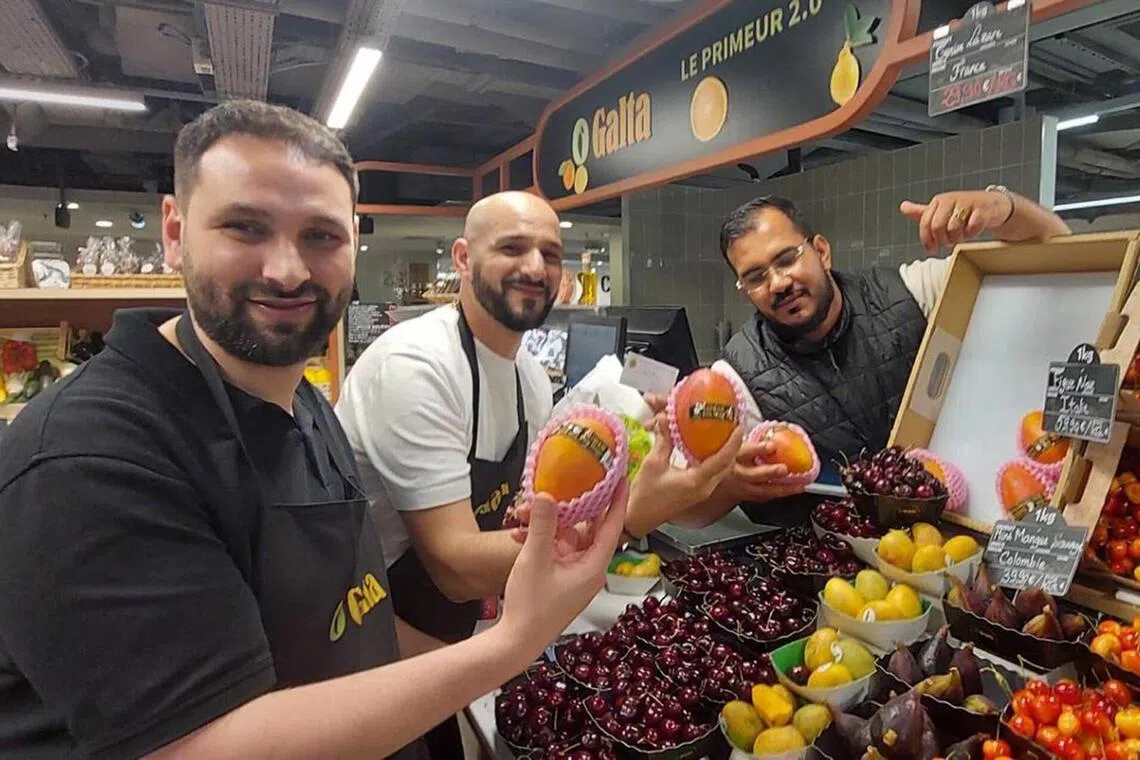
TAIPEI – One of the hottest commodities at the famed French department store Galeries Lafayette in Paris this summer was not a trendy handbag nor a pair of designer shoes – it was a mango. Specifically, Taiwan’s prized Irwin mangoes, which sold out within just two days of their debut there in June despite a staggering price tag of up to €99.90 (S$147) per kg, or some €25 for a single fruit.It was a similar story at other Parisian retailers, including the premium produce store Maison LFL in the wealthy suburb of Neuilly-sur-Seine, which hawked the sweet and aromatic fruit variety for around €60 per kg.Irwin mangoes are known for their vibrant red skin, rich aroma, and fibreless, melt-in-the-mouth sweetness. While popular varieties like India’s Alphonso are intensely sweet, the Irwin is said to retain a subtle, refreshing tartness that cuts through the sugar.By early July, customers in France had snapped up more than 4 tonnes of Taiwanese mangoes – all while paying top dollar for them.“We received interest from high-end restaurants and other vendors for more mangoes, but we’re at the end of the season so they will have to wait until next year,” said Carrie Wong, executive vice-chair of Natural House Group, the Taiwanese exporter behind the European shipment. “Taiwanese mangoes can easily win on flavour, which overcomes the high price,” she told The Straits Times, noting that they were particularly well-received by both Parisians and Middle Eastern tourists.The Irwin mango originated by chance in 1939 in the US state of Florida, through accidental cross-pollination between Lippens and Haden mango trees in the garden of horticulturalist F.D. Irwin. Irwin saplings were imported to Taiwan in the 1950s and later brought to Japan in the 1980s, where farmers developed the high-quality Miyazaki cultivar, said to be the most expensive in the world.Back in Taipei, the French sales were celebrated as a huge success story, and it was not just because the island’s mangoes had for the first time successfully entered Europe, home to some of the world’s most stringent plant quarantine and pesticide residue standards.It also allowed the island to further diversify its export reliance away from China, amid what Taipei has denounced as Beijing’s growing use of economic coercion tactics against the island’s agricultural goods.Beijing views Taiwan as its territory and has in recent years exerted economic pressure targeting the island’s food producers through swift import bans, with the goal of inflicting financial pain and influencing the island’s politics. After China abruptly banned imports of Taiwanese mangoes in 2023, citing biosecurity concerns, Taipei shifted its focus in volume-driven trade towards more premium markets in countries such as Japan and South Korea.Positioning its mangoes in the high-end tier also helps it overcome stiff cost competition from mass producers such as India and Pakistan. In Paris, Indian Alphonso mangoes typically retail for €13 to €15 per kg.“Taiwan’s mangoes are selling well in South Korea and now in France, proving there is no need to rely on the Chinese market,” said Chou Chun-mi, magistrate of Pingtung County in southern Taiwan, where many of Taiwan’s Irwin mangoes are grown. “Although international shipping and cold chain management is costly, it has enhanced the international competitiveness of Irwin mangoes and put a spotlight on Taiwan’s agricultural products,” she told reporters in a recorded video interview late June. ‘Weaponising’ fruit The greater international attention on Taiwanese mangoes today came from a setback for the island’s mango producers just a few years ago.In August 2023, Beijing unexpectedly halted imports of Taiwanese mangoes, citing the presence of mealybug pests in the fruit. However, officials in Taipei flagged the ban as a politically motivated economic pressure campaign following then Vice-President Lai Ching-te’s transit stops in the United States.Taiwan mangoes ready to be shipped to Britain. PHOTO: NATURAL HOUSEBeijing has repeatedly labelled Lai of the independence-leaning Democratic Progressive Party (DPP), now Taiwan President, as a “troublemaker” and a “dangerous separatist”. Fruit farmer Chen Ming-hsien, who heads the Jianxian Cooperative in Pingtung, a group known for cultivating top export-grade mangoes, remembers the anxiety after the ban all too well. “As soon as the ban was announced, the sudden surplus of mangoes had nowhere to go, causing many farmers to suffer heavy losses that year,” he said, adding that his group quickly launched home delivery and group buy services to move stock. Taiwan produces around 100 million kg of mangoes a year, the overwhelming bulk of which are consumed domestically. In a strong harvest year, Irwin mangoes cost as little as NT$100 (S$4) to NT$300 per kg locally.Of the 1 per cent exported every year, China was an important market. At its peak in 2019, the China market accounted for 59 per cent of Taiwanese mango exports. Today, Japan is the largest importer of Taiwanese mangoes, where the fruit is sold at prices up to five times those in China. In July 2025, a single Irwin mango from Taiwan made headlines when it was listed for a record 4,320 yen (S$35) at a Queen’s Isetan supermarket in Tokyo. However, that was still less than a Miyazaki mango, which can retail for up to 11,000 yen.Taiwan mangoes ready to be shipped to Europe. PHOTO: NATURAL HOUSEIn the first half of 2026, Taiwan exported US$3.62 million (S$4.67 million) worth of the fruit to the country, accounting for 31.8 per cent of the total export volume. South Korea is in second place, importing US$2.67 million worth of the fruit over the same period of time. Other destinations include Hong Kong, Singapore and New Zealand.“What we have learnt from China’s agricultural bans over the years is the importance of not putting all of our eggs in one basket,” said Chen, whose mangoes were among those shipped to Paris. Agriculture is not a major part of Taiwan’s semiconductor-focused economy; according to official figures, agricultural goods accounted for only 1.4 per cent of the island’s gross domestic product in 2025. Still, China’s targeted bans on the sector in recent years have hurt individual farmers – traditionally a strong support base for the DPP – who had long exported large amounts of their produce across the Taiwan Strait.In 2021, China blocked the imports of sugar apples, java apples and pineapples, which prompted the Taiwanese government to urge residents to consume more of these fruits to offset the loss of sales.Pomelo farmers were then left scrambling when Beijing banned Taiwanese citrus fruit in August 2022, a day after then US House Speaker Nancy Pelosi arrived in Taipei, and had to salvage unsold fruit by turning it into processed goods such as pomelo jam.Since that time, the island has worked to expand its export footprint beyond China. According to the island’s agriculture ministry, the share of Taiwan’s overall fruit exports to China plunged from a peak of 80.1 per cent in 2019 to 1.6 per cent in 2023. Chen, the mango farmer, told ST: “Taiwanese farmers have learnt how to better protect ourselves. You can say that China’s bans have actually made Taiwan’s agriculture industry more resilient.” At an agricultural awards event in June, President Lai said that the island must continue to reduce its dependence on any single market and pursue diversified global expansion. “China is weaponising agricultural products, and has attempted to use agriculture to pressure the (Taiwan) government,” he said. “The government will continue to improve cold chain technology and epidemic prevention capabilities to ensure that Taiwan’s agricultural products continue to be exported to the world,” he added. Like eating puddingBuoyed by the strong demand in France, Taipei is confident that its mangoes can eventually reach all 27 European Union member states, said Taiwan’s Agriculture Minister Chen Junne-jih. “Taiwan aims to build overseas demand through product quality and value,” the minister told reporters in June. “Hopefully, other premium Taiwanese fruits can follow a similar path into international markets.” Weeks after Taiwan’s push into the French market, around 1 tonne of the island’s mangoes was also shipped to Britain for the first time in late June.At London’s LingerMart, an Asian speciality grocer, pre-orders for more than 500kg of the mangoes were snapped up within a week. This was despite the steep retail price: A 2.5kg box of seven to eight mangoes was sold for around £118 (S$201), while a 5kg box cost £193. Taiwanese mangoes were sampled and sold at LingerMart in Richmond, London. PHOTO: LINGERMARTOne customer drove more than 1 ½ hours from Cambridge to the capital to secure a box, said LingerMart founder Gili Lai. Other customers, hailing from Taiwan, placed orders to “cure homesickness”, she said.“Bringing these mangoes to a strict and highly regulated market like the UK, and seeing them sell out so quickly, proves that Taiwan’s premium agricultural quality is capable of capturing the attention of an international audience,” she told ST. “It is a successful demonstration of Taiwan’s soft power through gastronomy,” she asserted.In Taipei, Japanese and South Korean tourists often form snaking queues in the shopping districts of Yongkang and Ximending for shaved ice desserts featuring Taiwanese mangoes.Taiwanese mangoes are popular ingredients in icy desserts. PHOTO: NATURAL HOUSEAt popular dessert store Smoothie House in Yongkang Street, South Korean visitor Jane Jee waited around 10 minutes in the sun to get a large bowl of mango shaved ice, topped with mango ice cream and diced mango. “Taiwanese mangoes are becoming quite famous in Seoul because they’re so sweet and juicy – they’re irresistible,” the 28-year-old said. Popular dessert store Smoothie House in Taipei’s Yongkang Street. ST PHOTO: YIP WAI YEEWong of Natural House Group, the Taiwanese fruit export company, said that people are easily drawn to Taiwanese mangoes because they’re so fragrant that one can smell them from the far side of a room. “Because of its texture, people also often say that it’s like biting into a smooth pudding instead of a piece of fruit,” she said.
Banned by China, Taiwan’s prized mangoes debut and sell out in Europe even with steep price tag
Full Article
Original Source
Read the full article at Straitstimes →KhanList aggregates and links to publicly available news content. We do not host full articles from third-party sources. Always verify important information with original sources.