
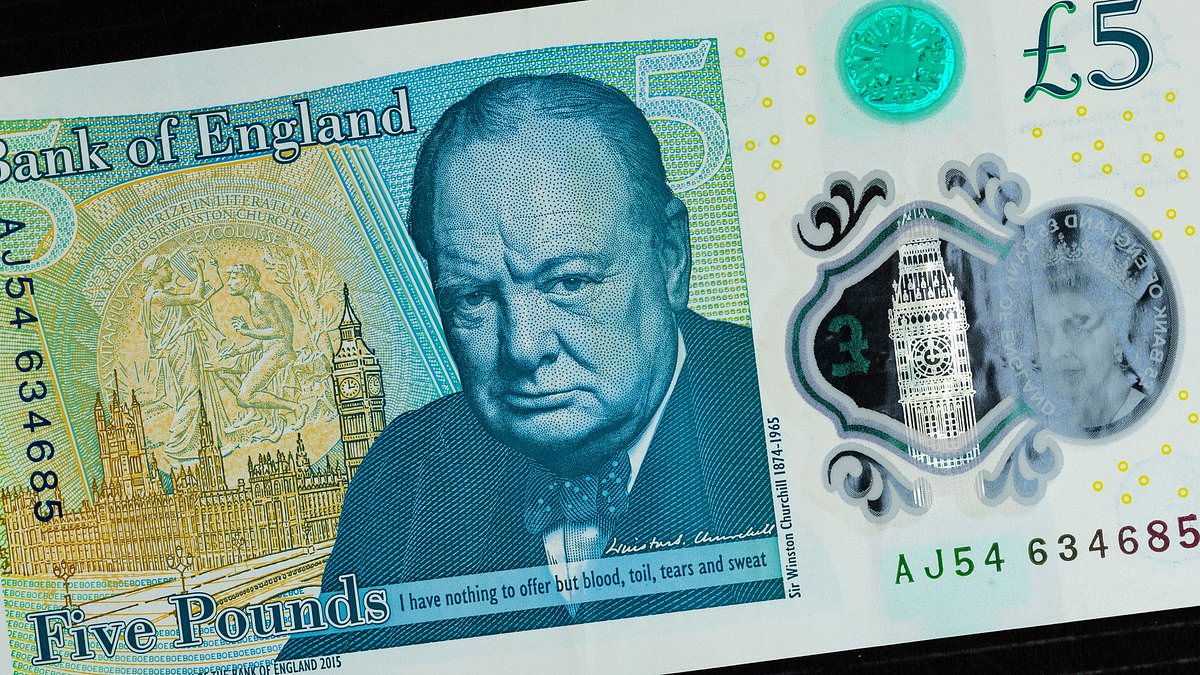
The Bank of England spent more than £85,000 on research to justify dropping Sir Winston Churchill and other British historical figures from banknotes, it has been revealed.Research carried out on behalf of the Bank suggested portraits of notable Britons such as Churchill, Alan Turing and Jane Austen should be replaced by wildlife designs. It was warned that historical figures could be seen as 'elitist and divisive' and that it risked promoting a 'backward-looking vision of the UK'.A Freedom of Information request has revealed that the Bank spent £63,000 to come to the decision and justify the selection of nature as a replacement theme.Savanta, a market research consultancy firm, was paid £49,000 to run focus groups about diverging from historical figures.Meanwhile, £22,500 was spent on public consultations about which animals should be used on a new series of banknotes.The move will mark the end of a tradition that has seen prominent Britons appear alongside the monarch on banknotes for more than 50 years.It prompted a major backlash, with the move described as 'bonkers' by critics and Tory leader Kemi Badenoch saying it was 'erasing our history' and 'a silly thing to do'. The Bank of England dropped Winston Churchill and other famous Britons from future banknotes after research warned that historical figures could be seen as 'elitist and divisive' British author Jane Austen is currently the face of the £10 banknote Mathematician and scientist Alan Turing currently features on the £50 noteCurrently, Churchill is depicted on the £5 note, Jane Austen on the £10, J.M.W. Turner on the £20, and Alan Turing on the £50. In response to the FOI request, the Bank told The Telegraph: 'Savanta was selected following a competitive evaluation process in which research companies that applied were assessed against a range of criteria, including value for money.'It added that during the public consultation stage that 'no external research or consultancy expenditure' had been incurred, but it did not record the time staff spent on the project.The Bank branded the move away from historical figures as a 'positive evolution', rather than 'censorship' or a 'cancellation' of history. More than 400,000 public votes were cast in a public consultation on a shortlist for the new nature-themed banknotes, which was divided into three categories by a panel of wildlife experts.The first, mammals, included the bottlenose dolphin, brown hare, European hedgehog, grey seal, pine marten and red fox.Six birds were also listed: the Atlantic puffin, barn owl, common kingfisher, Eurasian curlew, great spotted woodpecker, and white-tailed eagle.The final category of amphibians, insects and fish consisted of the Atlantic salmon, basking shark, buff-tailed bumblebee, common frog, Emperor dragonfly and marsh fritillary butterfly.The public consultation ended in July and Andrew Bailey, the Bank's governor, is set to make the final decision on which animals will be used by the end of the year.A spokesperson for the Bank of England previously said: 'To select the theme for our next series of banknotes, the Bank canvassed a range of opinion through a public consultation last year.'This consultation received 44,000 responses and nature had the highest proportion of nominations and was the driver for our decision.'This theme also received additional positive feedback in Bank commissioned focus groups that took place once we had the results of the public consultation.'Historical figures were first introduced on sterling notes more than half a century ago, when William Shakespeare appeared on the £20 note in 1970. The Bank has previously run into controversy over banknote designs after campaigners complained that too few women had featured in recent years, prior to Jane Austen appearing in 2017.History has also proved uncomfortable due to links with slavery. In 2021 the Bank removed from display a series of paintings and busts of governors and directors who had connections to the slave trade in the eighteenth and nineteenth centuries.
Bank of England spent £85,000 on research to justify dropping Winston Churchill and other British heroes from banknotes
Full Article
Original Source
Read the full article at Dailymail →KhanList aggregates and links to publicly available news content. We do not host full articles from third-party sources. Always verify important information with original sources.