
The surge in US government borrowing costs since the Iran war has given investors plenty to worry about. But Brian Moynihan, the second-longest-serving chief of a major US bank, doesn’t seem to be losing sleep over it.Bank of America’s chief executive of 16 years, who majored in history at Brown University, pulls out his foldable smartphone and brings up a chart tracking the market interest rate – or yield – on 10-year US Treasury bonds back to 1800. One of the most important numbers in finance, the yield has climbed by more than a third since late February and reached 5.36 per cent last week, its highest level in 24 years. The increase has been heavily influenced by debate over how the US Federal Reserve will set interest rates in the coming years.While the yield has swung from nearly 16 per cent in the early 1980s as central banks battled a severe inflation crisis, to just 0.5 per cent in March 2020, amid market panic over Covid-19, it has averaged about 5 per cent over the past 226 years.READ MORE“It gives perspective,” said Moynihan in an interview late last week in Bank of America’s EU banking headquarters in Dublin, adding that his economists were predicting three more Fed rate increases before inflation starts ticking down again in 2028. [ Global bond sell-off pushes 10-year Treasury yield to highest since 2002Opens in new window ]Perspective, however, appears to be in short supply among investors in US banks. Shares across the sector have fallen sharply from record highs in August, partly because investors are looking beyond the boost to interest income from higher rates and worrying instead about rising funding costs, weaker loan demand and increasing bad debts. Bank of America’s shares, meanwhile, plunged into bear-market territory on Wednesday – marked by a more than 20 per cent slump from their peak – after it reported a 17 per cent drop in third-quarter profit, just days after the interview, amid news of a $1.2 billion (€1.1 billion) fine over failures to detect potential money laundering and other illicit activity.[ Bank of America profits drop 17% after $1.2bn money laundering fineOpens in new window ]But despite the turmoil across US bonds and banking stocks, the broader economic outlook remains relatively robust. The International Monetary Fund forecast this week that US gross domestic product will expand 2.3 per cent both this year and next. Higher market rates “will slow down activity,” said Moynihan. “Does that mean it’ll slow down real fast? I don’t think so. With that market expectation on rates, they’re still saying the economy grows at 2 per cent-plus in the US, which is above trend. “The good news is that, underlying that, the US consumer is still spending strongly, despite all the statements saying things are not going well.” Brian Moynihan has led Bank of America since 2009. Photograph: Clodagh Kilcoyne for The Irish Times US consumersThe importance of US consumers cannot be overstated. Accounting for two-thirds of the country’s economy, they are expected to spend about $22 trillion this year. That equates to more than the size of the entire Chinese economy, the second largest in the world. “It doesn’t mean that the absorption of gas prices isn’t on people’s minds,” said Moynihan (67), a fourth-generation Irish American with a face straight out of the Kennedy family album.Just ask Donald Trump. Concerned that high fuel prices, driven by the Iran war, could trigger a voter backlash in the upcoming midterm elections on November 3rd, the US president has agreed a controversial deal to allow Russian diesel to reach global markets, expanded access to tax-exempt red-dyed diesel, and pressed European allies to release emergency reserves.Opinion polls point to Democrats regaining control of the House of Representatives and potentially flipping the Senate. What might such a scenario mean for policy direction?“When you have a split government, people have to work together,” said Moynihan. “It’s hard to predict, because there are a lot of different voices. But it’s generally a structure which in the past has led to compromises on a few core things. We’ll see what happens.” [ The US’s financial position is deteriorating rapidly. This is bad news for IrelandOpens in new window ]Immigration is the most obvious potential area, according to Moynihan. While the Trump administration has advanced key priorities such as tax cuts, deregulation, and the use of tariffs as leverage over trading partners, comprehensive reform of the immigration system has proved more difficult, even if it has increased enforcement. “What I hear from our clients and customers is that they want to be able to figure their way through on immigration. They want to know what the rules are going to be so that they can adjust their business models,” Moynihan said. “Construction companies all over the country, farmers and hospitals are saying, ‘I need workers. I used to get them this way, but I’m not getting them through this way. So, how are we going to figure this out’?”While some argue that natural population growth in the US is the answer, Moynihan said: “It takes 18 years to make an 18-year-old. So, you’re not going to have a change in population in the United States of any consequence. It’s going to be an interesting debate.” He said there was still “a lot of work to be done” on reaching new trade deals with Canada and Mexico. Relations with both neighbours have become more volatile and strained, with Canadian prime minister Mark Carney, in particular, turning more confrontational over the summer. Major news outlets from Bloomberg to the Washington Post have reported that US business leaders have, by contrast, been reluctant to criticise Trump publicly during his second presidency, fearing retaliation or risking access to the White House.Canadian prime minister Mark Carney with US president Donald Trump. Photograph: Adrian Wyld/The Canadian Press/AP The CEO of America’s second-largest bank, with $3.5 trillion of assets, has likewise avoided directly challenging the president. Perhaps his most pointed intervention came in a CBS interview last December, when asked about political interference with the Fed as Trump was openly attacking its rates policy. “The market will punish people if we don’t have an independent Fed,” he warned.” And everybody knows that.”The cautious approach hasn’t spared Moynihan Trump’s ire – or the occasional cold shoulder.Three days after his second inauguration in January 2025, Trump used a video address to the World Economic Forum in Davos to scold the Bank of America boss and JP Morgan chief Jamie Dimon over allegations that their banks were denying services to – or “debanking” – conservative customers.“He was saying that people weren’t banking people because they believe X, Y, or Z. We honestly don’t believe that’s correct,” said Moynihan. Moynihan was the only CEO of a major Wall Street bank not to be invited to a reception honouring Trump when he attended Davos earlier this year, according to a Financial Times report at the time, months after he was left off the list for a dinner of banking executives at a White House event last November. Asked how history will judge Trump’s economic legacy, Moynihan was circumspect. “I think it will take time,” he said, noting that tax cuts for workers and new provisions allowing companies to deduct certain investment costs more quickly have boosted economic activity. But it will take years to determine whether the gains are sustainable, Moynihan added. [ Bank of America’s Dublin EU hub sees profits dip to $1.76bn in 2024Opens in new window ]He was keen to emphasise how his group, whose roots date back to the founding in 1784 of The Massachusetts Bank, has helped administrations through the centuries. “We’re here to serve every administration,” he said. Yet the new $1.2 billion fine marks a low point in the bank’s relationship with the current one. “When a bank of this size fails to meet its anti-money laundering and sanctions obligations, the consequences extend far beyond its own walls, exposing the entire US financial system to significant illicit finance risks,” US treasury secretary Scott Bessent said as he announced the penalty. It has left Moynihan, CEO since 2010, facing fresh scrutiny of the bank’s processes and controls, having spent the early years of his time at the helm resolving legal and regulatory claims stemming from the US housing and mortgages bubble that collapsed in 2007–2008. Asked by analysts during a conference call on Wednesday about “how it gets to this point” and whether there was a misunderstanding of the rules, he said: “I think at the end of the day, we understand what they need us to do. We’re deep in the process of remediating.”Irish-American background Moynihan, whose ancestors emigrated from Ireland in the 1850s, was born in Marietta, Ohio, where his father worked as a research chemist with DuPont. The second-youngest of eight siblings, he earned a Bachelor of Arts in 1981 from Brown, where he co-captained the rugby team and met his future wife, classmate Susan Berry. Bank of America CEO Brian Moynihan is a fourth-generation Irish American. Photograph: Clodagh Kilcoyne for The Irish Times After securing a law degree from the University of Notre Dame in 1984, he took a position at Rhode Island-based law firm Edwards and Angell. One of his clients was Fleet Financial in Boston, which lured him nine years later to become its deputy general counsel.Moynihan would wear many hats at the company before and after its 1999 merger with local rival BankBoston. He was managing FleetBoston’s wealth and investment management division when it was taken over in 2004 by Charlotte, North Carolina-based Bank of America. [ The global economy and the art of living dangerouslyOpens in new window ]Bank of America’s then-CEO, Ken Lewis, tapped him to become president of the enlarged group’s wealth management business. He appointed him as the group’s general counsel in December 2008, just before Bank of America completed its rescue takeover – albeit for a price of $50 billion – of Merrill Lynch, one of Wall Street’s most storied names. Less than a month after the deal was sealed, Merrill Lynch’s former CEO John Thain resigned and was replaced by Moynihan as president of global banking, wealth and investment management. Moynihan – who speaks quietly and sometimes mumbles – was a surprise choice to lead the group in late 2009. The board was known to have been searching for an outside star after Lewis resigned amid a shareholder backlash following the disastrous Merrill deal. EU hub post BrexitBank of America chose Dublin as its EU headquarters in 2017 in the wake of the Brexit referendum. The unit has two main divisions: global banking and markets, and support services, which includes a global technology and operations centre. The US banking giant has had a presence in the Republic since 1968. It has more than 1,000 employees in Dublin and about 400 contractors. The group opened a new office in Belfast late last year and announced last week that it had hired more than 300 staff there, initially focused on anti-money laundering and financial crime compliance. It has a goal of creating up to 1,000 roles in the North. “We knew the talent was there. We knew that there was capacity, with office space and other things we could get. And it’s a city that’s continuing to grow,” Moynihan said. “We knew we were going to have to expand this business, because it always grows when the business grows.” All told, Bank of America has about 210,000 employees across 35 countries – broadly the same headcount as in 2007, even though it took on about 76,000 staff through its 2008 acquisitions of Merrill Lynch and mortgage lender Countrywide Financial. Moynihan has said that Bank of America’s ongoing adoption of artificial intelligence (AI) is focused on getting more out of its workforce rather than cutting jobs. The bank has rolled out around 150 AI use cases across the group so far, with “hundreds” more in the pipeline, he said. He said there is little room for error when rolling out AI to customers, because trust, security and reliability are fundamental to a banking relationship.“If we used it to make loans, and it turned somebody down, and they alleged we turned them down because of whatever non-valid credit-based decision ... and the [AI agent] couldn’t explain its work, that’s where the agents are going to be tricky to implement.”Moynihan declined to be dragged into the AI bubble debate, deferring to research last week from the bank’s market strategists, who noted that a narrow group of AI companies has been driving the Nasdaq 100 Index to all-time highs recently. “Low breadth is a classic feature of bubbles building and typically doesn’t stop until they pop,” they said. Profit surgeBank of America’s shares surged more than fourfold between Moynihan taking charge in 2010 and mid-August. Its annual profits grew at a similar pace even as total assets rose by only 60 per cent. The $1.2 billion fine – while embarrassing – equates to about 3.6 per cent of the group’s net income for the 12 months to the end of September, and has only brought the stock back to where it was in late May. The CEO lives in Wellesley, Massachusetts, an affluent suburb west of Boston, and divides his working time between Boston and the group’s headquarters in Charlotte.Succession planning moved up a notch 13 months ago when the bank promoted two executives – Dean Athanasia and Jim DeMare – to co-presidents of the entire business, and chief financial officer Alastair Borthwick was given the title of executive vice-president.But Moynihan was coy when asked how long he planned to stick around. “I don’t talk about it,” he said. “But I expect to serve as long as the board will have me and I’m having fun.” CVName: Brian Moynihan.Job: CEO of Bank of America.Age: 67.Family: Married to Susan Berry, whom he met at college, with three adult children.Lives: Wellesley, near Boston in Massachusetts.Something you might expect: He is chancellor of Brown University, where he previously studied.Something that might surprise: He reportedly likes to amuse himself by slipping obscure, archaic words such as “fantods”, “fructify”, “gainsay”, and “concomitant” into calls with analysts.
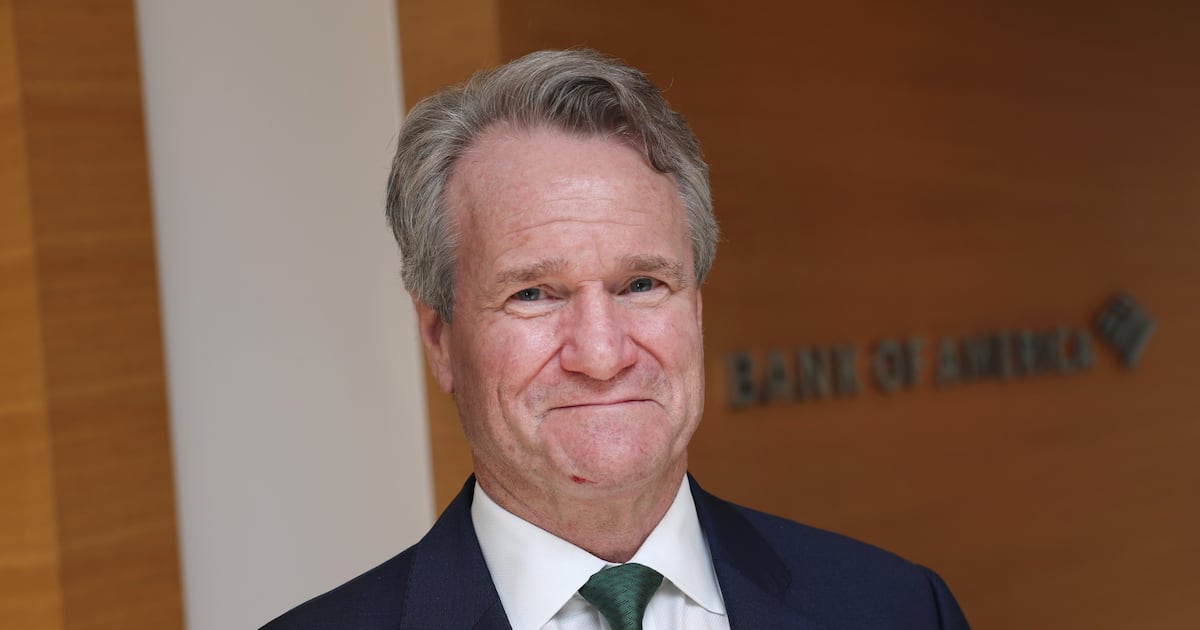
Bank of America CEO: ‘The good news is that the US consumer is still spending strongly’
Full Article
Original Source
Read the full article at Irishtimes →KhanList aggregates and links to publicly available news content. We do not host full articles from third-party sources. Always verify important information with original sources.