
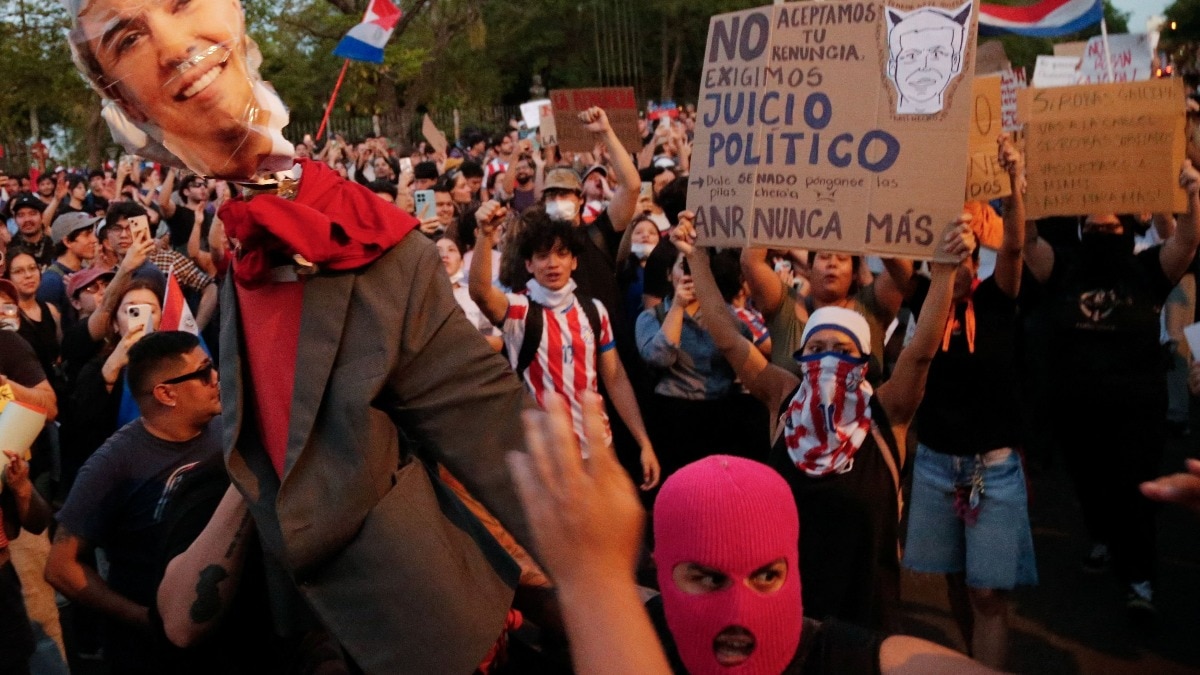
The collapse of a rapidly expanding digital bank has plunged Paraguay into a financial and political crisis, leaving nearly three million customers in a country of 6.5 million unable to access their savings. The crisis has put hundreds of millions of dollars in public funds at risk and forced President Santiago Pena, a former International Monetary Fund (IMF) economist and ally of US President Donald Trump, to announce his resignation.However, Paraguayan lawmakers are resisting Pena's resignation, and, instead, want him impeached.At the heart of the crisis is Ueno Bank, a digital lender controlled by the Grupo Vazquez business conglomerate. The bank was placed under the control of Paraguay's central bank on November 3 after regulators found that its financial position had deteriorated sharply.The intervention triggered protests, criminal investigations and impeachment proceedings against Pena, who previously held a stake in Grupo Vazquez. On November 5, Pena announced his resignation, saying he wanted to preserve Paraguay's stability and democratic institutions. However, lawmakers did not accept his departure. As of Friday (November 6), he remained in office as the Senate prepared to proceed with impeachment proceedings.HOW UENO BANK BECAME A FINANCIAL GIANTParaguay is a landlocked South American country bordered by Brazil, Argentina and Bolivia. Its economy relies heavily on agricultural exports and hydroelectricity. Ueno Bank became one of the country's most prominent financial institutions through rapid expansion. Grupo Vazquez acquired Financiera El Comercio in 2021, transforming it into Financiera Ueno. The bank launched its digital banking brand in February 2022, according to its 2023 annual report.It subsequently acquired and merged with Vision Banco in 2024, expanding its customer base and operations.According to Reuters, Ueno had around three million customers and administered roughly $850 million in public funds, including money belonging to state institutions and pension-related bodies.Grupo Vazquez remained its controlling shareholder through a chain of holding companies, according to S&P Global Ratings.WHY DID UENO BANK COLLAPSE?The immediate trigger was a deterioration in Ueno's financial position, particularly its capital adequacy and lending quality.According to the Associated Press (AP), the Central Bank of Paraguay initiated resolution proceedings after identifying weaknesses in the bank's assets, poorly documented transactions and loans to companies linked to Grupo Vazquez.AP reported that central bank inspectors had identified risky insider lending as early as June. The bank had allegedly extended large loans to companies connected to its owners, exceeding legal limits and without adequate collateral.When regulators corrected Ueno's accounts, its capital fell to less than half the legally required minimum, the central bank said, according to AP. The regulator intervened on November 3, beginning the transfer of deposits and recoverable assets to other banks before liquidating the remaining institution.The intervention disrupted Ueno's banking operations, leaving millions of customers unable to access their savings or make payments.The consequences extended beyond ordinary depositors.AP reported that the state pension and healthcare fund had approximately $380 million in deposits and investments with Ueno. Around 32,000 retirees who received pension payments through the bank were also affected.The government subsequently approved legislation requiring a state guarantee fund to repay stranded depositors within five business days. According to AP, initial payments to customers with smaller accounts began on November 5.The crisis also prompted criminal action.AP reported that prosecutors charged 27 bank officials and associates with breach of trust and attempted fraud. Six executives, including founder Miguel Vazquez and bank president Juan Manuel Gustale, were ordered jailed pending trial, while two others were placed under house arrest.WHAT'S PRESIDENT PENO'S LINK TO UENO BANKThe banking crisis became a political one because of Pena's connections to Grupo Vazquez.According to AP, Pena is an economist and former finance minister who had previously worked with the International Monetary Fund (IMF). He became Paraguay's president in August 2023.Reuters and AP reported that Pena had previously held a stake in Grupo Vazquez, the conglomerate controlling Ueno Bank. He maintains that he sold his stake in March 2025 and denies having invested directly in the bank.Another controversial connection involves Carlos Carvallo, who headed Financiera Ueno, the bank's predecessor, before Pena appointed him president of Paraguay's central bank.Carvallo resigned on November 3 at the President's request, following criticism of the regulator's supervision of Ueno.BANK COLLAPSE TRIGGERS PROTESTS AND IMPEACHMENTThe collapse triggered demonstrations in the capital, Asuncion, as depositors demanded access to their money. Retirees, workers and other customers joined protests, while employees of Ueno and related businesses raised concerns about unpaid wages and job security, Reuters reported.On November 4, opposition lawmakers submitted impeachment articles against Pena. Former president and influential Colorado Party leader Horacio Cartes also indicated his support for impeachment.On November 5, Pena announced his resignation in a televised address, saying his departure was necessary to preserve Paraguay's stability.However, the resignation did not take effect. According to Reuters, a joint congressional session lost its quorum after lawmakers from Pena's Colorado Party walked out. The lower house subsequently voted 78-0 to advance impeachment proceedings, while the Senate moved ahead with a trial and summoned Pena to appear.AP reported that opposition senators argued that accepting his resignation could allow Pena to become a senator for life, potentially granting him legal protections against prosecution. An impeachment conviction, by contrast, would deprive him of that entitlement.Vice-President Pedro Alliana is in line to succeed Pena if he is formally removed from office. What is noteworthy is that Paraguay is seeing the collapse of its biggest bank with a former IMF economist at the country's helm.- Ends(Written by Shounak Sanyal)
Bank collapse leaves half of Paraguay without fund access under economist-president
Full Article
Original Source
Read the full article at Indiatoday →KhanList aggregates and links to publicly available news content. We do not host full articles from third-party sources. Always verify important information with original sources.