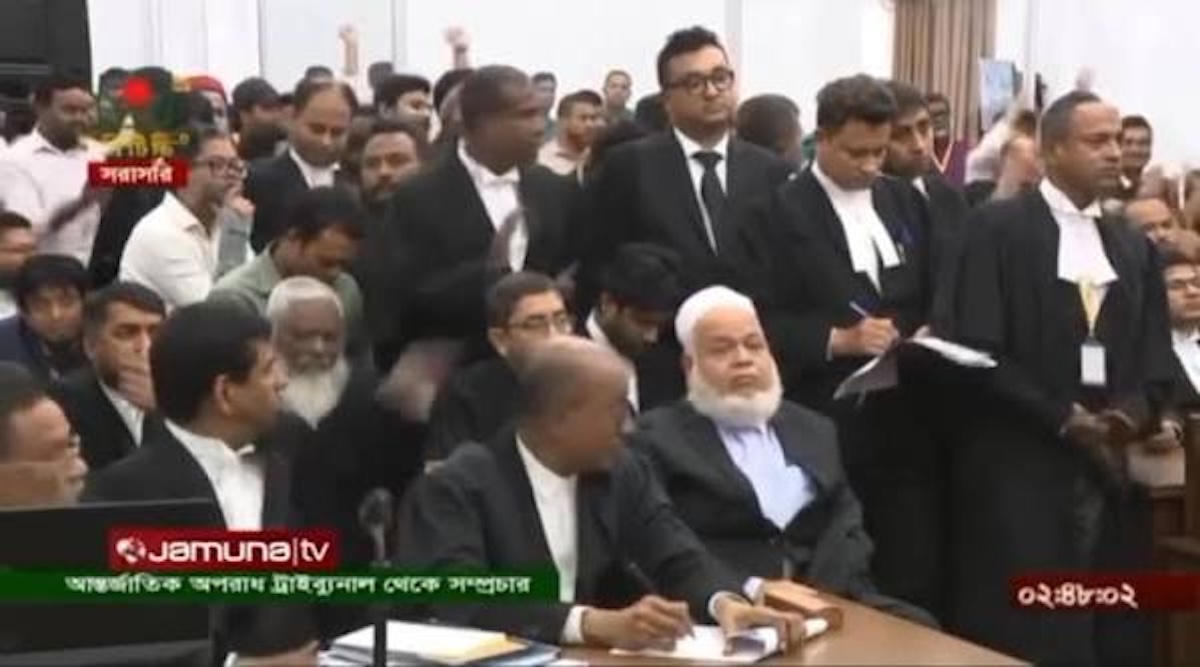
A death sentence is supposed to be the moment a legal system proves it can be trusted with its gravest power. In November, Bangladesh’s International Crimes Tribunal handed down exactly that verdict against former Prime Minister Sheikh Hasina, for crimes tied to the killings of the July-August 2024 uprising. Eight months later, Hasina says she now intends to return to Bangladesh by December, together with senior Awami League colleagues, including a former home minister who faces a death sentence of his own, to surrender voluntarily and put her record before the country in person rather than leave it settled by a trial conducted in her absence. Whatever one makes of that gambit, it turns what might have been a closed legal chapter back into a live political question, and reopens a harder one underneath it: What happens when the institution built to deliver justice is compromised before the trial even begins. The Bangladesh case The killings of July and August 2024 were real, and so was the public demand that someone answer for them. But a detailed legal analysis published this month by a Bangladeshi barrister and London School of Economics visiting fellow lays out, in granular detail, how the tribunal that delivered this verdict was assembled. Bangladesh’s interim government, unelected and governing without a sitting parliament, amended the tribunal’s founding statute four times through executive ordinance, changes that under the constitution’s own terms required parliamentary ratification that never came and could not come. The bench itself was reconstituted with judges who had not attained the rank the law requires, following the removal of the country’s chief justice and other senior judges months earlier. The prosecution’s central evidence, leaked surveillance recordings, was admitted without any hearing on how it had been obtained or whether that method was lawful. And the trial itself moved from the appointment of defense counsel to a death sentence in under five months, on a casualty record contested enough that the United Nations’ own fact-finding mission, examining the same events, said the evidence did not yet support individual criminal conviction. None of this proves Sheikh Hasina is innocent of everything alleged against her, and nothing here should be read as a defense of the conduct that triggered the 2024 uprising in the first place. The point is narrower and, in some ways, more troubling: A tribunal built this way cannot actually tell the public, or history, whether the person it convicted is guilty. It can only tell them what the government currently in power wanted the record to show. That is a loss for the victims’ families as much as for the defendant, because it leaves the one thing they were owed, a credible account of what happened and who was responsible, permanently in doubt. A pattern, not an anomaly What makes the Bangladesh case worth dwelling on is not that it is unique but that it is legible, a clear specimen of a mechanism now visible across very different political systems. Pakistan’s courts have processed cases against former Prime Minister Imran Khan and his party for three years on timelines and evidentiary bases that have drawn sustained criticism from independent legal observers, just as, at other moments, courts there have moved against his predecessors and rivals in ways their own supporters called political. Myanmar’s junta tried Aung San Suu Kyi behind closed doors on a stack of charges assembled after her government’s overthrow. None of these cases are identical, and this is deliberately not an argument about who was right in any of them. It is an argument about method: In each, an institution with genuine legal pedigree, a real statute, credentialed judges, a functioning courtroom, was bent toward a result decided in advance, and then presented to the public as ordinary justice. Scholars of democratic backsliding call this autocratic legalism, the use of law’s own language to defeat law’s substance, and it is more durable than a coup precisely because it never announces itself as illegitimate. It arrives wearing the state’s own signature. The cost compounds quietly. When one political faction is granted blanket immunity while its rivals face the harshest possible charges, as has happened in Bangladesh’s post-uprising transition, courts stop functioning as a check on power and start functioning as its instrument. Every government that watches this happen, anywhere in the region, absorbs the same lesson: The judiciary is available to whoever holds office next, to be pointed at whoever inconveniences the office-holder. That lesson, once learned, is rarely unlearned by the next administration, whatever its politics. What this means for India This is where the question stops being academic for New Delhi. Bangladesh has formally requested Sheikh Hasina’s extradition from India under the 2013 bilateral treaty, and that treaty explicitly allows India to decline a request that is political in character or not made in good faith. Hasina’s own stated plan to return and surrender voluntarily does not resolve that question. If anything, it raises the stakes on getting it right, since India may soon be weighing not just an extradition request but the reception a returning former head of government receives in a country whose courts have been assembled this way. India does not need to adjudicate Bangladesh’s internal politics to take that seriously; it only needs to look at how this particular tribunal was built, and ask whether a conviction produced this way meets the treaty’s own threshold for cooperation. That is a legal judgment, not a partisan one, and it can be made without endorsing or condemning anyone’s conduct in the events of 2024. More broadly, India has spent years positioning itself as the Indo-Pacific’s most credible democratic partner, a status that depends on being seen to take due process seriously even – especially – when doing so is inconvenient. A region watching its neighbours turn courts into instruments of political consolidation will notice which larger power treats that pattern as a warning and which treats it as background noise. The distinction between genuine accountability and its counterfeit is not an abstraction for the families of Bangladesh’s 2024 dead, and it should not be treated as one in New Delhi either. Getting this right protects something more durable than any single verdict: the credibility of the idea, still fragile across much of the region, that courts exist to establish truth rather than to enforce whoever currently holds power. Advocate Prabhav Ralli is practicing lawyer in New Delhi who specializes in International Law. Tarun Agarwal, PhD, is an associate fellow at the Center of Policy Research and Governance, New Delhi, where he leads the International Relations and Conflict vertical.
Bangladesh’s Hasina death penalty: when courts become weapons
Full Article
Original Source
Read the full article at Asiatimes →KhanList aggregates and links to publicly available news content. We do not host full articles from third-party sources. Always verify important information with original sources.