
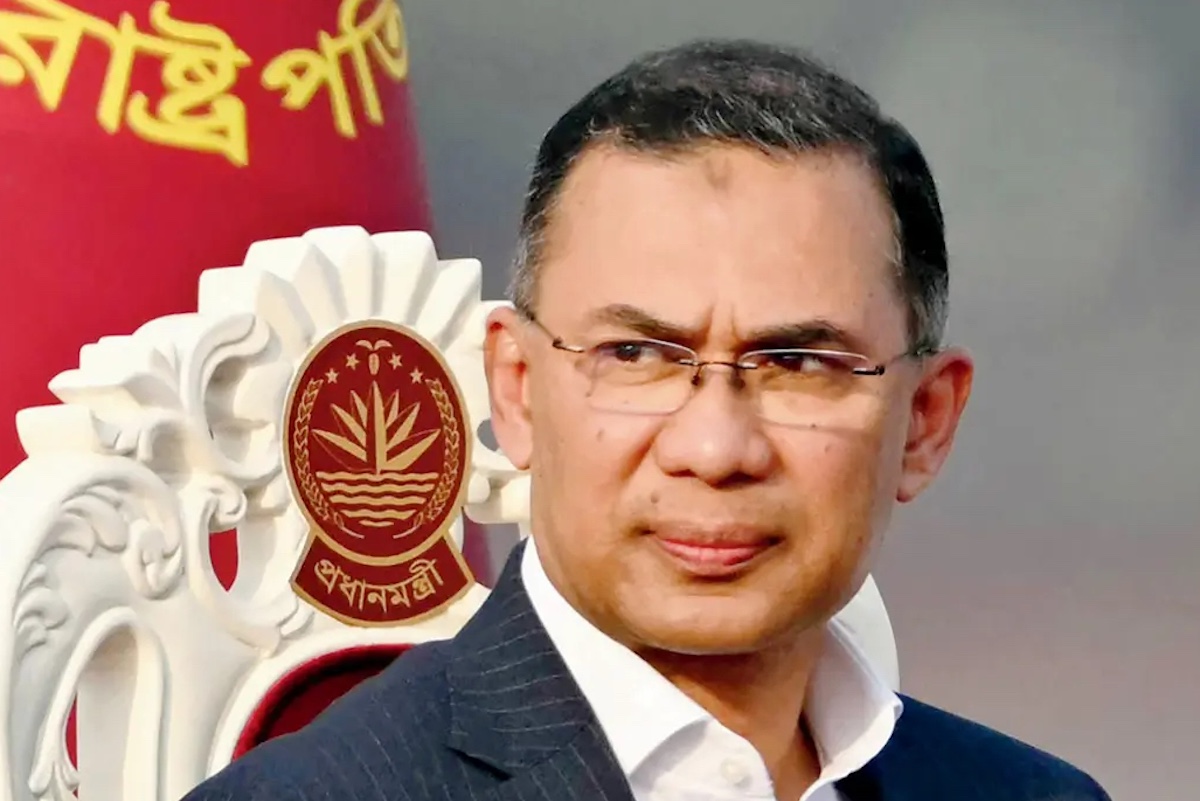
Last December was one of the most turbulent months in Bangladesh’s recent history. The country was looking ahead to the February election when Sharif Osman Hadi, a young political leader, was shot and later died on December 18. His death was followed by mob attacks on Prothom Alo, The Daily Star and cultural organizations including Chhayanaut and Udichi. Then, on December 25, Tarique Rahman returned home after 17 years in exile. Five days later, his mother and former prime minister Khaleda Zia died. A year on, December is approaching with an altogether different set of uncertainties, but there are reasons to think it could be just as consequential. The anniversaries of Hadi’s death and the attacks on media and cultural institutions are only part of the story. Several political and diplomatic tensions are building at the same time, and their convergence could make the month particularly difficult for Bangladesh. The biggest uncertainty is Sheikh Hasina, who has indicated that she intends to return to Bangladesh in December and surrender before a court. On November 9, a British lawyer claiming to represent her also wrote a letter to the acting high commissioner of the Bangladeshi embassy in New Delhi, requesting a new passport and national identity card for Hasina. The issue came up at a meeting of the BNP parliamentary party later that day, where Home Minister Salahuddin Ahmed said the government would take the necessary steps under the existing extradition treaty with India if Hasina wanted to return. Prime Minister Tarique Rahman, who chaired the meeting, made no direct comment on the matter. Earlier that day, Foreign Affairs State Minister Humaiun Kobir described the reported request for a new passport and national identity card as “utterly ridiculous”, saying Bangladesh wanted Hasina handed over under the extradition treaty rather than return as an ordinary traveler. On November 10, Prime Minister’s Information and Broadcasting Adviser Zahed Ur Rahman said Hasina herself had not applied for a passport and that the government saw no legal obstacle to bringing her back through extradition. International Crimes Tribunal Chief Prosecutor Md Aminul Islam, however, said there was no legal scope to issue her a new passport and that her death sentence would be enforced upon her return, as she had exhausted her legal options by failing to appeal within the stipulated 30 days. All this development is quite significant since Hasina remains a polarising figure in Bangladesh with a following among sections of the population, despite being sentenced to death in absentia for crimes against humanity over the 2024 uprising, charges she denies. A return would present the authorities with difficult questions: how to enforce the court’s verdict, ensure her security and deal with the crowds and political reactions her arrival could trigger. Even an announcement of a return date could bring people onto the streets, which are already showing signs of unease. The security situation has become particularly concerning in recent days. At least 19 buses were torched between November 7 and 9, while Dhaka Metropolitan Police data showed 49 crude bomb explosions in the capital over three days. On November 10, a further 22 incidents of arson and crude bomb explosions were reported across the country. One person was killed and at least 10 vehicles were torched that day. Police have blamed leaders and activists of the Awami League and affiliated organizations, alleging that the attacks are intended to create unrest ahead of December. The frequency and geographical spread of these incidents are unsettling. If the authorities respond with sweeping arrests or excessive force, a security problem could quickly turn into another political confrontation. There is also the question of what December represents politically. It is Victory Month for Bangladesh, and this will be the first one under the current BNP government. The legacy of 1971 has long been central to Bangladesh’s political contestation. The Awami League built much of its political identity around the Liberation War, while its opponents have repeatedly accused it of using that history to silence criticism. The 2024 uprising has made the debate over the country’s political past and its future even more complicated. How the new government approaches Victory Day commemorations, and how rival political groups respond, could become another source of tension. The possibility of competing rallies, speeches and demonstrations makes the timing particularly sensitive. The anniversary of the attacks on newspapers and cultural institutions raises a different but equally important question: has anything changed since that night? The attacks on December 18 and 19 were not simply acts of vandalism. An investigation by The Daily Star and Dismislab found that online incitement had helped build up hostility towards the newspapers and cultural organizations before the mobs attacked them, while visible threats went unaddressed for hours. A year later, it is worth asking how many of those responsible have been brought to justice and whether journalists, editors and cultural workers feel any safer. If fresh unrest breaks out, these institutions could once again become targets because of what they represent. How the government protects them will be an important measure of its commitment to freedom of expression. All of this is happening against the backdrop of an uneasy relationship with India. Hasina’s continued presence in India has been a major source of friction since she fled Bangladesh in August 2024. Dhaka has formally requested her extradition, but New Delhi has yet to hand her over. If Hasina returns, the circumstances of her departure and India’s role in the process will inevitably come under scrutiny. If she stays, the extradition issue will continue to weigh on bilateral relations. Meanwhile, rhetoric from Indian politicians is hardly helping. BJP lawmaker Nishikant Dubey recently called for India to reclaim Noakhali, Sylhet and Chattogram port, claiming they had been wrongly handed over during Partition. He is not speaking on behalf of the Indian government, but his remarks are difficult to dismiss as an isolated provocation, given the history of similar statements by other Indian politicians. In Bangladesh, such comments are bound to provoke resentment and give nationalist voices further ammunition at a time when relations are already strained. They also make it harder for either government to build domestic support for cooperation on issues such as water sharing, trade, border management and security. Each of these issues could be dealt with separately. Hasina’s possible return is a legal and diplomatic matter; the recent attacks are a security concern; Victory Month and the media anniversary raise questions of political responsibility and historical memory. But they will not unfold separately. A decision or announcement concerning Hasina could trigger demonstrations. Those demonstrations could turn violent, inviting a forceful response from the authorities. The resulting confrontation could revive the very questions about political repression and democratic freedoms that Bangladesh has struggled to put behind it. Meanwhile, inflammatory statements from India could add another layer to an already charged atmosphere. The BNP government will face its first December in office with all these questions hanging over it. How it handles the month will matter as much as the events themselves. Will it treat political dissent and public demonstrations with restraint? Will it ensure accountability for the attacks on media and cultural institutions? Can political leaders find common ground, at least during Victory Month, or will the country’s history once again become a tool for settling present-day scores? And can Dhaka and New Delhi prevent their disagreements from spilling further into public hostility? Bangladesh has weathered many difficult periods, but this December could test several of its institutions at once. The danger is not necessarily that any one of these developments will prove unmanageable. It is that they may feed into one another, leaving little room for political or diplomatic miscalculation. By the end of the month, Bangladesh may have a clearer sense of how much has changed since last December – and how much remains unresolved. Jannatul Naym Pieal is a Dhaka-based journalist, writer and researcher with over a decade of experience in professional journalism. He is also the author of 10 published books and a researcher focusing on Bangladesh’s media industry and its intersections with broader social and academic fields.
Bangladesh braces for a December of converging crises
Full Article
Original Source
Read the full article at Asiatimes →KhanList aggregates and links to publicly available news content. We do not host full articles from third-party sources. Always verify important information with original sources.