
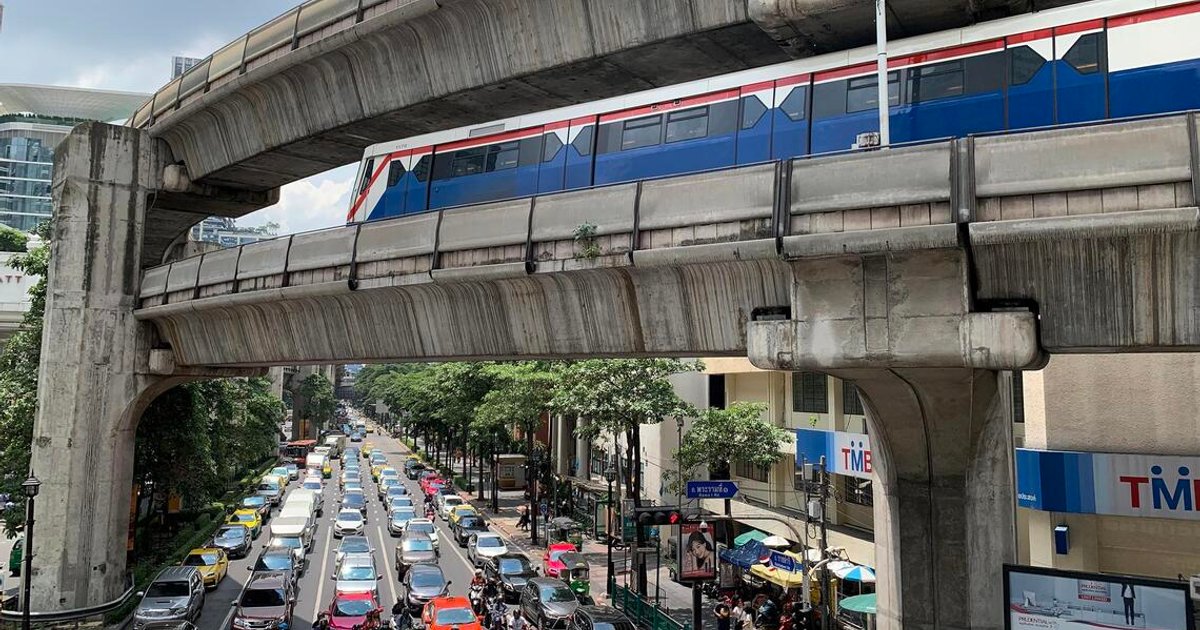
BANGKOK – Thailand’s Deputy Prime Minister and Transport Minister Phiphat Ratchakitprakarn has set Jan 1, 2027 as the target for introducing common ticketing across Bangkok’s urban rail network and surrounding provinces, with fares capped at 45 baht (S$1.71) per journey.Speaking on the programme Talks With The Anutin Cabinet on October 10, 2026, Phiphat said passengers would pay a single 17-baht entry charge, without paying another entry fee when transferring between rail lines.The Mass Rapid Transit Authority of Thailand (MRTA) would manage the central system, while Krungthai Bank would handle payment processing and return fare differences to passengers within three days, Phiphat said.The government intends the scheme as a New Year gift to reduce commuting costs.“This policy follows the prime minister’s instruction to reduce living and travel costs, with the MRTA managing the system and Krungthai Bank handling the back-office arrangements,” Phiphat said. “We also plan to connect road, rail and boat services and develop rail freight to lower the country’s logistics costs.”Payment talks continue ahead of January launchThailand’s Transport Ministry is negotiating changes to the Green Line’s Rabbit payment system to support common ticketing by the January deadline, Phiphat said.The Green Line, operated by Bangkok Mass Transit System (BTS), remains the main payment-system challenge.Phiphat said rail transport and common ticketing legislation had passed, and agreement had been reached to use the international EMV (Europay, Mastercard, and Visa) standard for contactless credit and debit card payments.The planned payment system would allow foreign visitors with compatible Visa cards to tap into rail services, Phiphat said, comparing the arrangement with Thai travellers using bank cards on public transport in Singapore.Phiphat described the Green Line as a central part of Bangkok’s rail network, supporting journeys involving the Purple, Blue and other lines. Resolving payment compatibility would make transfers substantially easier, he said.Bangkok and surrounding provinces have plans for approximately 500km of urban rail, of which about 280km have been completed and another 90km are being developed, according to Phiphat.The additional routes are expected to open progressively from 2028.Phiphat described the existing network as involving two or three operators across its different lines, including services under the State Railway of Thailand (SRT) and the MRTA. Administration and fare collection must be brought together before a fully integrated ticketing system can operate, he said.Phiphat argued that lower fares would leave passengers with more disposable income, citing current daily travel spending of 60, 80 or 100 baht. The proposed 45-baht ceiling would apply to each journey. He also expected the policy to encourage public transport use, ease road congestion and improve environmental conditions.Electric buses and piers to join common ticketing in 2027The Transport Ministry aims to connect bus and boat services with rail under common ticketing in the fourth quarter of 2027, supported by electric feeder buses and upgraded passenger piers.The Bangkok Mass Transit Authority (BMTA) has ordered an initial 1,520 electric buses, while private operator Thai Smile Bus already operates approximately 2,000, Phiphat said.Once the BMTA receives its vehicles, the Department of Land Transport will bring the authority and private operators together to redesign routes around rail stations and adjust services to the city’s changing layout.“The new approach will shorten bus routes, with starting and finishing points at stations on the different rail lines. We must also consider service frequency and how many minutes passengers wait between buses,” Phiphat said.Connections from residential sois (side streets) to main roads remain under discussion between the ministry and the Department of Land Transport, with no conclusion yet reached.Phiphat expected electric feeder services on main roads to begin around August 2027, or by the fourth quarter at the latest.The BMTA expects delivery of the first 1,520 electric buses between March and May, followed by another 800 in late December, bringing the total to 2,320 during 2027. Phiphat said the authority aimed to operate an entirely electric fleet by the end of that year.The new buses would provide wheelchair spaces and ramps. Existing 50% fare discounts for older passengers and school and university students would remain, while children under seven would travel free.The Transport Ministry is discussing welfare-card support with the Finance Ministry to protect passengers currently using cheaper, non-air-conditioned buses as the fleet becomes fully air-conditioned.Under the proposal, the BMTA would register those passengers, whom Phiphat put at no more than 300,000 people a day, so they could continue paying their existing fares. The government would credit the fare difference to their welfare cards.Phiphat estimated that the electric fleet would save approximately 1.2 billion baht in fuel costs and close to 2 billion baht in maintenance annually, for total savings of around 3 billion baht to 3.2 billion baht.The leased-bus providers would be responsible for supplying replacement vehicles when needed and renewing buses after seven to eight years.For boat services, the ministry plans to complete 16 of 29 Smart Pier upgrades by the fourth quarter of 2027, enabling EMV payments when boarding and leaving boats. Piers would join common ticketing as soon as they were ready, without waiting for the entire programme to finish.The planned water-transport integration includes Saen Saep canal boats, allowing passengers to connect with rail and bus services through the shared ticketing system.Rail freight expansion targets lower logistics costs by 2033The prime minister has instructed the Transport Ministry to make rail the principal mode of freight transport by 2033 to reduce national logistics costs, Phiphat said.Phiphat outlined the following development timetable:North-eastern rail: The double-track route to Nong Khai is expected to be completed in 2031, connecting with rail services from southern China reaching Vientiane through a planned Mekong River bridge. Another route would link the North-east with Laem Chabang Port.Northern rail: Projects involving Chiang Mai, Chiang Rai, Chiang Khong and Den Chai are expected to be completed in 2029 or 2030.Bangkok-Chumphon: Phiphat expects the route to be completed in 2027.Southern extensions: A mobile Cabinet meeting has approved tendering for three sections: Chumphon-Surat Thani, Surat Thani-Hat Yai and Hat Yai-Padang Besar on the Thai-Malaysian border. Tenders are planned for 2027, with completion by 2033.The southern connections would allow goods to travel by rail from Hat Yai through Malaysia to Singapore without being transferred to ships, Phiphat said. Cargo could alternatively be taken to Penang for onward shipment by sea.“Road freight will remain, but trucks will serve as feeders, travelling no more than 150km from factories or industrial estates to railway stations,” Phiphat said. “This will free up main roads for the public.”The Transport Ministry also intends to develop maritime freight by using Thailand’s position between the Pacific and Indian oceans, Phiphat said.Phiphat argued that ships serving Laem Chabang spend approximately two days travelling into and out of the Gulf of Thailand. He put the port’s transshipment share at no more than 5%, suggesting it might be no higher than 3%, compared with 97% in Singapore.The ministry is discussing demand for another deep-sea port on the Gulf coast with the Board of Trade of Thailand and the Federation of Thai Industries. Phiphat said such a port could serve ships passing southern Thailand on their way back to Singapore without the lengthy Gulf detour, although the proposal requires further study.Motorway proposal would follow rail upgradesThe Transport Ministry has studied and discussed upgrading Highway 4, or Phetkasem Road, after the rail programme is completed, Phiphat said.The proposal would add two lanes on each side of the road and elevate the central lanes into a motorway with flyovers and no traffic lights, allowing continuous travel from Bangkok to Songkhla. Existing surface roads would remain available to local traffic.Phiphat said the road project would require substantial funding and would therefore follow completion of the rail improvements.Responsibility for road-rail crossing safety rests with the SRT, Phiphat said. He reported that work on crossings in western, eastern and northern areas had been completed, with inner Bangkok remaining to be addressed.The SRT plans to elevate railway tracks in Bangkok and allow buses to pass underneath, removing crossings at road level. Phiphat set a completion target of six years, with an outer limit of 10 years. THE NATION/ASIA NEWS NETWORK
Bangkok targets common rail ticketing with a $1.71 fare cap by 2027
Full Article
Original Source
Read the full article at Straitstimes →KhanList aggregates and links to publicly available news content. We do not host full articles from third-party sources. Always verify important information with original sources.