
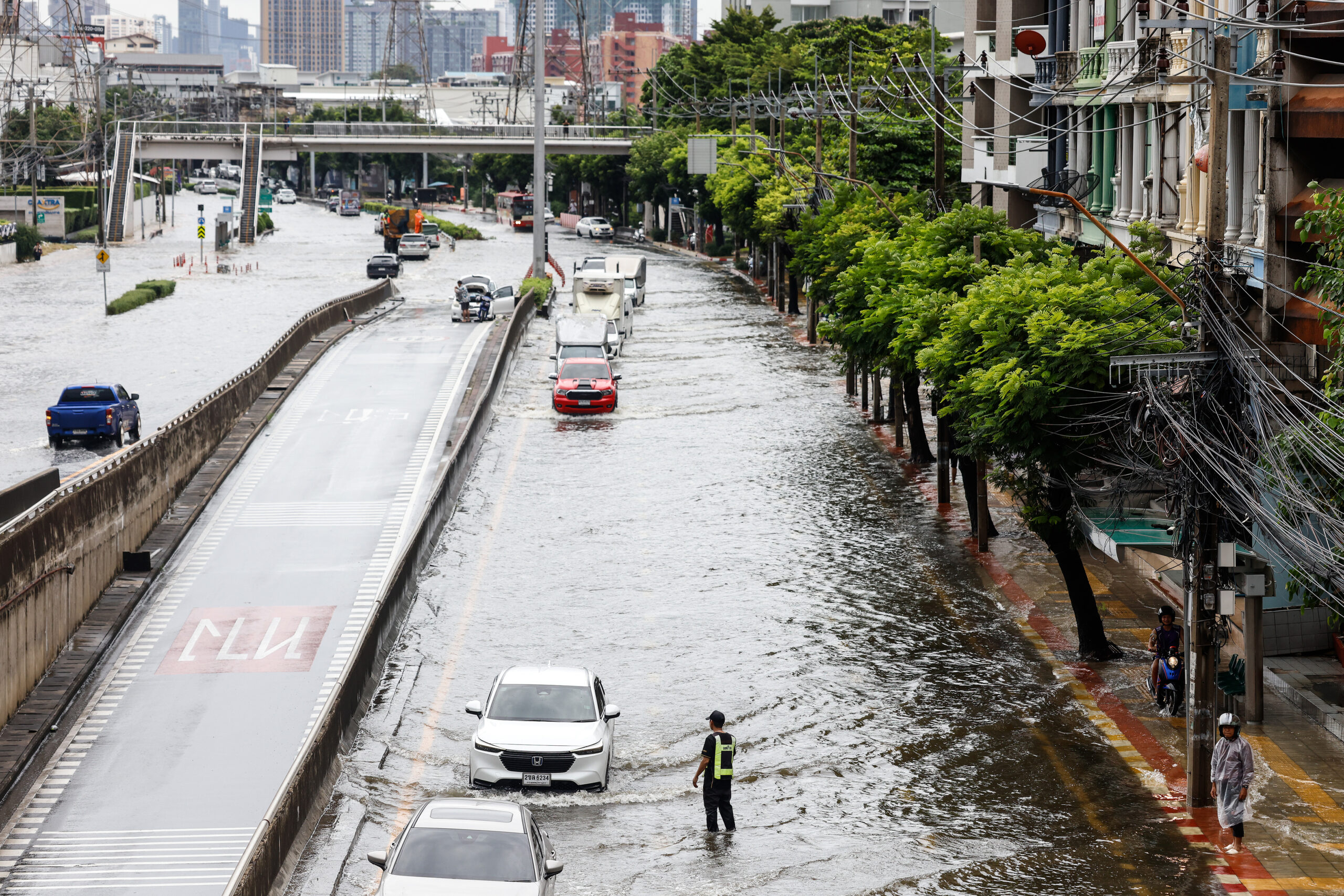
Bangkok received nearly a month’s worth of rain in a single weekend, flooding roads and homes across the Thai capital, and forcing the government to close public offices and postpone economic data releases. More than 12 inches of rain fell in Bangkok from Friday, close to the amount the city typically receives during the entire month of September, one of its wettest periods of the year. The deluge overwhelmed drainage systems across the low-lying metropolis. Major roads disappeared beneath floodwater over the weekend and vehicles were partially submerged. Residents waded through knee-deep water to reach public transport or buy food, with floodwaters reaching chest height in some neighborhoods. Tourists carried suitcases over their heads as they made their way through flooded streets to hotels. Flooding persisted Monday on some major roads and in outlying districts. Prime Minister Anutin Charnvirakul’s government declared Monday and Tuesday holidays for government offices in Bangkok and surrounding provinces, a metropolitan region of more than 10 million people. The flooding also disrupted the government’s economic calendar. The Industry Ministry postponed until Wednesday the release of a revamped manufacturing production index designed to better capture fast-growing industries including electronics tied to the artificial-intelligence boom. No deaths have been reported. In some neighborhoods, however, floodwater has left residents unable to leave their homes easily for food and other necessities. Economic Hit The economic damage is expected to be relatively contained. The three-day deluge could shave 0.025 to 0.05 percentage point off economic growth, equivalent to about 5 billion to 10 billion baht ($298 million), according to a preliminary estimate from the University of the Thai Chamber of Commerce. The impact will come mainly from damage to household property, flood-control expenses and reduced spending on travel and consumption, said Thanavath Phonvichai, the university’s president. He expects Thailand’s economy to expand 2.2%-2.3% this year despite the flooding, helped by relatively quick receding of floodwaters. A man sits with his belongings inside his house in Bangkok on Sept. 28, 2026; photo credit: Dario Pignatelli/Bloomberg The flooding is far less severe than the catastrophic inundation of 2011, which killed hundreds of people, disrupted global supply chains and forced major factories to shut. But this weekend’s deluge has hit Bangkok itself particularly hard, disrupting daily life across parts of the capital. The flooding comes as Anutin is already facing signs of weakening political support. A poll published Sunday showed backing for the prime minister and his Bhumjaithai Party falling even before the weekend deluge. Still, the floods themselves are unlikely to pose a major political threat because the disruption is concentrated in Bangkok, outside Bhumjaithai’s main political base, according to Titipol Phakdeewanich, a political science lecturer at Ubon Ratchathani University. “The flooding is serious, but it won’t be enough to bring down the government,” he said. More rain and thunderstorms are forecast Monday, with the Thai Meteorological Department warning of further heavy downpours and localized flooding in Bangkok and surrounding areas. The weather system that drenched Bangkok and central Thailand is expected to shift north Monday and Tuesday before moving toward Myanmar, models and forecasts show. Conditions around Bangkok are forecast to become more seasonal or slightly drier by Wednesday, according to WeatherMapping.com. Despite the disruption, the Commerce Ministry said the broader retail and wholesale network remains operational and major retailers are replenishing inventories normally. Some convenience stores in flood-hit districts including Bang Kapi, Min Buri and Rangsit have faced delivery disruptions. The economic hit could be more pronounced in Bangkok, where the flooding may cut third-quarter output by 0.23%, led by losses in retail and financial services, according to Rangsit University economist Aat Pisanwanich. The capital’s tourism industry could also lose as much as 10 billion baht from flight cancellations and travelers switching destinations, he said. Top photograph: Drivers navigate flooded roads in Bangkok on Sept. 28, 2026; photo credit: Dario Pignatelli/Bloomberg Copyright 2026 Bloomberg. Topics Tech
Bangkok Gets a Month of Rain in Weekend, Disrupting City
Full Article
Original Source
Read the full article at Insurancejournal →KhanList aggregates and links to publicly available news content. We do not host full articles from third-party sources. Always verify important information with original sources.