
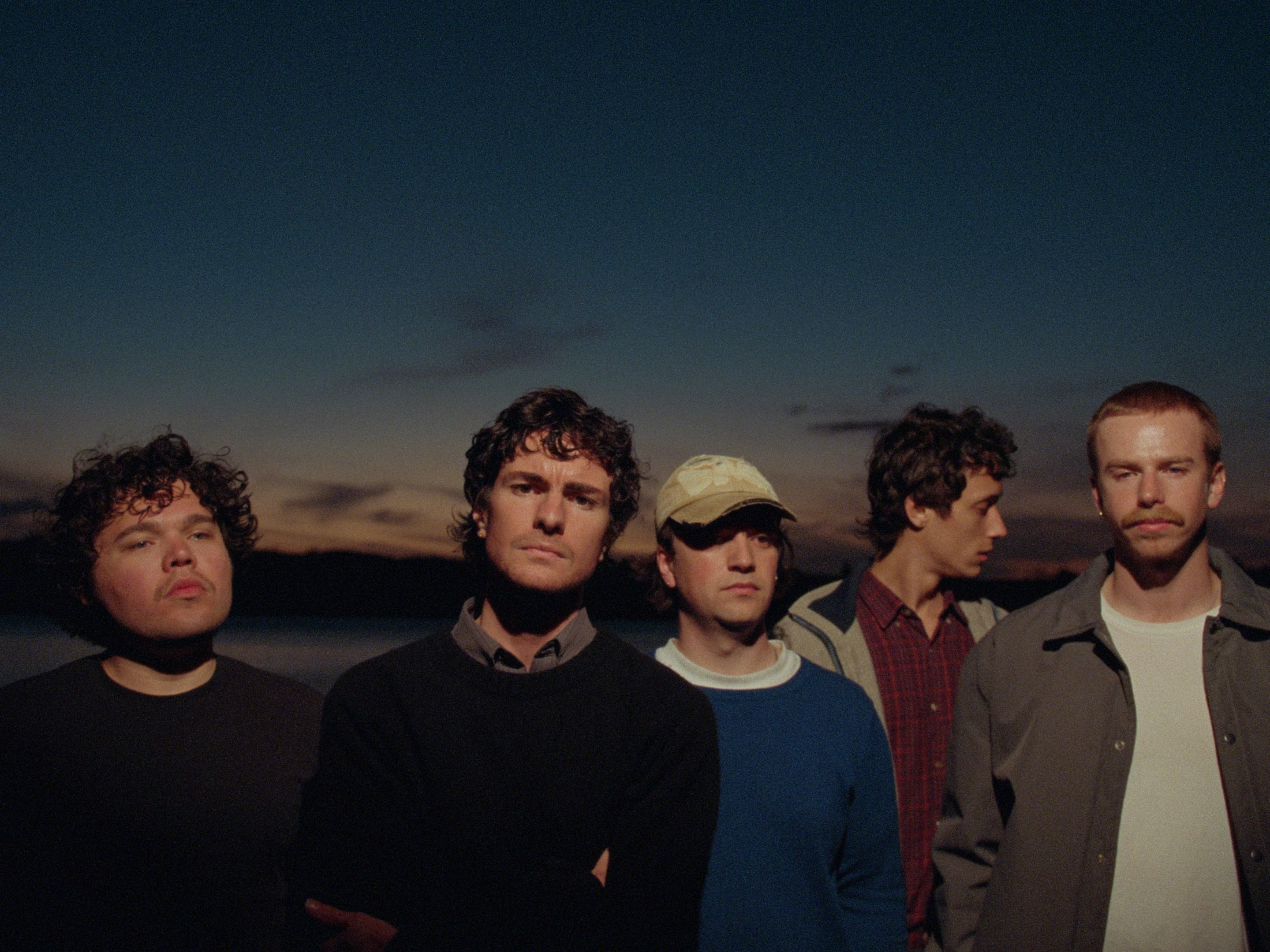
"Little Green Bolt" startled me. Awning's recent single whisks you away immediately with a brisk, bass-driven backing track and syncopated guitar stabs seemingly stapled in from "Everlong." The beat is propulsive in a way that reminds me of Radiohead or Tokyo Police Club, but with a swinging swagger you can't teach and a sense that it might go off the rails at any moment. And then the chorus hits, and instead of wrecking, the train explodes. Over distortion bombs and droning squall, Christian Dimick shouts with reckless urgency and throat-shredding rawness: "I want to remember what you said! I want to remember every word!" It's one of those holy shit moments rock fans look for, when a band takes it there.The Auckland rock band's debut album How many angels can dance on the head of a pin? is full of instances like that. Backed by his childhood friend Riley Noonan on drums, Damin McCabe on bass, and Eli Chamberlain and Ethan Broughton on guitar, Dimick lets loose with a fearless volatility to match the music, channeling grief, distress, and elation into anthemic howls and bellows. Even a song like opening track "I'm Up," with its acoustic intro and slo-mo verses, eventually finds its way to clamor. "This is both a love song and a meditation on how life slows down, in a threadbare kind of way, when you are isolated from your loved ones," Dimick says of the song.Awning are sharing "I'm Up" today along with details on the new album. Set for release on January on Winspear, the project conjures echoes of hard-hitting indie rock from across the decades: the combustible pop acumen of Pixies and their grunge descendants, the ragged rock 'n' roll glory of Divine Fits guys Dan Boeckner and Britt Daniel, the bleary post-punk suaveness of Iceage or King Krule. Dimick, who first found renown as a visual artist, is remarkably good at this rock frontman thing too, and his bandmates feed off each other's energy to powerful effect.Below, check out "I'm Up" video, read my recent conversation with Dimick, and check out the tracklist for How many angels can dance on the head of a pin? Awning is promoted as this band from Christian Dimick, an acclaimed visual artist. Is it fair to say you were known for your visual art before your music?CHRISTIAN DIMICK: I don't really know. I've been playing music since I was a little kid, and I only really started making paintings or drawings after high school. But I don't know what I was known for first.Tell me about your path as an artist. How did you break through? And what do you feel has been the appeal of your art? What do people tend to notice and appreciate about it?DIMICK: About both mediums, or…? Sure, it can be either one. I meant your visual art, but I'm open to hearing about the music now too.DIMICK: I think people respond to how I work intuitively in both visual art and music. That's one thing that working with painting and drawing has taught me over the years, spending lots of time in a painting studio on my own, is to trust my own judgment and be confident in when I should hold onto things and when I should let them go, and when an idea is working and when it's not. You're not really surrounded by other people to help you along with making decisions. You have to get very good at making them on your own, and in an immediate fashion. Yeah, I think that's something that people respond to. If people have said something really nice to me after the show, it's that. All of us, or the music, or me as a performer, it seems like I'm playing from an immediate space. I don't go on stage and think about what I'm doing. I try to do the exact opposite. It's a space where not having forethought is something that's admired or positive. And it's the same with painting. The more I do it, the easier it becomes to not overthink what I'm doing. And that's something that's been transferred from drawing or painting into music over the years, I think. Being a visual artist has made me a different kind of musician than I was.You mentioned you did music first? DIMICK: When I was a little kid, my granddad, he was a concert violinist. Not as his full-time job, but he played the violin. So when I was a little kid, I learned the violin. And then, when I was about 6, I started learning the guitar as well. And then I played music all through my teenage years, different sort of punk bands. And then I sort of just found my — I was actually studying music, and then became really disenchanted with studying music. So I started painting and drawing all the time, and then I sort of swapped degrees at university, and then spent a bunch of years not really playing much music and more focusing on visual art. And now it's all coming full circle.Why did you become disenchanted with studying music?DIMICK: This is when I was maybe 18 or 19. I was studying composition, which was super based in learning a lot of theory and reading music charts, just really theory based, and it felt super uncreative to me. And I think what I really needed at that time was to be going out and playing music with other people. But as someone leaving high school, you feel like you need to go university ‘cause that's what everyone else is doing, so I went and did that and was very unhappy. But I found my own way, and it actually led me to doing something that I really love, that I would never have thought I would have done.You're an artist peer at the Grace Gallery. What does that mean?DIMICK: It just means I'm a represented artist by that gallery, and that I'm essentially part of the family. We try and not operate on a traditional model of galleries. It's more like I'm a friend of the gallery as opposed to being a client or whatever of the gallery, if that makes sense.Is it similar to being signed to a record label or not?DIMICK: Yeah, I guess there's some similarities there, maybe. With Grace, the gallery I show with, it's a professional relationship. But also my friend Emil [Scheffmann] who runs it, he's my very, very good friend, and it's quite a relaxed professional relationship. Whereas signing on with the label felt a bit more serious and intense. You have to get an entertainment lawyer, and you have to do all this other scary shit. Especially with someone overseas that you haven't met before, it's all a bit more intense. But there's similarities there. You have a loyalty to this person, and they give you opportunities, and then you give them your work. It's a trade-off. There's similarities there for sure.Speaking of signing to a record label, how did you end up with Winspear?DIMICK: It was kind of bizarre. I was in Melbourne on a painting residency, and then I met with a friend of a friend called Emma, who's now our manager. Our bass player Damon sent her the record ’cause he knew she worked in music and she might be interested in hearing it and know some people that we could send it to. And then Emma was keen to jump on board to be our manager. So then she started sending the record out to people, and Winspear just picked up the record. We had no expectations as to anyone being interested at all. If you'd asked me at this time last year whether I would have thought this was a possibility, I would have said no for sure. But yeah, Winspear listened to it, they liked it, and then we had a couple of casual Zoom calls online. And Jared [Jones], who runs Winspear, you know, played it very cool and we couldn't really tell if he was, he was interested or not.And then maybe one month or two months went by, and then they proposed releasing the record through Winspear. And then here we are. And now we've developed a really beautiful friendship with Jared and everyone who works there. They're incredibly nice people, and I feel like we're relatively fresh as a band. People don't really know anything about us. For them to pick up the record and want to work on it with us, just based on how much they like the music, is a big compliment.Were you familiar with the label before?DIMICK: I wasn't massively familiar with the label, like as an entity, but I really liked a lot of bands that were on the label that I didn't realize were on Winspear, like Slow Pulp and Teethe. I love those bands, but I'd never really made a connection or focused in on them as a label. Until all of this stuff happened, I've never really been a label person.You're not following along like, “Oh, this artist’s on this label.”DIMICK: No, unless it's like — you know, we have Flying Nun here in New Zealand. Maybe I'm making myself look bad, but I've only really deep-dived into Flying Nun's whole discography. But I've been more interested in labels since all this has happened.Yeah, it's suddenly become very personally relevant.DIMICK: Yeah, totally. You can see a label's taste. When you start sifting through all their artists, you can see all these threads between groups or artists.Your bio talks about 2023 as the launch of this version of the band with the five of you. Did Awning exist in some other form before that?DIMICK: Awning before that was just me in a shed, making demos on my laptop. But yeah, eventually me and some friends decided it would be fun to play some shows. So we put a lineup together, and Riley [Noonan], who still plays drums, was playing drums, and Eli [Chamberlain] was in it. And our friend Baxter [Perry] at the time was playing bass, and our friend Tharushi [Bowatte]. And then the lineup changed. I moved cities. But yeah, we started playing as a band in around 2023. It became more of an actual thing as opposed to me just on my own.How did the music change when you became this full-fledged band? Was the style pretty much the same when it was just you?DIMICK: No, when it was just me, it was very lo-fi, folky. I was listening to a lot of the Microphones or whatever, or Elliott Smith or something. And then slowly over time, the band’s become louder. Maybe a little bit more abrasive. Just less folky, less acoustic guitars.Yeah, I was going to say, even compared to the self-titled release you put out last year, this new one seems a lot rawer and heavier to me. What was driving that change?DIMICK: As each record or release has gone on, it's been more and more writing together in a room as a band. So you're just responding to each other's energy, you're playing in a louder space, or just playing generally louder. So vocals get more intense to match that energy. The songwriting just takes on — it’s a different life force. The way you write a song in a bedroom on your own is so different to writing in a space with other bodies and other people. It’s active, and you're responding to each other. That's why this, the newest record, sounds far more raw. It's just a different setup. Did you know your voice could do that before you were writing these songs? It sounds pretty cool.DIMICK: Not really. Yeah, I think that's another thing, with vocal performance, you're never gonna do that sitting alone in your bedroom. So yeah, sometimes I surprise myself. Like I didn't know I could sing in that register or something. But you just figure out that you can, I guess. So that's one way that the music has evolved.How do you feel like you've grown as a songwriter since you started this project?DIMICK: I think I've become better at working alongside people. Like the band as it's developed into this upcoming release, I feel like over the years, just in general I've gotten better at writing music with other people and being a better listener as a musician. I think you just pick stuff up through doing or through osmosis or whatever. I couldn't really tell you a specific thing, but I know that I've gotten more confident. And like I was saying earlier, a little bit more trusting in my ideas, and when they're shit and when they're OK. I don't really know if I've gotten better as a musician or anything, but I think I've learned to trust my songwriting intuition a bit more. I'd say maybe that I've gotten a bit better at that.When you put out “Little Green Book,” you said it was about a grief too heavy to sing about in a song. Is it too heavy to speak about in an interview?DIMICK: Yeah, maybe, if that's alright. I think that that's the purpose of the music. It's a way to express something in a cathartic public way. It's too uncomfortable to do that in any other format. It's a way to be expressive without giving people your life story. Not everyone needs to know about that, your private business. It’s good to keep something for you, I think.That's cool, but I will say there are some other songs on the album that are a little less abstract. Like that song is sandwiched by “I'm Up” and “Play Dumb,” and I feel like those are really straightforward and relatable, almost universal.DIMICK: Totally. Yeah, I agree.I get what you're saying about trying to put a degree of separation in, but some of these songs have a plainspokenness about what you're feeling that makes it really easy to latch onto. I think some writers maybe would try to use more oblique language, but it feels like you're giving somebody a lot to latch onto in terms of putting themselves in the song. “Play Dumb” is a song I can imagine a lot of people shouting along to.DIMICK: Yeah, I hear what you're saying. I think for certain songs about certain things, there's that necessity to create some distance through the style of language you're using within the lyrics. And then there's some songs where it feels OK and it feels like people would actually quite easily relate to your experience, so it feels OK to be direct in the way you write the lyrics. It just varies between subject.“how many angels can dance on the head of a pin?” Where does that song come from, and why is it the title track?DIMICK: That song is kind of a multitude of things. It's about a dream I had about my mum who passed away when I was a kid. And I've only had a select few dreams about her in my life. But the lyrics in the verse are taken from the imagery of that dream. And then I guess the question or the statement that is the chorus lyric is more reflective of my life currently. That statement essentially means, “How many more arguments can one have with themselves before we can get on with it?” When you merge those two things together, it's kind of strange, but it works for me. A lot of it's imagery taken from a dream.I'm sorry to hear about your mom. I imagine that probably hangs over a lot of what you create.DIMICK: Yeah, definitely. You're talking about universal things; at some point, everyone will experience this sort of thing. It's a universal thing. People stick around, or the idea of people floats around, and they affect what you make, especially as an artist. Some people say people with strong creative antennae are maybe a little bit more curious and interested in making a connection with people that aren't here. I definitely feel like that sometimes.TRACKLIST:01 "I'm Up"02 "Little Green Book"03 "Play Dumb"04 "The Thing"05 "Novotel"06 "How many angels can dance on the head of a pin?"07 "We are going somewhere strange"08 "Washhouse/Glasshouse"09 "Videotape"10 "Birds"TOUR DATES:02/20 - Brisbane, AU @ Valley Crawl03/15-21 - Austin, TX @ SXSW 202705/12-15 - Brighton, UK @ The Great Escape FestivalHow many angels can dance on the head of a pin? is out 1/29 on Winspear. Pre-order it here.
Band To Watch: Awning
Full Article
Original Source
Read the full article at Stereogum →KhanList aggregates and links to publicly available news content. We do not host full articles from third-party sources. Always verify important information with original sources.