
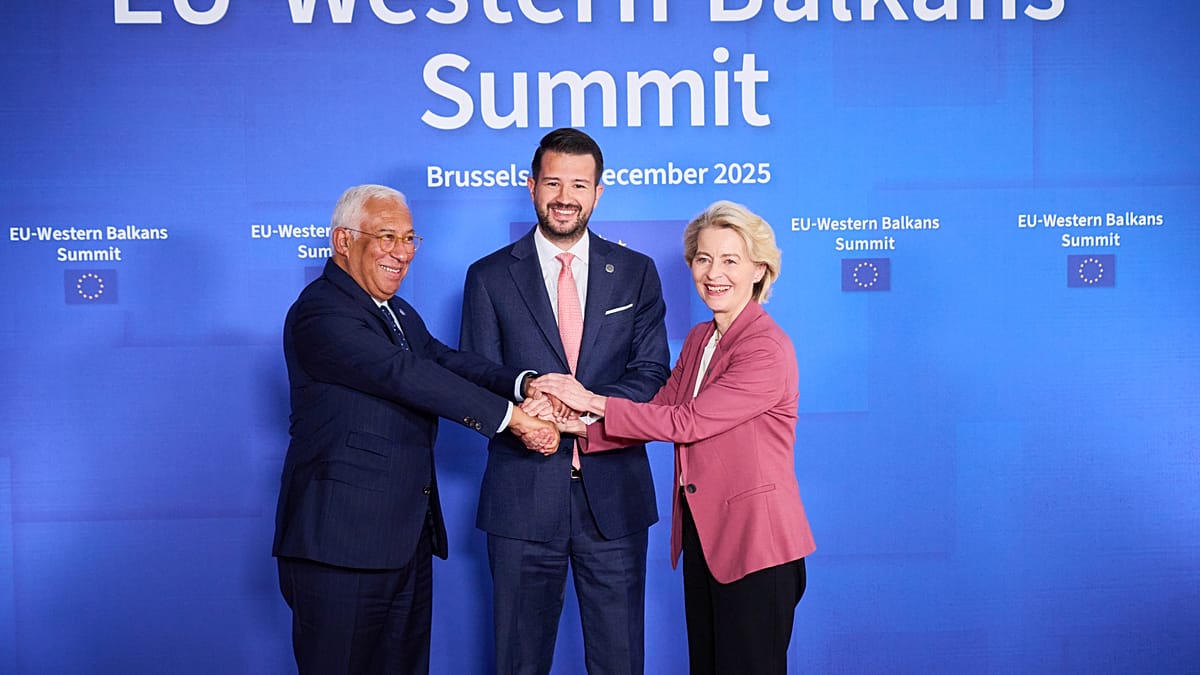
The Balkan waiting room. Before EU leaders get stuck into what promises to be a fractious European Council tomorrow and Friday, they have another summit in Brussels today, with their counterparts from the Western Balkans. Expect plenty of warm words about Europe’s shared destiny, but rather more awkward conversations about how to get there, Luca Bertuzzireports. ADVERTISEMENT ADVERTISEMENT The empty chair. Serbia, the region’s biggest country, will be conspicuous by its absence. The student movement that swept Aleksandar Vučić from power in last month’s parliamentary elections is still scrambling to form a government. The newly elected parliamentary speaker and acting president, Aleksandar Čupić, was invited but has urgent parliamentary business to attend to. Belgrade is not expected to endorse the summit declaration either. Its absence conveniently spares Serbia’s incoming leadership from taking a position on some thorny issues, notably aligning with EU foreign policy on Russia and normalising relations with Kosovo. The latter remains particularly sensitive, as the diplomatic kerfuffle over a Serbian nationalist song played at the European Commission’s enlargement conference last week demonstrated. We’ll be speaking to former Kosovo President Vjosa Osmani on Europe Today this morning. Montenegro’s moment? At the other end of the enlargement spectrum, Montenegro is tantalisingly close to the finish line, with Brussels aiming to have its accession treaty ready for signature by June. But two obstacles loom. The first is Croatia, the EU’s newest member, which is ratcheting up pressure on its prospective successor to settle a longstanding border dispute. Italy has pushed back, insisting that enlargement should be based on candidates’ own merits rather than bilateral grievances. The second is the proposed ten-year probation period for newcomers, with voting rights potentially suspended for serious rule-of-law breaches. Brussels wants to avoid another Viktor Orbán experience; Podgorica wants assurances it won’t become a second-class member. Montenegro's President Jakov Milatović is also our guest on Europe Today. Money talks. Beyond the accession politics, today’s summit will focus on economic integration and security cooperation. Announcements on payments to Albania, Montenegro and North Macedonia from the EU’s €6 billion regional Growth Plan are expected shortly. Plans to extend the EU’s roaming-free mobile phone regime to the region are also advancing. As we saw at our own Euronews Enlargement Summit earlier this month, the prospect of a bigger EU is more tangible than it has been in years. But with French presidential elections looming next spring, the political window for enlargement may not stay open indefinitely. Something rotten in the state of Denmark? Danish Prime Minister Mette Frederiksen’s hardline approach to migration is setting the cat among the pigeons in her European political family, with Socialist MEPs gearing up for a showdown over her increasingly controversial rhetoric. The latest flashpoint was a Danish podcast last week in which Frederiksen declared her opposition to a “great replacement of the population”, language critics say echoes the far-right conspiracy theory. She also spoke of Denmark’s “original tribe, which is ethnically Danish” and the need to preserve a strong majority culture. “This podcast was a disaster,” one S&D MEP told Vincenzo Genovese. Portuguese and German MEPs voiced their objections at a stormy group meeting in Strasbourg on Monday, prompting S&D chief Iratxe García Pérez to promise a formal debate. How far is too far? Frederiksen has long been an awkward fit for Europe’s centre-left. Her restrictive migration policies have gone hand in hand with the electoral decline of Denmark’s once-powerful far right. But her latest initiative – teaming up with Austria, Germany, Greece and the Netherlands to establish a migrant return hub in Rwanda – directly contradicts the S&D’s opposition to such facilities. “For now, no one is taking her side,” a senior Socialist lawmaker told Euronews. No disciplinary action is expected, and any sanctions would be a matter for the wider Party of European Socialists. But the impending showdown exposes a deeper dilemma for Europe’s centre-left: how far can Social Democrats accommodate demands for tougher migration policies without compromising their own principles? In other news Holding the centre. The European Parliament’s centrist chiefs – Manfred Weber, Iratxe García Pérez and Valérie Hayer – met in Strasbourg to hammer out a coalition agreement for the second half of the parliamentary term. Crucially, the deal is not expected to prevent Weber’s EPP from voting with the far right, a major bone of contention. Renew Europe is making the agreement a condition for backing Roberta Metsola’s re-election as Parliament president. Not a single molecule. EU Energy Commissioner Dan Jørgensen told Euronews’ On the Record that Europe will never return to Russian energy, whatever Washington and Moscow agree. Even if peace brings an end to sanctions, the EU’s gas import ban will remain. Meanwhile, he warns consumers to brace for a difficult winter. COP out? Brussels is drawing up plans to overhaul UN climate summits after the COP31 fiasco in Antalya. The Commission wants more transparency, streamlined negotiations and an end to a system where one country can block nearly 200 others. Meanwhile, smaller coalitions of willing countries could drive the fossil fuel transition. Asylum ruling. The European Court of Human Rights (ECHR) ruled on Tuesday that Poland and Latvia exposed to inhuman or degrading treatment individuals who have tried to enter their territory from Belarus in 2021. The ruling could set a precedent for similar cases of state-sponsored pressure, such as the mass arrival of irregular migrants in Ceuta from Morocco last July. Space invaders. NATO chief Mark Rutte has vowed to defend allies against threats in space following German media reports that Russia could launch a nuclear-armed satellite within weeks. Moscow denies the allegations. Such a weapon could devastate satellite networks underpinning global communications and navigation, violating the 1967 Outer Space Treaty. Lessons unlearnt. Twenty years after Alexander Litvinenko’s murder in London, his widow Marina told Euronews that the West’s feeble response emboldened Vladimir Putin, paving the way for Russia’s war in Ukraine. She warns Europe against negotiating from a position of weakness and insists justice ultimately requires putting Putin’s regime on trial. Putting the brakes on Beijing. The European Commission has capped Chinese hybrid car imports at 191,780 vehicles between December and June, in a bid to protect struggling European carmakers. The provisional quotas, which also cover other major exporters including Japan, Turkey and Britain, follow an EU-China trade agreement in October. Longer-term restrictions are in the pipeline as Brussels seeks to rein in its whopping €360 billion trade deficit with Beijing. Quantum leap. Determined not to repeat the mistakes of the AI race, Brussels unveils its Quantum Act today, aiming to make Europe a global powerhouse in the technology by 2030. The plans favour European companies in public procurement. But there’s a security imperative too: quantum computers could render existing encryption obsolete, leaving everything from banking to government communications exposed. The devil in the detail. Pope Francis’ private diaries, published yesterday, reveal that the late pontiff believed he had encountered the devil three times, including once while leading the Catholic Church. “He looked at me with eyes of fire,” he wrote. The notes also reveal that Francis wrestled with the temptations of power and wanted to allow married men to become priests but backed away for fear of a Vatican backlash. Austen Ivereigh, an Oxford Fellow in Contemporary Church History and biographer of Francis, is on Europe Today this morning to talk about it. We’re also keeping an eye on Europe Today features interviews with Montenegro President Jakov Milatović, Irish Renew MEP Barry Andrews, Austrian Socialists & Democrats (S&D) MEP Andreas Schieder, Danish S&D MEP Niels Fuglsang, ECFR senior policy fellow Szymon Kardaś and Pope Francis’ biographer Austen Ivereigh. Informal meeting of EU housing ministers, Dublin European Parliament plenary session in Strasbourg. Includes a debate with European Commission President Ursula von der Leyen on Europe’s role in protecting the international order and securing peace for Ukraine. That's it for today. Vincenzo Genovese and Luca Bertuzzi contributed to this newsletter.
Balkan to the future: The long and winding road to Brussels
Full Article
Original Source
Read the full article at Euronews →KhanList aggregates and links to publicly available news content. We do not host full articles from third-party sources. Always verify important information with original sources.