
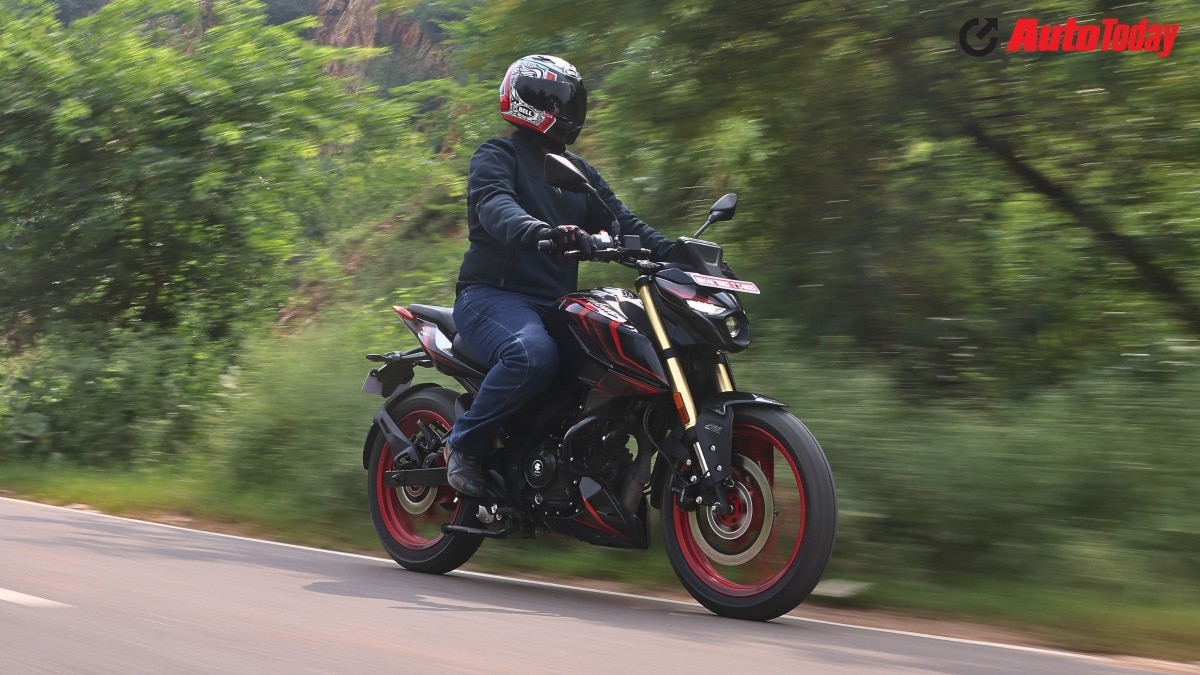
Bajaj has given the Pulsar N160 more power, sharper responses and a serious technology boost. But does the SS have what it takes to unsettle the Apache?Bajaj Pulsar N160 SS reviewThe Bajaj Pulsar N160 has always been the sensible Pulsar. It sits between the old-school appeal of the Classic range and the enthusiast-focused NS family, offering a combination of performance, practicality and technology without going too far in either direction. That formula has worked well for Bajaj, with the N160 crossing seven lakh sales globally and continuing to evolve with updates to its equipment and chassis. The N160 SS is more than a cosmetic update with a new colour and a few added features; it gives the motorcycle a more substantial new identity. Now, Bajaj has gone a step further with the N160 SS. This isn’t one of those updates where a new colour and a few features are used to give an existing motorcycle a new identity. The biggest change is the engine, but the SS also brings an electronic throttle body, ride modes, traction control, revised gearing, a larger USD fork, new tyres, altered ergonomics and a much more sophisticated instrument cluster. In other words, there is a reason this motorcycle exists.What exactly has changed? The new 164.5cc oil-cooled engine on the N160 SS makes 18.5bhp at 9,500rpm and 14.4Nm at 8,000rpm. The N160 2V uses a 164.9cc air-cooled engine, but the SS gets four valves instead of two. The aforementioned motor made 16bhp@8,750rpm and 14.65Nm@6,750rpm. The new 164.5cc, single-cylinder, oil-cooled engine unit produces 18.5bhp@9,500rpm and 14.4Nm@8,000rpm. The four-valve motor also gets an oversquare 63.5 x 52mm bore and stroke, compared with the undersquare configuration of the two-valve engine. That change in architecture is important because it tells you what Bajaj was trying to achieve. A larger bore and shorter stroke generally allow an engine to operate more comfortably at higher rpm, and that is exactly what the N160 SS wants you to do. It is a more power-oriented engine than the relaxed two-valve motor it replaces at the top of the range. The valve train has also been upgraded, with larger valves allowing greater airflow. Bajaj has reworked the thermal management too, adding an improved oil cooler, a new scoop to direct air over the cylinder head and an optimised jet lubrication system. The engine is designed to spin to nearly 11,000rpm. The gearing has been revised as well. Bajaj’s data shows the N160 SS has greater tractive effort at the wheel than the Apache RTR 160 4V, while the crawl function allows the motorcycle to maintain sufficient torque at very low speeds. In practical terms, it reduces the need for constant clutch and gear inputs when negotiating slow-moving traffic or tight situations.The biggest technological change is the move to an electronic throttle body. This enables four riding modes: Road, Rain, Off-Road and Sport. These aren’t simply different dashboard settings. Bajaj says the electronic throttle and traction control allow the motorcycle to offer different throttle responses and power-torque characteristics depending on the selected mode. There’s also a fifth ‘Tour’ mode which has a slightly different layout on the dash. There is also traction control, which can be switched off, while the dual-channel ABS remains permanently active. That distinction is worth knowing because the N160 SS gives you some freedom to play with the rear wheel, but not at the expense of the safety net provided by ABS. Also, the SS gets a radial rear tyre, but the size remains the same as the 2V configuration. The five-inch TFT is another key upgrade, signalling the N160 SS’s shift towards a more tech-focused package. Another big and welcome change is the addition of the five-inch TFT, which is probably the most visible sign that the N160 SS is moving into a more tech-heavy space. It brings Bluetooth and Wi-Fi connectivity, phone mirroring, music controls, document storage and Google Maps mirroring to the Pulsar. The last one is the feature that genuinely matters on a motorcycle like this. Instead of relying only on basic turn-by-turn navigation, the screen can mirror Google Maps from a connected phone, putting the familiar navigation interface directly in the rider’s line of sight. What I like about the TFT is that it isn’t there merely to make the N160 SS look more expensive; there is a reasonable amount of functionality behind it. It also gives the SS a clear advantage over the N160 S, which gets a five-inch colour LCD, while the SS gets the full TFT treatment.The interesting part is that Bajaj hasn’t simply replaced the two-valve N160 with the four-valve motorcycle. The range now gives buyers a choice. The 2V engine continues in three variants: the base single-channel version, a higher-spec single-channel version and a dual-channel version. The 4V engine is offered in two versions, the N160 S and the top-spec N160 SS. The updated prices stand at Rs 1.22 lakh, Rs 1.25 lakh and Rs 1.32 lakh for the three 2V variants, while the 4V S costs Rs 1.34 lakh and the SS costs Rs 1.43 lakh (all prices ex-showroom). The N160 S gets the four-valve engine, single-channel ABS, 37mm USD fork and four ride modes, while the SS adds the dual-channel ABS, traction control, adjustable levers, TFT display, Bluetooth and Wi-Fi connectivity and Google Maps functionality. The SS also gets the larger 300mm front disc and 230mm rear disc. The motorcycle keeps its compact, muscular stance along with the projector LED headlamp. Visually, Bajaj hasn’t radically altered the N160 because the basic shape still works. The motorcycle retains its compact, muscular proportions and the projector LED headlamp, but the SS gets a new graphics package and three new colourways. There are sharper lines, red wheel accents and carbon-fibre-inspired detailing. The SS gets new graphics, three colours, sharper lines, red wheel accents and carbon-fibre-inspired detailing. Personally, I’m not a huge fan of the added graphics or coloured alloy wheels. I think the underlying design is clean enough to stand on its own. But I understand why Bajaj has gone down this route. The N160 SS is now directly taking the fight to the TVS Apache RTR 160 4V, and that motorcycle has always had a more overtly sporty visual identity. The riding position has also been altered. The handlebar is 39mm higher and 19mm further back, while its angle has been revised. The new seat profile aims to improve long-ride comfort. We found the riding position comfortable, though the seat itself felt less forgiving over longer stints. The seat profile is new too. On paper, this should make the N160 more comfortable and less demanding during longer rides. In reality, I found the revised riding position comfortable enough, but the seat itself wasn’t particularly kind to me over a long stint. While Bajaj has clearly worked on ergonomics, this isn’t automatically a motorcycle I’d choose for marathon saddle time. Since we’re on the topic, let's talk about the experience in the hot seat, which isn’t just a metaphor. On the day of shooting the N160 SS, temperatures crawled past 42 degrees.How does it ride? The N160 SS feels light and nimble despite its 151kg kerb weight, with easy steering, predictable handling and a compact feel that makes it effortless to place on the road. The N160 SS feels light and nimble from the moment you get moving. Despite weighing 151kg, it changes direction easily and feels compact underneath you. The steering is friendly, the chassis is predictable, and the motorcycle doesn’t require much effort to place on the road. Also, the chassis has been optimised by Bajaj, and the swingarm itself has been made specifically for the 160, rather than borrowing one from the N250, like earlier. At 100kmph, it feels planted. The 37mm USD fork and wider rear tyre add stability, making highway cruising more confidence-inspiring. There is enough stability to make highway cruising reassuring, and the 37mm USD fork and revised rear tyre certainly contribute to that confidence. But there is a catch. The engine feels strained at that speed. This is where the character of the new four-valve motor becomes obvious. The oversquare configuration has helped Bajaj chase more power and a stronger top end, but it also means you need to use the rev range to get the best from it. The N160 SS needs a few revs to come alive, but wring the throttle and its character quickly shines through. The N160 SS isn’t the kind of motorcycle that feels effortless when you’re simply sitting in a tall gear and expecting the engine to do everything. You need to wring the throttle. And when you do, the motorcycle comes alive. The 18.5bhp arrives at 9,500rpm, and the engine continues pulling strongly towards its 10,900rpm peak. The older 2V made its 16bhp at a much lower 8,750rpm, so the SS clearly has a more top-end-oriented character. Bajaj’s claimed 0-60kmph time drops from 5.0 seconds for the N160 2V to 4.5 seconds for the SS, while claimed top speed rises from 112.7kmph to 114kmph. The downside is that vibrations begin to creep in from around 8,000rpm. That isn’t necessarily a problem when you’re enjoying the engine’s upper reaches, but it does become noticeable when you’re holding higher revs for an extended period. The electronic throttle transforms the ride, with Road as standard, Sport sharpening responses, Rain softening them and Off-Road adapting for loose surfaces. The engine itself is still relatively refined, though. Bajaj has reduced reciprocating mass to improve NVH, and the Pulsar’s characteristic exhaust note has become more pronounced. The electronic throttle is perhaps the biggest difference in the way the motorcycle can be ridden. Road is the natural default, while Sport sharpens responses. Rain makes things more measured, and Off-Road changes the motorcycle’s behaviour for loose surfaces. The traction control adds another layer of reassurance and can be switched off when you want more freedom. The crawl function is another feature that doesn’t sound particularly exciting until you use it. In slow traffic, the motorcycle can maintain enough torque at low speeds to reduce the amount of clutch slipping and gear changing required and speaking of which, this is one of the best clutch and gearbox combinations I’ve seen in some time. The clutch is butter smooth and going through the transmissions feels effortless. For a motorcycle that will spend plenty of time in cities, that’s genuinely useful. Fuel economy, inevitably, is part of this equation. Bajaj’s supplied figures put the N160 SS at 44kmpl, compared with 47kmpl for the older N160 2V. The Apache RTR 160 4V is listed at 43kmpl. So, you are giving up some efficiency compared with the 2V, but the SS remains marginally ahead of its key rival on the supplied figures. And that’s probably the most important thing about the N160 SS. It hasn’t abandoned the practical brief of the N160 in the pursuit of performance, which is a definite plus in its favour.Verdict The N160 SS packs more power and features at a competitive price, but vibrations and long-ride comfort hurt it. Still, its nimble, planted character makes the Apache rivalry interesting. The Pulsar N160 SS is an interesting proposition: Yes, it is more powerful than the Apache on paper and packed to the gills with features and is about the same in terms of pricing. But it isn’t perfect, with high-rpm vibrations, a strained feel at 100kmph and a seat that isn’t ideal for long stints. But it is nimble, planted and genuinely engaging when ridden hard. The N160 SS has arrived with a clear target, and it seems to be well prepared for a fight. It’s game on, and this is a battle that will ultimately be settled on the sales charts. Interestingly, even in 2026, the Apache and Pulsar are still fighting it out!Subscribe to Auto Today Magazine - EndsPublished On: Aug 17, 2026 10:10 IST
Bajaj Pulsar N160 SS review, first ride: Can it take the fight to the TVS Apache?
Full Article
Original Source
Read the full article at Indiatoday →KhanList aggregates and links to publicly available news content. We do not host full articles from third-party sources. Always verify important information with original sources.