
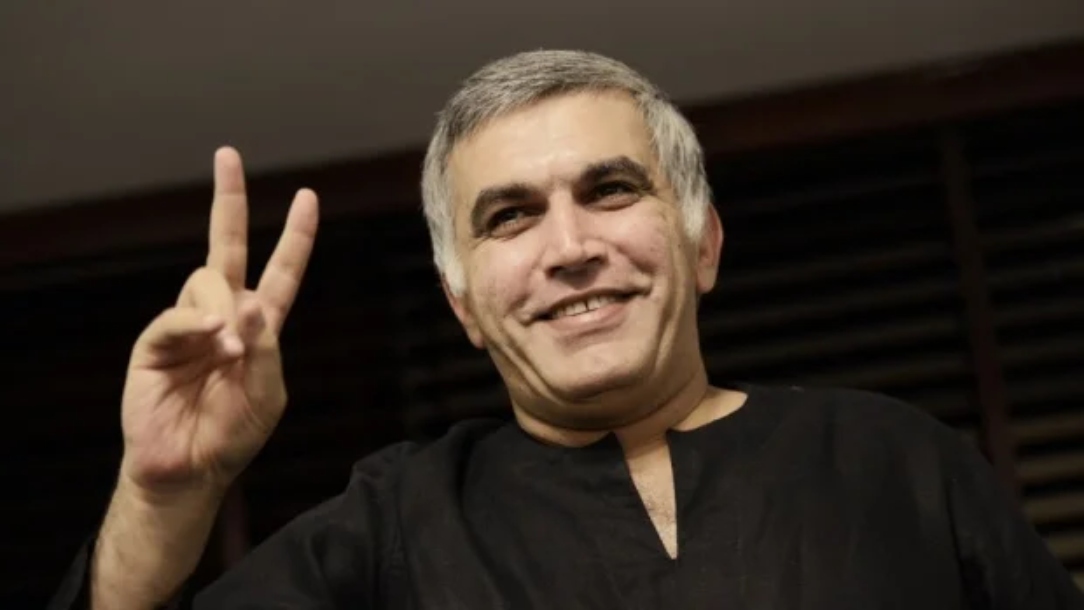
Bahraini human rights activist Nabeel Rajab died on Tuesday in Turkey at the age of 62. Fellow campaigners said he died after suffering a heart attack. Ebrahim Sharif, an activist who was a close friend of the family, told the Associated Press that Rajab’s wife and daughter found him unresponsive early in the morning at their home in Turkey. Reflecting on the activist's life, Sayed Ahmed al-Wadaei, advocacy director at the London-based Bahrain Institute for Rights and Democracy, described him as a "beautiful soul" who was "as noble as his name [Nabeel]". "Nabeel defended our rights with dignity and paid a heavy personal price, as did his family, for standing up for the rights of his people," Wadaei wrote on X. "He suffered imprisonment and abuse by the state for exposing human rights violations. He left Bahrain after witnessing the body of Sayed Mohamed Almousawi, who was murdered under torture." New MEE newsletter: Jerusalem Dispatch Sign up to get the latest insights and analysis on Israel-Palestine, alongside Turkey Unpacked and other MEE newsletters Rajab left Bahrain early in the Iran war and fled to Turkey after fearing he would be imprisoned again by Bahrain for releasing a statement accusing the government of the death of Almousawi, a former political prisoner. Rajab, who became one of the most recognisable figures of the country’s pro-democracy movement, spent much of his adult life challenging the authorities over political repression, torture and restrictions on freedom of expression. Nabeel Rajab: A true patriot's journey Read More » As president of the Bahrain Centre for Human Rights (BCHR), Rajab helped bring international attention to abuses in the Gulf kingdom, documenting violations and campaigning for the release of political prisoners. His activism made him a frequent target of the Bahraini authorities, who repeatedly arrested and prosecuted him over his participation in demonstrations and his criticism of the government. He was released from prison in 2020 while serving a five year prison term for his activism into a non-custodial sentence. Rajab was among the most prominent activists to emerge from the 2011 uprising in Bahrain, when thousands of demonstrators took to the streets demanding political reform, greater accountability and an end to discrimination. His campaigning extended beyond Bahrain’s borders, with Rajab criticising western governments and regional allies for supporting the Bahraini authorities. In 2015, Rajab spoke to Middle East Eye after coming out of prison, and said the tide was slowly changing with internationational partners acknowledging that "Bahrain is a dictatorship that marginalises and discriminates against its indigenous population". "Before, nobody talked about Bahrain, but today [in 2015] 47 Western countries are criticising Bahrain's human rights record, and today you see awareness among people, among media, which never existed," he said. From rights campaigning to the streets Born in Bahrain on 1 September 1964, Rajab studied political science and history at the University of Pune in India and graduated in 1987. He became involved in human rights activism during the 1990s, a period of political unrest in Bahrain, and later helped establish several civil society organisations. Among them was the Bahrain Centre for Human Rights, founded in 2002, which documented allegations of torture, arbitrary detention and restrictions on civil liberties. The Bahraini authorities dissolved the organisation in 2004, but it continued its work despite the ban. Rajab later became its president and helped establish the Gulf Centre for Human Rights, expanding his work to document abuses across the region. His activism covered a wide range of issues, including the treatment of migrant workers, political prisoners, freedom of speech and the rights of people detained by the United States at Guantanamo Bay. He grew more prominent as social media enabled activists to communicate directly with international audiences. The 2011 uprising Rajab emerged as a leading figure during Bahrain’s 2011 pro-democracy uprising, which began in February that year as protests swept across the Arab world. Demonstrators gathered at the Pearl Roundabout in the capital, Manama, demanding political reforms and an end to discrimination and repression. Rights groups condemn Bahrain's largest mass trial of Shia clerics in history Read More » The authorities responded with a violent crackdown. In March 2011, troops from Saudi Arabia and the United Arab Emirates entered Bahrain as part of a Gulf Cooperation Council deployment, helping the government suppress the protests. Rajab documented the crackdown and became a prominent voice in the international campaign to hold the Bahraini authorities accountable. He criticised the arrests of opposition figures, the treatment of detainees and the use of force against demonstrators. His work also put him at odds with Bahrain’s regional allies, particularly Saudi Arabia, whose military intervention he opposed. The authorities increasingly targeted Rajab through arrests, prosecutions and travel restrictions. In May 2012, he was detained for criticising the interior ministry for failing to investigate attacks by pro-government armed gangs against Shia residents. He was subsequently convicted of insulting a public institution. In August that year, he received a three-year prison sentence for his involvement in protests and demonstrations. The sentence was later reduced to two years on appeal. His detention drew international condemnation, with human rights organisations arguing that he was being punished for exercising his rights to freedom of expression and peaceful assembly. After his release in May 2014, Rajab continued to criticise the government. He was arrested again in October that year over social media posts criticising the interior and defence ministries. He was later released on medical grounds in July 2015, but remained subject to restrictions on his freedom of movement. In June 2016, he was arrested once more, this time over comments about Bahrain’s participation in the Saudi-led military campaign in Yemen and allegations of torture inside Jaw Prison. In February 2018, a Bahraini court sentenced him to five years in prison for what prosecutors described as spreading false news and insulting state institutions. The case drew widespread criticism from international human rights groups and United Nations experts. During his imprisonment, concerns were repeatedly raised about Rajab's health and treatment, especially prolonged solitary confinement and poor prison conditions. Human Rights Watch reported that he was held in a cramped and unhygienic cell for extended periods. He was released in 2020.
Bahraini activist Nabeel Rajab dies in Turkey
Full Article
Original Source
Read the full article at Middleeasteye →KhanList aggregates and links to publicly available news content. We do not host full articles from third-party sources. Always verify important information with original sources.