
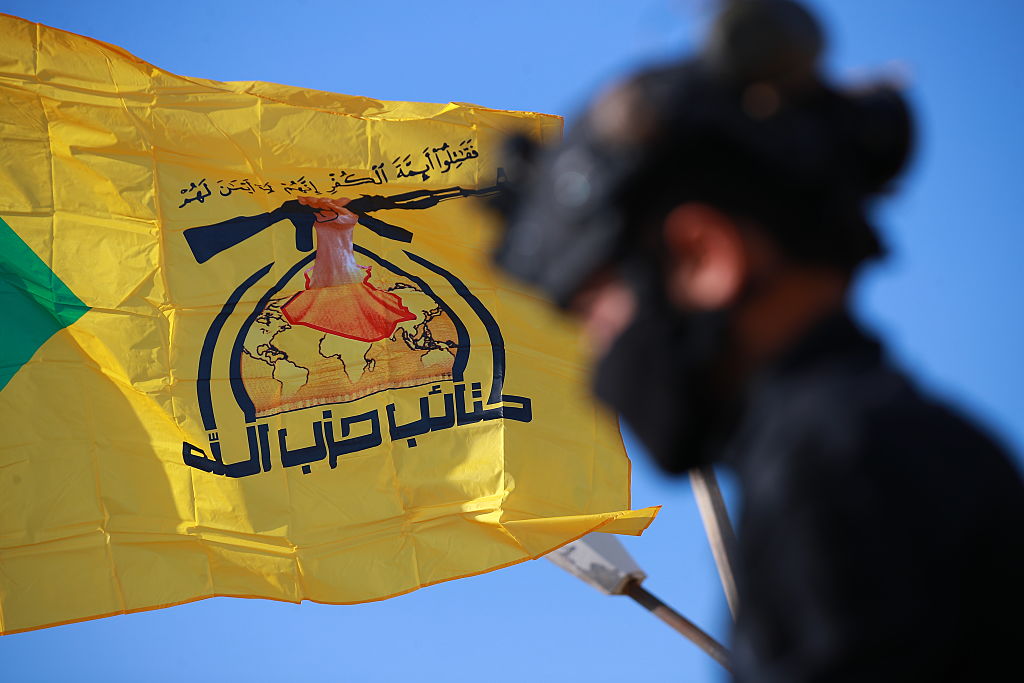
The Iraqi government is entering a militia stronghold for the first time in more than a decade. On November 20, Iraqi security forces entered Jurf al-Sakhar, a subdistrict less than 40 miles southwest of Baghdad that has been outside state control for well over a decade. The Iran-backed, U.S.-designated Foreign Terrorist Organization Kataib Hezbollah has controlled the area since it helped liberate it from Islamic State control in 2014. Iraqi Prime Minister Ali al-Zaidi instructed Kataib Hezbollah to withdraw from Jurf al-Sakhar after a report released on November 9 disclosed that an oil theft scheme in the area has generated hundreds of millions of dollars for the group since at least 2021. Kataib Hezbollah initially rejected calls to withdraw from its stronghold, but the group, Shiite leaders in Iraq, and Esmail Qaani, the commander of Iran’s Islamic Revolutionary Guard Corps-Quds Force, reached an agreement for the deployment of government forces to the area. However, the agreement reportedly gives Kataib Hezbollah a month to withdraw and leaves some security in the hands of the Popular Mobilization Forces (PMF), an Iraqi security organization dominated by Iran-backed militias. Zaidi’s attempt to restore state sovereignty over Jurf al-Sakhar is the first major confrontation between Zaidi and the militias resisting disarmament, but Kataib Hezbollah’s ability to dictate terms to the state shows that Baghdad doesn’t have a clear upper hand. Iraqi Government Has Failed To Control Jurf al-Sakhar for More Than a Decade Jurf al-Sakhar is a historically Sunni area in a strategic location between Baghdad, the route to the Shiite holy cities of Najaf and Karbala, and the western province of Anbar, a Sunni stronghold. Around 120,000 of the area’s predominantly Sunni residents were displaced when ISIS captured it in 2014 and during the offensive to remove the group. Since the Shiite militia Kataib Hezbollah consolidated control of the area, it has prevented the return of many residents, with Iraq’s Ministry of Migration and Displacement estimating that 6,000 families were still displaced in 2024. The group has also used its control of the territory for criminal activity and reportedly maintained illegal detention facilities in the area. Elizabeth Tsurkov, an Israeli-Russian researcher kidnapped by the group, said that she was held there for four and a half months until her release in September 2025. Kataib Hezbollah also turned Jurf al-Sakhar into a key weapons production and storage hub. The United States has previously struck pro-Iran terror cells in Jurf al-Sakhar that have launched attacks on U.S. forces, including during the ongoing conflict with Iran. Plan for Exerting State Control Provides a Back Door for Kataib Hezbollah Zaidi established a military command for Jurf al-Sakhar that includes a brigade from the Iraqi Army, a brigade from the Federal Police, and a regiment from the energy police alongside two brigades from the PMF. Kataib Hezbollah controls the 45th, 46th, and 47th brigades of the PMF, and the PMF’s chief of staff, Abdul Aziz al-Muhammadawi, is also a senior commander for Kataib Hezbollah and a U.S.-designated terrorist. Kataib Hezbollah also retains influence over some brigades outside its direct control, including the 72nd Brigade, which is part of the new command alongside the 79th Brigade. The 72nd Brigade has operated in the region alongside Kataib Hezbollah. Washington has made clear to Baghdad that addressing Iran-backed militias is a requirement for ongoing financial support for Iraqi security forces. Washington should consider Baghdad’s ability to exert control over the entirety of Iraq’s territory in any evaluation of the Iraqi government’s commitment and ability to decrease militia power. The Trump administration should verify — independently and in coordination with the Iraqi government — that the entirety of Jurf al-Sakhar is secured by Iraqi government forces and that all illicit financial and military activity in the area ceases. Furthermore, the PMF should not play an ongoing role in securing Jurf al-Sakhar. While the inclusion of the PMF was likely a requirement from Kataib Hezbollah for the transfer of control, the PMF’s role in the command center should be transferred to other Iraqi security forces after the group removes itself from the area. Bridget Toomey is a research analyst at the Foundation for Defense of Democracies (FDD). For more analysis from Bridget and FDD, please subscribe HERE. Follow FDD on X @FDD. Follow Bridget on X @BridgetKToomey. FDD is a Washington, DC-based, nonpartisan research institute focusing on national security and foreign policy.
Baghdad and Iran-Backed Militias Narrowly Avoid Conflict Over Militia-Held Territory
Full Article
Original Source
Read the full article at Fdd →KhanList aggregates and links to publicly available news content. We do not host full articles from third-party sources. Always verify important information with original sources.