
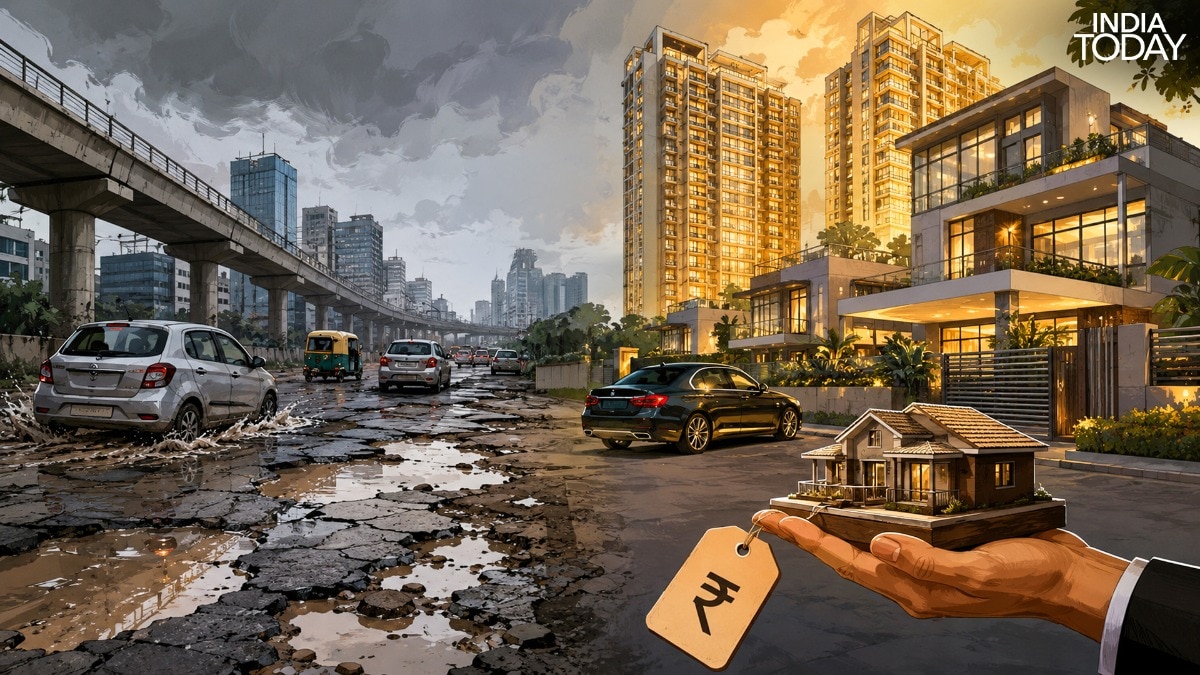
Gurgaon has its share of potholes, traffic and drainage woes. Yet, luxury homes continue to command prices running into hundreds of crores. So, what is driving this property boom?You could spend an hour stuck in Gurgaon traffic, drive over a road full of potholes and then worry about waterlogging when it rains. But when it comes to buying a home, none of that seems to be stopping people from paying record prices.Take the latest headline-grabbing deal. Entrepreneur Manav Sardana has bought a penthouse at DLF's The Dahlias in Gurugram for Rs 271 crore. And this is not a one-off deal. In October 2025, a Delhi-NCR-based industrialist bought four apartments at the same project for nearly Rs 380 crore. Together, the residences covered more than 35,000 sq ft.The Dahlias is not the first project to put DLF5 on India's luxury housing map. DLF's The Camellias has already established the area as a preferred address for CEOs and high-net-worth individuals, including Shark Tank India personalities Aman Gupta, Ashneer Grover and Peyush Bansal,So, what explains this apparent contradiction? How can a city struggling with traffic jams, poor roads and drainage issues continue to see homes and apartments sell for hundreds of crores? The answer, experts say, lies in what Gurgaon offers beyond its roads and civic infrastructure: jobs, businesses, connectivity, limited land and access to some of the most important parts of Delhi-NCR.PROPERTY PRICES ARE RISING DESPITE THE POTHOLESGurgaon's property boom is not just about people buying bigger homes. The city has become one of India's biggest corporate and employment hubs, and that economic activity has created sustained demand for housing. The rise in prices is also visible in the broader market. According to an ANAROCK report, among the 11 cities analysed, Noida and Gurugram led capital appreciation, with prices rising 125% and 117%, respectively. Rental yields in the two cities also rose by 70 basis points and 80 basis points, respectively.That suggests the price rise is not being driven only by ultra-luxury transactions. Gurgaon's broader residential market has also seen strong appreciation.Mohit Gawri, Vice President of Sales at Rise Infraventures Limited, said the city's property values are being driven by factors beyond the immediate quality of housing.“Gurugram’s property values are being shaped by much more than the immediate supply of homes. The city’s USP as a major corporate and employment centre, its proximity to the airport, expressways and metro corridors, and the expansion of commercial activity have created a level of demand that is not purely investment-led. The premium, therefore, is often for the location and the access it provides, as much as for the property itself,” he said.HERE LOCATION CAN BE WORTH MORE THAN THE HOUSEFor a buyer at the top end of the market, the price of a home is not simply about the number of bedrooms or the size of the living room.Being close to a corporate hub can mean a shorter commute. Being near the airport can make frequent travel easier. Access to expressways and metro corridors can make it simpler to move across the NCR.That connectivity can command a significant premium, particularly among affluent buyers.“Location and connectivity remain among the strongest drivers of Gurugram’s property premium. Proximity to major corporate and employment hubs, the airport, expressways and metro corridors provides residents with shorter commutes and easier access to key parts of NCR,” Gawri said.Rajjath Goel, Managing Director, MRG Group, also pointed to connectivity as an important part of the premium paid by affluent buyers.“The proximity to employment centers, highways, airports, and the growing metro connectivity provides additional value to the location, especially for the affluent buyers,” he said.This is perhaps the biggest reason why Gurgaon can have two very different realities at the same time. A resident may be frustrated by a bad road outside the neighbourhood, while still valuing the fact that the airport, office district or major highway is within easy reach.THE LUXURY MARKET IS NOT JUST ABOUT SPECULATIONWhen a property sells for Rs 271 crore, it is easy to assume that the buyer is simply betting on prices going even higher.But property experts say there is genuine end-user demand in the luxury segment as well.Gawri said buyers are increasingly looking for homes that match their lifestyle and provide easier access to business centres and the wider NCR.“While there is certainly an expectation of further appreciation in the market, that expectation is being supported by real demand and strong fundamentals. A significant part of the buyer base is looking for a home that befits their lifestyle, shorter commutes, access to business centres and easy access to NCR,” he said.The same trend is visible in the luxury segment, where buyers are increasingly paying for quality, facilities, location and exclusivity.“The luxury category is also seeing true interest from consumers with consumers prioritising more on quality, facilities, location, and value. Though sentiment from investors adds to the bullishness of the market, sustainable pricing will always be reliant on true demand, quality, and fundamentals,” Goel said.This means that while expectations of future appreciation may be supporting prices, experts do not see the entire luxury market as being driven by speculative buying.THE LAND FACTOR: WHY SCARCITY MATTERSThere is another force working in favour of Gurgaon property prices: the limited availability of well-located land.As the city has expanded, finding large parcels of land in established areas with good connectivity has become increasingly difficult. This scarcity becomes particularly important in the premium segment, where buyers want a combination of location, space, privacy and high-end amenities.Goel said property prices are now being determined by a combination of “real demand from consumers, scarcity of land, presence of corporations and infrastructural development”.Gawri also believes the limited availability of well-located land, combined with strong employment and housing demand, can support the premium commanded by established locations.So, while there may be plenty of apartments being built across Gurgaon, that does not necessarily mean there is an unlimited supply of homes in the locations that affluent buyers want.BUT WHAT ABOUT THE ROADS AND DRAINAGE?This is where Gurgaon's property story gets complicated.The city's rapid development has often moved faster than its civic infrastructure. Traffic congestion, poor roads and drainage problems remain everyday concerns for residents.The question is whether these problems could eventually start weighing on property prices.Goel believes they could matter more in the future.“Civic infrastructure will continue to be a key determinant for appreciation in the future. Drainage, road connectivity, and traffic management will add to the value proposition of Gurgaon,” he said.At the same time, he believes the city's structural advantages remain strong.“Nevertheless, employment generation, connectivity, and scarcity of developable land offer structural backing to valuations,” Goel added.Gawri similarly expects infrastructure to evolve as the city grows, but cautioned that not every part of Gurgaon will perform in the same way.“Gurugram’s infrastructure will continue to evolve as the city grows. With strong fundamentals, including employment opportunities, commercial expansion and connectivity, demand for well-located projects is expected to remain sustainable,” he said.However, individual projects and micro-markets could see different levels of price movement depending on their location, connectivity and surrounding infrastructure.IS GURGAON PROPERTY BECOMING OVERVALUED?With apartments changing hands for hundreds of crores, it is natural to ask whether the market has simply become too expensive.Experts say buyers are already becoming more selective.“Prices have moved up considerably, so buyers are becoming more selective about the product, developer and location rather than simply buying because prices are rising,” Gawri said.That could mean the next phase of Gurgaon's property market will be less about simply riding the city's overall price rise and more about identifying projects and locations with strong fundamentals.A correction, however, cannot be ruled out.Goel said a meaningful correction could happen if employment growth slows, demand falls sharply or the market sees very high supply absorption.“Currently, the fundamentals of Gurgaon remain very good for creating long-term value,” he said.TWO GURGAONS, ONE PROPERTY MARKETPerhaps the easiest way to understand Gurgaon's property boom is to think of the city as having two different versions.There is the Gurgaon residents experience every day, i.e., the traffic jams, potholes, waterlogging and drainage problems. Then there is the Gurgaon seen by property buyers, a major corporate hub with high-paying jobs, proximity to the airport, highways and metro connectivity, growing commercial activity and limited availability of well-located land.For now, the second Gurgaon, is proving more powerful in determining property prices.The Rs 271 crore Dahlias penthouse may seem almost disconnected from the everyday reality of Gurgaon. But at the top end of the market, buyers are not paying only for four walls and a view. They are paying for location, access, exclusivity, lifestyle and proximity to the economic engine of the NCR.The city's infrastructure problems remain very real. But as long as jobs, businesses, connectivity and demand continue to grow, Gurgaon appears capable of doing something that may seem counterintuitive: keeping property prices high even when the roads below are anything but premium.- EndsPublished By: Jasmine anandPublished On: Aug 17, 2026 15:45 IST
Bad roads, bumper property prices: What makes Gurgaon homes worth crores?
Full Article
Original Source
Read the full article at Indiatoday →KhanList aggregates and links to publicly available news content. We do not host full articles from third-party sources. Always verify important information with original sources.