
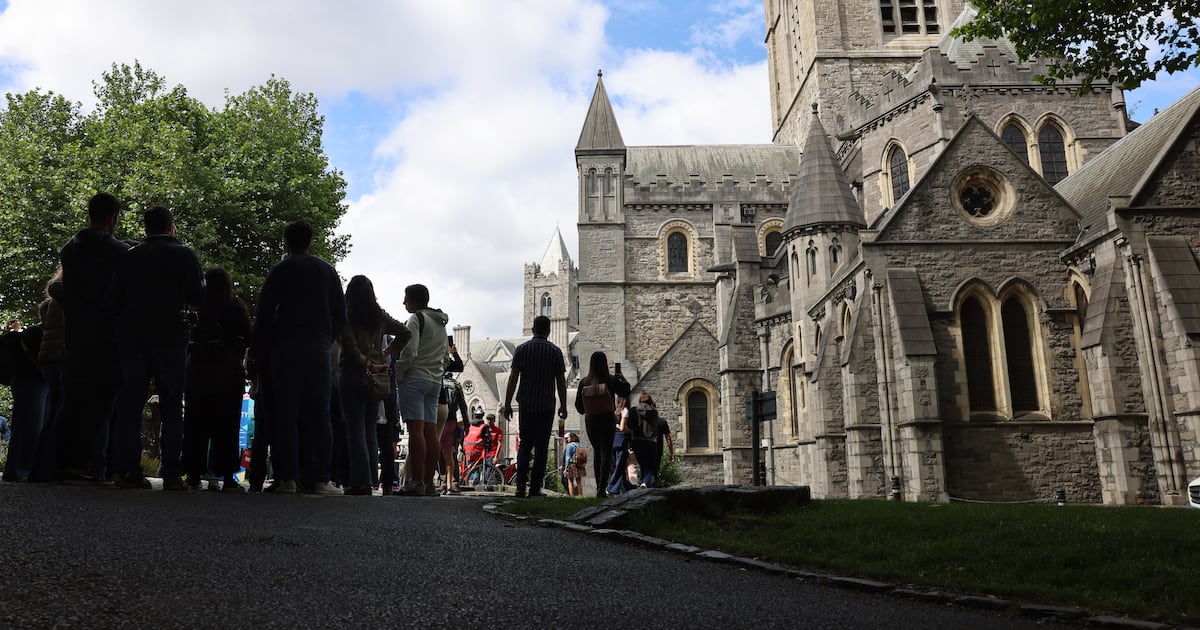
The six million or so tourists visiting Dublin every year can make the streets busy. The situation is a challenge for locals, who find prices high, paths congested and hotels growing out of cracks in the pavement.Until now, you could just stay out of town and things would be all right. But Fáilte Ireland has had an idea. If some of those tourists – or excess future tourists – can be lured out of their traditional Christ Church-to-Trinity heartland in the city centre, then more of their spending can be absorbed into the city’s wider economy.Enter the neighbourhood plan. On offer is a contract for any clever agency that can bring footfall to different areas of Dublin. Fáilte Ireland wants things worked out for up to eight neighbourhoods, followed by a pilot running in three that can point the way for expansion in the future, once stakeholders are placated.“Place-based and neighbourhood-focused tourism development can help disperse visitors and visitor spend, spread the economic benefits of tourism more widely, strengthen local identity, support community participation and contribute to sustainable tourism growth,” says the tender document.READ MOREThis is concerning news for Dublin sophisticates, coming so soon after the cost of a flat white was left unaddressed in Budget 2027. Some of the vibes-ier inner suburbs so beloved of Time Out’s Coolest Neighbourhoods In The World could be at risk – Phibsborough, the Liberties, Stoneybatter, Smithfield and Inchicore among them.There’s not an enormous amount to see in some of these areas – no castles or vellum manuscripts – but they do have pints of Guinness, which is often enough for tourists these days. The shadow of a dreamIs there a youth culture card or is there not a youth culture card? That is the question facing artistic directors considering whether they need to develop a rap version of Hamlet for next year. Jack Chambers, Minister in charge of shooting down kites, seems to think not. “It wasn’t possible to fund and deliver the cultural card for next year,” he told reporters after delivering his culture-card-free budget on Tuesday.This stood in stark contrast to the confidence of headlines mere weeks before. Taking advantage of a strategy favoured by Overheard when it comes to housework, the Fine Gael side appears to be maintaining that just because no progress has been made toward doing it, it doesn’t necessarily mean it’s not being done. [ Why did an Irish Army plane go on a dream family holiday?Opens in new window ]Was the culture card ever real? Sort of. Overheard understands that the dynamic officials of the Department of Culture, Communications and Sport were at one point tasked with getting things moving for delivery early in 2027, researching continental versions, although the pressure may now be off.And the Arts Council, more familiar with surrealist long-durational performance art than most, kept the faith, and still welcomed the card in its post-budget response despite the lack of an announcement. “The Arts Council is supportive of this project and the ongoing development work as part of the Programme for Government,” it told Overheard when asked why, before obliquely adding: “The Arts Council continues to support our colleagues in the Department of Culture, Communications and Sport and wider Government as an adviser on many arts and culture initiatives.”This is little consolation to the 17-year-olds of today, who will be grown and gone long before they get their free sample of the cultural life. Is nothing sacred?It was in Connacht that the war on jazz was fought most fiercely in the 1920s and 1930s. Not one of the major meccas of swing, Mohill, Co Leitrim, nonetheless perceived itself to be in an existential battle for the bodies and souls of its young people as Fr Peter Conefrey, various TDs, newspapers and the Gaelic League tried to beat back the bands. The nation moved past the threat in the end, with jazz declared “not evil” in the Dáil in the 1960 during a debate about whether television was evil. But echoes of the war were heard half an hour down the road this week in Boyle, Co Roscommon. Nathan Carter, who is more country-n-Irish than Count Basie in his musical sensibility, was forced to cancel a Christmas concert in the town over clerical opposition. The hierarchy had the upper hand on this occasion: the gig was scheduled to take place literally inside St Joseph’s church in the town, until it wasn’t. Nathan Carter: more country-n-Irish than Count Basie. What happened? Fr Gerry Hanly PP retired on August 14th. Fr John Gannon, his successor, is apparently more of a traditionalist. Carter’s management said it was “extremely disappointed to get a phone call from Fr John in Boyle” cancelling the concert. But Kevin Doran, Bishop of Elphin, defended the principle of keeping the profane out of the sacred space. “I’ve nothing against concerts, I love music. One of the things I lost out on a little bit by coming west is that I used to love going to the National Concert Hall, but that’s neither here nor there,” he told the symphony-starved listeners of Shannonside FM. But there’s a difference between “hymns and songs that reflect the Christmas story” and “deck the halls”, he said – and the church is for worship. An Post goes electricWith 2,000 electric vehicles in its fleet, it’s fair to say An Post has a high demand for electricity. More vans are reliant now on the charger than the diesel pump after several years of investment – and just in time, given the problems in the Middle East.It also manages more than 200 properties, which fact undoubtedly lit up an efficient modern LED light bulb at headquarters: why not install loads of solar panels? So it is that the mail carrier has moved to harness the power of the sun at “approximately 53” of its locations nationwide.More An Post vans are reliant now on the charger than the diesel pump after several years of investment. Photograph: Bryan O'Brien/The Irish Times This follows a prior wave that took in 30 buildings, beginning in 2020. The roll-out seems promising. An installation at Athlone last year showed “strong generation potential” for both on-site consumption and future export to the grid, An Post’s most recent sustainability report said. As long as the weather holds.
Bad news for Dublin’s coolest neighbourhoods – there’s a plan to bring them tourists
Full Article
Original Source
Read the full article at Irishtimes →KhanList aggregates and links to publicly available news content. We do not host full articles from third-party sources. Always verify important information with original sources.