
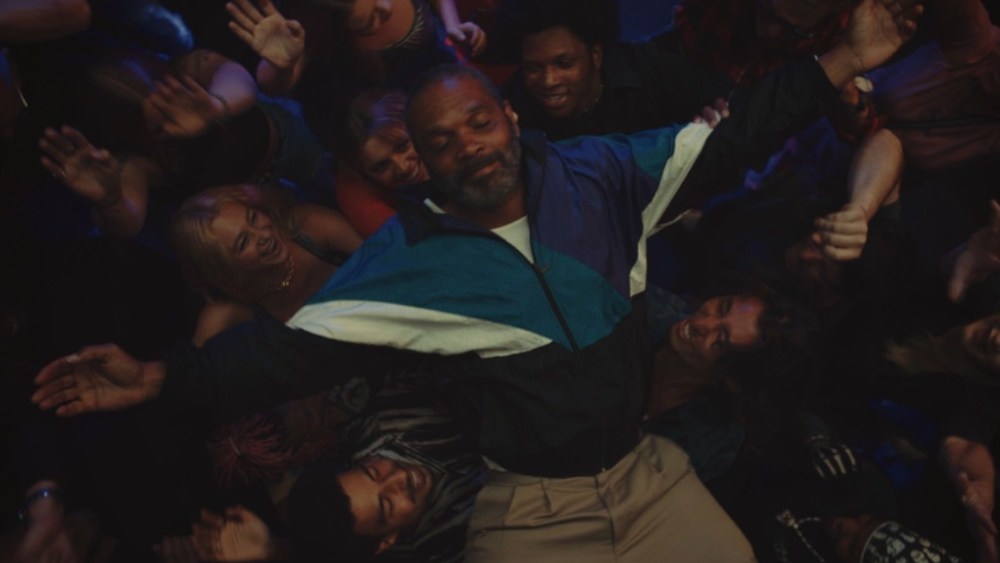
British actor Ray Panthaki – known for “Boiling Point” and “Marcella” – goes personal in directorial debut “In Starland.” Very personal. His first feature is produced by his London-based Le Bateau Lavoir, Archface Films and Killer Films, headed by Christine Vachon and Pamela Koffler, who have just been presented wih Honorary Oscars. Variety announced Killer Films boarding “In Starland” in October. “In Starland” world-premieres at Tallinn Black Nights Film Festival. “I was a young carer and often felt I hadn’t come of age when society tells you that you’re supposed to. I had responsibilities that most people my age didn’t,” Panthaki tells Variety. “That changed when my acting career took off in my early twenties, but I’d carried this thought around: what if someone got to their forties and had never really lived? I found that quite heartbreaking, but also full of possibility.” He adds: “It might never be too late to become the person you were supposed to be.” Ernie (Clarence Maclin) is about to discover this when his quiet, unremarkable life in a small American town is turned upside down by a group of young influencers who force him out of his shell. Panthaki describes his film as a “coming-of-middle-age story.” “I don’t believe that becoming yourself is something reserved for the young. Sometimes it takes half a lifetime to understand what’s been holding you back, and perhaps another half to do something about it.” His characters keep on fighting: for companionship – like Ernie – or for internet fame and glory like some of his new friends. What unites them is loneliness. “It’s something I’ve experienced myself, and I’ve seen people very close to me go through it. Particularly with older people, there’s something about someone having lived this entire life and then finding themselves alone that I find incredibly moving. It wasn’t really a question of whether I’d explore it, but when,” notes Panthaki. He calls loneliness “one of the great contradictions of our time.” “We’ve never been more connected, and yet we seem to be feeling more disconnected than ever.” “I suppose that’s where the film becomes quite spiritual for me. Beneath all the noise, the technology and performance, we’re all just human beings looking for love, acceptance and a sense of belonging. There’s a big difference between being seen and being known. Maybe that’s what the film is really about.” Panthaki has a “huge amount of hope” in the new generation, but also admits they’ve inherited a world where everything is “increasingly measured in numbers.” “The irony is that at one point I tried to play that game myself. We’d spent years trying to finance the film, and I thought: Right. If the industry wants numbers, I’ll give them numbers. I’ll cast ten influencers with a combined following of 250 million people. Except I wasn’t particularly comfortable with it,” he recalls. He changed his mind, ultimately choosing people who were simply right for the part. “No follower counts, no industry heat, no looking at what people had done before,” he says. “As an actor, I know what it feels like to be judged on things that have nothing to do with your ability to do the job. I know what it’s like to lose a job when everyone wants you, but the studio wants a bigger name. There was something quite satisfying to finally be in a position to correct some of the things I’d experienced myself.” “On the first day of rehearsals, I told the cast that we were going to make this film for every single ‘no’ we’d ever had as artists.” For the role of Ernie, Panthaki was looking for someone “who could communicate an entire lifetime without saying very much.” “Clarence has this extraordinary quality where you can just stay on his face and feel the weight of everything that’s happened to him. There’s a tremendous vulnerability there, but also something unpredictable and even dangerous,” he says. “He wasn’t the Ernie I’d imagined when we wrote the script. But there was something in his screen test that I couldn’t ignore – a truth that would be very difficult to manufacture.” It wasn’t easy to get “In Starland” off the ground. “I got to make the film I wanted to make, with the people I wanted to make it with, without having to compromise my beliefs. It’s the hardest thing I’ve ever done, but it feels quite fitting to have spent seven years making a film about a man who’s trying to find his own way in the world.” He doesn’t like to call it an indie, however. “There are films that are considered independent that still have a whole infrastructure of public funding and institutional support behind them. We didn’t have any of that. I’ve embraced the term ‘non-dependent’, which Ted Hope has written about,” he says. “So many things that happened throughout this process that I couldn’t have planned or explained. They only strengthened my belief that this was a story I was meant to tell, and that there was a reason it needed to be told now.” Panthaki also ignored the naysayers also when completing the soundtrack. Obsessed with ’80s hits, he made sure his characters loved them too. “Nothing like disguising your own taste in music as character development! Nostalgia is such a powerful thing. Music can take you back 40 years in a second, and I wanted the audience to feel that. Particularly through Ernie, who’s carrying around a whole lifetime of memories and experiences,” he says. He wrote all the songs into the script. “I knew exactly what I wanted and where I wanted it, but getting them was a different story. ‘Everybody Wants to Rule the World’ is one of the greatest songs ever written. It captured so much of what the film was exploring. Power, control, celebrity, and this very human desire to feel important. I couldn’t imagine opening the film any other way.” He wrote to some of the musicians personally. “We had absolutely no business trying to get [these songs] on our budget, but I’ve always believed in going directly to artists. You’d be surprised how often people want to help when they understand your ‘why’,” he recalls. “I’ve spent seven years being told we couldn’t do things. We couldn’t shoot in America on that budget; we couldn’t make it in 20 days; we couldn’t get those actors; we couldn’t afford that music. And we just kept finding ways.” “There’s very little in this film that we haven’t had to fight for in some way.”
Backed by Honorary Oscar Winner Christine Vachon, Ray Panthaki’s Directorial Debut ‘In Starland’ Marks a ‘Coming-of-Middle-Age Story’
Full Article
Original Source
Read the full article at Variety →KhanList aggregates and links to publicly available news content. We do not host full articles from third-party sources. Always verify important information with original sources.