
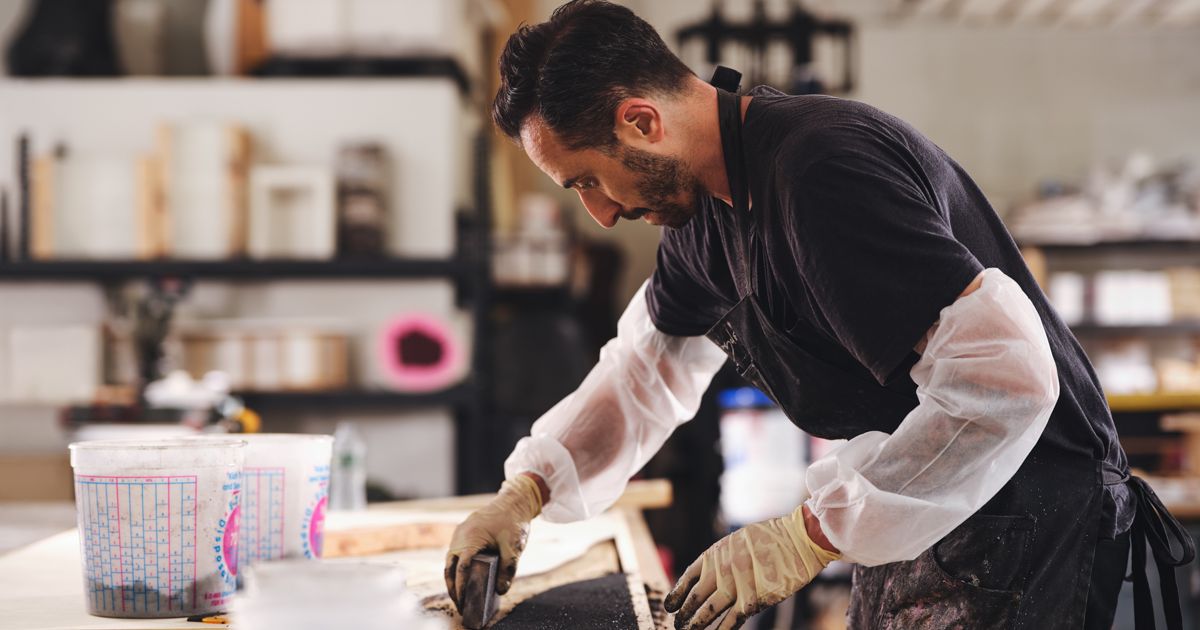
The designer streamlined his 20-person operation to go back to making things by hand. Photo: Joe Kramm Early in his career, Fernando Mastrangelo entered a design scene reeling from the 2008 recession. Newly degreed with a sculpture M.F.A. from Virginia Commonwealth and a formative stint assisting artist Matthew Barney, Mastrangelo was ready to work, but he couldn’t rely on familiar channels for establishing his name. Conventional pipelines for selling and showing design were stagnating, and heritage manufacturer contracts had evaporated. In that vacuum, an entrepreneurial cohort of American designers established new avenues for survival. Scrappy showcases like Sight Unseen OFFSITE and Collective Design Fair gave them direct access to the market. Instagram provided immediate links to interior designers and private collectors. Mastrangelo was among those who championed his own direct-to-collector business. Being able to keep his revenue meant he could expand quickly: from working solo to a 20-person production hub in East New York that turned out nearly 200 works each year. Soon he was making custom spatial installations for Fendi, Stella McCartney, and Audemars Piguet, along with ombré sand cylinders and other designs for top interior firms including Kelly Wearstler and Ingrao. Now, after almost two decades running one of the most formidable self-sustained studios in American collectible design, Mastrangelo is joining the roster of Cristina Grajales Gallery in Tribeca. It’s an about-face of sorts, considering his frequent critique of the traditional artist-gallerist relationship, one often strained by delayed compensation for designers and the pressure to create a predictable, homogenous product. But the choice to reenter the gallery system wasn’t just a personal choice; it underscores a broader change in how studio design is being produced and, perhaps more importantly, sustained. Designers are streamlining and zeroing in on what matters to them. “After ten years of building a direct-to-collector business, I realized I wanted to spend less time managing an industrial infrastructure and more time creating the work,” Mastrangelo says. “Joining Cristina allows me to return to the essence of a craft-led practice.” Starting October 8, the fruits of this labor will be on view in “Territories,” Mastrangelo’s first solo show at Grajales’s gallery. The ensemble of pieces in the exhibit — a suite of sculptural tables, seating, and wall reliefs in hand-dyed sand, crushed glass, and rare-earth oxides — signals an evolution of his proprietary cast-mineral process, which he had previously used to create furniture. The work this time comes from having not only more time to make it but also a different environment altogether, spurred in part by the pandemic, which afforded Mastrangelo a moment to pause and reflect on his beginnings as a designer. Stepping back from coordinating large volumes of products to creating just 20 to 30 museum-grade one-offs, he relocated from a large industrial warehouse in Brooklyn to a 6,000-square-foot studio in Hudson, New York. “I wanted every single piece leaving the studio to pass directly through my own hands again,” he explains. That experimentation stretched out over a steady, five-year dialogue with Grajales, who watched him test ideas without applying any pressure. Their partnership today provides a clear structure: She assumes global logistics, client relations, and market positioning, and he gets to focus on creating work. From left: Photo: Joe KrammPhoto: Joe Kramm From top: Photo: Joe KrammPhoto: Joe Kramm That shift allowed him to reengage with a set of concerns he had approached early in his career: everything from the sheer scale of geological time to colonial history and consumerism. Informed by geopolitical debates around borders, extraction, and disputed topographies, the “Territories” collection is made of rare-earth oxides and minerals central to global tech supply chains and defense infrastructure, like silica and crushed quartz. It explores how physical landscapes carry stories of state sovereignty and environmental memory (Trump’s attempted annexation of Greenland was top of mind). This body of work recalls earlier, more art-oriented pieces like Felix, a controversial 2009 sculpture that rendered a Colombian coca farmer in 22 kilos of cocaine. To execute the new collection, Mastrangelo relied on a “blind-casting” process he’s reacquainted himself with in the past few years. He pours aggregates of crushed glass and sand sourced from around the world into inverse molds without being able to see or control how the colors settle. The results of this process, rendered as topographies and gradients of hues, feel enduring and permanent, as if the pieces are hewn out of geographic rather than man-made formations. Looking to the future, Mastrangelo foresees an industrywide return to small-batch practice as a template for sustaining one’s business. His own course correction arrives at a key inflection point for contemporary design. Escalating real-estate prices, the rising costs of fabrication, and changing market demands (not to mention the underlying threat of recession) have made the mega-indie studio model increasingly difficult to maintain in major cities. Other peers in the field have taken similar measures, including lighting designer Lindsey Adelman and gallery R & Company, who have recently scaled down to focus on connoisseurship and supporting talent more directly. And yet, this streamlining doesn’t mean the work will become slipshod; the field is starting to undergo a healthy recalibration away from decorative flourish toward material rigor and the craft-driven ethos of the American studio movement (also the subject of numerous gallery and museum shows across the U.S. this fall). From left: Photo: Joe KrammPhoto: Joe Kramm From top: Photo: Joe KrammPhoto: Joe Kramm “Territories” is on view at Cristina Grajales Gallery (50 Vestry Street, Tribeca, NYC) from October 8, 2026 to February 12, 2027. Designing With Straw in the East Village Rafael Prieto’s New Furniture Is Made of the Building Across From His Studio Karim Rashid’s Very Pink New Jersey Home See All Back to the Studio with Fernando Mastrangelo Your product is saved! You’ll receive emails when your saved products go on sale. Manage preferences.
Back to the Studio with Fernando Mastrangelo
Full Article
Original Source
Read the full article at Curbed →KhanList aggregates and links to publicly available news content. We do not host full articles from third-party sources. Always verify important information with original sources.