
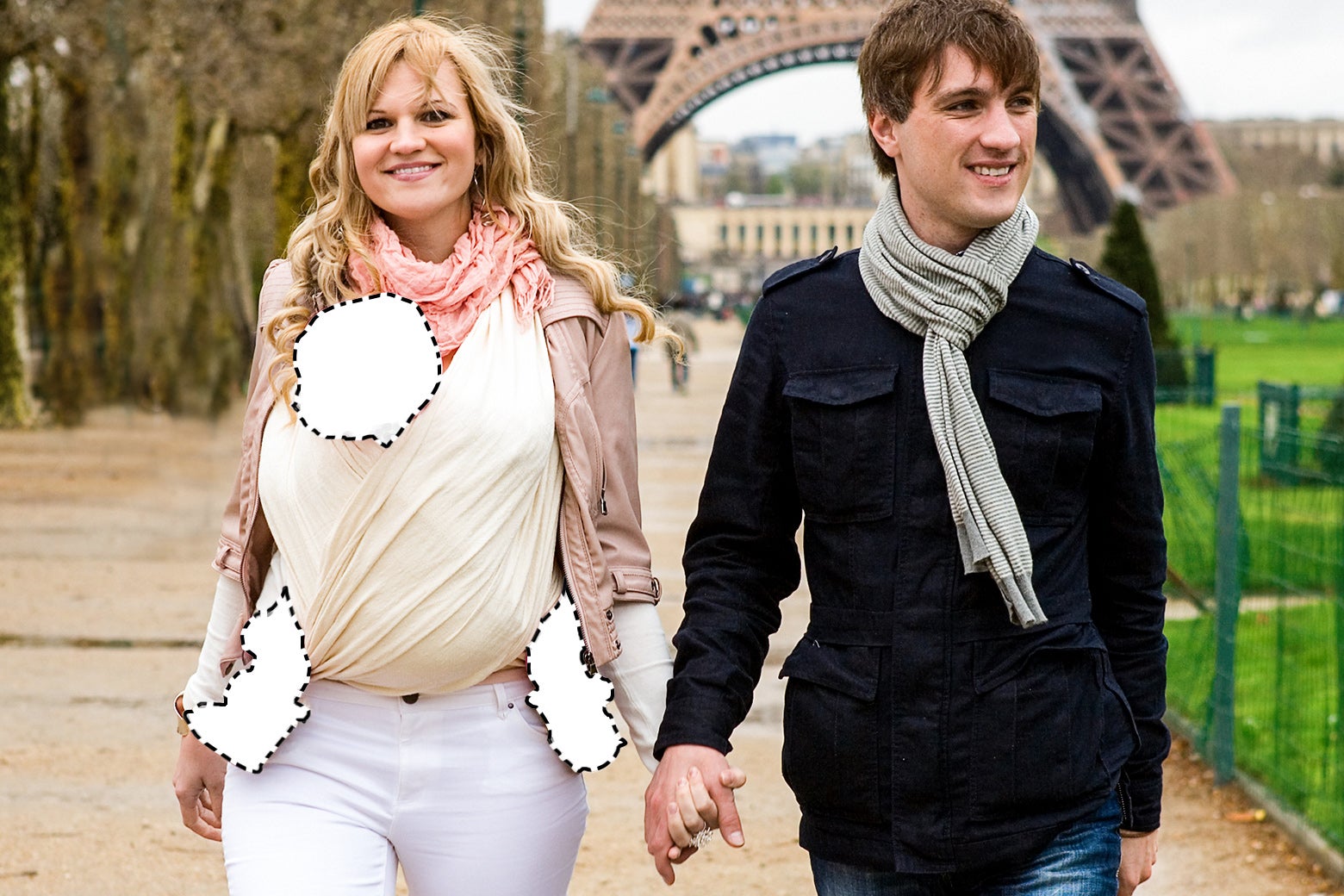
Fashion Where’s the Baby? Something’s missing from high-end baby-gear ads. Something small and squishy. Photo illustration by Slate. Photo by Getty Images Plus. Sign up for the Slatest to get the most insightful analysis, criticism, and advice out there, delivered to your inbox daily. I knew when I had a baby that my diaper bag would not be a “diaper bag.” My diaper bag would be an REI hiking pack from the ’90s, in perfect emerald green, that had accompanied me for solo trips through the Tetons and Glacier and the Presidentials. Yes, it was one of those magical compact backpacks that could hold everything, but more importantly, I knew it wouldn’t seem like a diaper bag—meaning I’d actively retain some of my identity outside of being a parent. Selecting this bag also meant that I’d be impervious to some of the marketing that hunts down all parents. I knew I’d have to buy some new things, but my life would not be subsumed by baby-gear ads. I was too resourceful for that! How interesting of me, how marketing-resistant of me, how I’m-not-like-the-other-parents of me. The baby brands, of course, were two steps ahead of me. They know my impulse well. For the past few years, they’ve released a continual surge of marketing that appeals to parents who are not entirely interested in seeming like parents at all. In fact, by the time I entered parenthood in 2024, some of the most desirable, luxe, trendy baby-gear brands had started leaving the baby out of the conversation entirely. The stroller company Bugaboo—famous for collaborating with brands like Stella McCartney, Diesel, and Marc Jacobs—is a notable example. In an image on their homepage, a mother poses in a floor-length denim number and luxe (Jenni Kayne?) slides atop a rocky cliff that reeks of Big Sur, her balletic hand on the stroller. In Caraa’s baby collection—a thoughtfully specific range of parent-focused items that includes diaper bags, pacifier pods, an insulated baby-bottle bag, a baby changing set, stroller caddies, a stroller pouch, winter stroller gloves, and a breast pump bag—there’s barely a baby in sight. What is in sight? A pool table, an outside café table around lunchtime, parents in lacy sheer tops, the trippiest of heeled sandals and kitten heels, white satin pants, leather jackets. The earrings accenting the model in the images for the winter stroller gloves? Covetable. Her gaze—mid-distance, critical, literary—is even more so. Meanwhile, Artipoppe—who make wearable carriers, something like a front backpack that holds an infant—even manage this effect while (necessarily) having the baby in the image to demonstrate how the carrier works. Their imagery almost comically foregrounds dancerly, beautiful parents, seemingly indifferent to the babies in the carriers. It’s almost like the baby is an accessory, rather than the reason for the product. The purpose of this strategy is clear: Be a devoted, discerning parent—just don’t come off like one. Baby brands know how to indulge this dictum with marketing that makes you feel picky, special, and sophisticated—maybe your life has irrevocably changed, but in their hands, the shining core of your individual taste can radiate on. It’s pandering and it works, said Emma Joss, the co-founder of Wiggle Room, a creative marketing studio that focuses on parents. (She hasn’t worked with any of the brands mentioned in this article.) “Parents want so badly, right now, to be seen as people, not parents, especially millennial parents,” Joss said.“We’ve been told our whole lives that we’re individuals and we’re special. Our generation, in particular, wants things that appeal to us and our lifestyle, versus items that fit into parenting as a whole. So these brands put these items inside of a person’s life, so they can exactly see themselves in it.” The Bugaboo stroller website, for example, leads with a quiz to find the perfect stroller for your lifestyle, a nod to the unique complexity of your individual needs. At the same time, Joss pointed out that most of these products aren’t actually that different from each other—at a certain point, a high-end diaper is a high-end diaper, so brands are especially eager to communicate how these are exactly suited for you. The luxuriously minimal, bafflingly pricey diaper brand Coterie knows this thoroughly. A couple of weeks ago, Coterie participated in a little stunt marketing with an ad on the back cover of Golf Digest. The ad had no imagery of parenting or children whatsoever. It spoke in the language of the golf-minded fellow who happens to have children: It was heavy on percentages, it made a clear argument, and the whole ad scheme got a write-up in the Wall Street Journal. In effect, it turned diaper purchasing from a lowly chore into a gallant, well-informed act of taste and intention. CityMouse is another good case study. Their tagline is “Bags made for motherhood even though they don’t look like it.” Their images don’t feature a single baby in sight—just adult abs and incredible posture (both hard-won after pregnancy). But their descriptions are truly some of the most useful I have ever, ever seen. Each bag description gets granular about what exactly it can contain: two insulated bottle pockets, a wipe pocket with a magnetic flap so you can get them instantly, an attachment to the stroller. Alongside the number of pouches and snacks and wipes they fit, they also include room for a phone, a Rhode lip gloss, and Touchland hand spray, and an Amex. Which brings us to price. I won’t tell you what any of these accoutrements cost. They are all pricey. They are all, by my estimate, between two and six times as much as another totally well-made brand. What you’re paying extra for is something that you actually like. Victoria de la Fuente Ayers, a tech founder who also runs the popular Zillion Trillion newsletter on motherhood and design, told me that mothers in particular are interested in something that’s special for them because of the cultural message that once you’re pregnant, nothing is about you anymore. “Is the Artipoppe really better for your kid?” she asked rhetorically. “That’s not why I’m buying an Artipoppe! I’m buying it because it makes me feel good about walking around with my kid with something that I find beautiful. It’s about me. And because it’s marketed in a chic way, I feel like I’m thriving as a parent.” “The brands that are doing this are all premium,” she continued. “It’s a luxury to be able to be selfish after you have a kid.” This sort of indulgent marketing likely speaks to a niche group of parents who were very intentional in their decision to have children and when. For a group that views parenthood as more of a choice, rather than a fulfilled expected path, they’re already in the mindset of careful consideration. And frankly, they’re accustomed to thinking about themselves. They factor that into everything, rather than just subsuming their consumer desires into the baby’s needs. It’s not that the baby’s needs aren’t important—they’re the table stakes; they’re a given. It’s just that these products speak to the extra thing that makes them feel like them. Parents who can afford that feeling are also likely to have enough disposable income to be picky consumers. In mid-October, Cathaleen Chen reported for Business of Fashion that even though global birth rates are declining, the market of baby and maternity items grows, demonstrating “a shift from volume to value” (fewer items sold, but more expensive ones). These parents, more likely to be older, are less likely to be price-sensitive about items for their child, even in high inflation. Chen’s article is titled “How Babies Became Luxury’s New Aspirational Category.” I see this marketing strategy as less about how the luxury item is the baby, but that the luxury item is the parent’s ability to navigate parenthood in a “cool” way.The babies are here to be seen and heard and to be deeply impactful in all the soul-deep and visually invisible ways—but not in the way where you’re holding a hideous purple plastic changing mat. These parents want the brands to tell them how much they respect their discerning taste, said Jacqueline Cooke, an interior designer and creative director at Mersene Studios who also closely follows aesthetic trends related to child-rearing. Early parenthood especially is a time when self-expression is stifled. It’s hard to even have an uninterrupted conversation when a child is there—let alone some space to feel peaceful or creative. And so there’s an extra susceptibility to purchases that promise a little expression, Cooke theorized. “It’s a vulnerable time of ego death. It’s a complete rearrangement and you don’t feel like yourself. I think what brands are saying is, ‘You haven’t lost your cool factor, you are yourself,’ ” she told me. Which brings me back to the diaper bag of it all. I love using my old backpack, not just because it’s thrifty and stealth and doesn’t appear to be a diaper bag, but because it makes me feel more interesting (an illusion). This bag has witnessed not only the view of the swing set, but also backcountry waterfalls and remote Greek beaches. And if you’re assuming that my child doesn’t care about any of this, I’m thrilled to issue a correction. My 2-year-old loves bags. He started repurposing things into bags before he even had access to one. His first bag was his ukulele—he’d jam little toys through the strings and store a variety of trinkets, and once, my watch, in there. Then he found an old Wilson tennis-racket bag, which he uses as his “guitar case” to store the ukulele that holds his other things. It’s a creative impulse, a repurposing, and one of the many things this kid and I have in common. Family Fashion Parenting Millennials
Baby Brands Are Selling a Strange New Fantasy
Full Article
Original Source
Read the full article at Slate →KhanList aggregates and links to publicly available news content. We do not host full articles from third-party sources. Always verify important information with original sources.