
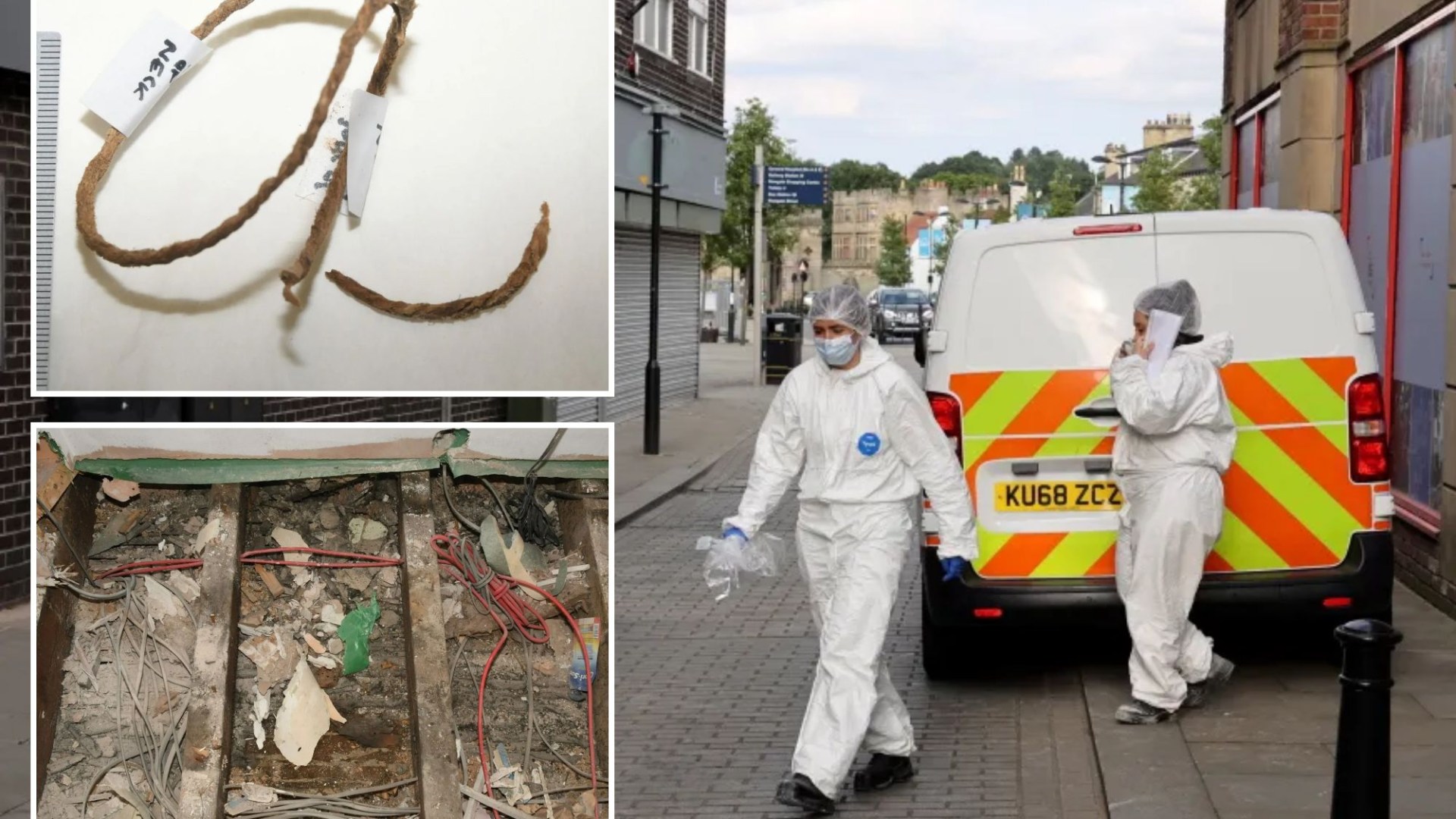
MYSTERY remains over the skeleton of a newborn baby boy found wrapped in a newspaper from 1910 with twine looped around his neck, an inquest heard. The tragic discovery was made during renovations on a home in Bishop Auckland in July 2024. The baby was discovered under floorboards in Bishop Auckland Credit: NNP He had been ‘garrotted’ with twine Credit: NNP The newborn – named as Baby Auckland – had been wrapped in newspaper then buried under floorboards. Twine had been looped three times around his neck, knotted, then looped again. Sign up for The Sun newsletter Thank you! Coroner Crispin Oliver said the tot was garrotted while he was still alive and recorded a verdict of unlawful killing. He said the most likely explanation was that the “person in a position to care for him while he was most vulnerable” took the decision to end the boy’s life “by means of strangulation using twine as a garotte”. The coroner added: “As such, this was homicide.” Given the passage of time, there was no prospect of any criminal proceedings, the coroner said, despite lengthy police inquiries. The hearing was told that the investigation involved DNA testing, a radio carbon expert and a forensic anthropologist as well as public appeals. Mr Oliver said – unusually – all elements of the inquest process were engaged, meaning it was necessary to establish who the deceased was, as well as how, where and when he died. Most read in The Sun The coroner said there was no record of the baby existing. He said: “This is a very sad and singular case.” A builder was renovating the property when he discovered the baby Credit: Durham Constabulary He had been wrapped in a newspaper Credit: NNP Giving his conclusion, he said that Baby Auckland died in or shortly after 1910 “having been garrotted with twine” shortly after his birth, then concealed under the floorboards. Mr Oliver said: “This was a terrible thing to have happened to a defenceless infant. “It happened in our community but it happened over a century ago and it is heart-warming how the public and individuals in this community have stepped up to do the right thing by Baby Auckland.” The coroner praised the painstaking police investigation, and Durham County Council for organising a funeral, supported by a funeral director who gave their services for free and a memorial firm which provided a headstone. The baby was wrapped in a newspaper called The Umpire, dating from 1910. Renovations were being carried out in a second floor room at the building at Fore Bondgate by owner Peter Moody, who made the discovery under a floorboard. He told police that the skeletal remains had what looked like a metre of garden twine around the neck. Records established that the property, used as a cafe at the time, was built in the late 19th century. Detective Chief Inspector Mel Sutherland, who led the police inquiry, said forensic anthropologist Dr Micol Zuppello worked at the scene and established that the remains were human and male. Dr Zuppello believed the body, since mummified, was placed face-down. She judged the remains were that of a baby of 38-40 weeks gestational development. It was not possible to say if the baby was stillborn. Home Office pathologist Dr Louise Mulcahy told the inquest she could not ascertain the cause of death. There was no sign of trauma on the skeletal remains, but there was no soft tissue left to establish if poisoning was a factor. She confirmed to the coroner that the twine was looped and knotted directly around the baby’s neck, then wrapped in newspaper, rather than the chord being used to tie the wrapping, like a parcel. That finding led the coroner to judge that the baby had been strangled with the twine. DNA testing did not reveal any known living relatives, Mr Sutherland said. The detective said public appeals in the media led to two sisters to come forward believing that they could be related to a servant who worked at the property, but a DNA test did not match. Mr Oliver asked Mr Sutherland if the twine could have been used to hang a religious artefact around the baby’s neck, or if string could have been used in midwifery practices at the time, but the detective said neither was likely. The inquest also heard from Dr Brian Tripney, a radio carbon dating expert from Glasgow University, who used a bone sample to establish that the baby was born in a period between the mid-1600s and 1955. Speaking to reporters after the hearing, Mr Sutherland said the two-year investigation had been frustrating and challenging due to the passage of time. Without modern sources of evidence such as CCTV or phone records, he said investigators had to think laterally and use different techniques. He said: “It was heart-warming to see how many people gave Baby Auckland the send-off that he got.” After the funeral in April, Cathy Hunt, Durham County Council’s cabinet member for children and young people’s services, said: “Sadly, for reasons we will never know, this little boy was never given the dignified and appropriate burial he deserved, so it was important that he was laid to rest in a way that honoured a life that could have been.”
Baby boy whose skeletal remains were found wrapped in newspaper from 1910 was deliberately ‘garrotted’ with twine
Full Article
Original Source
Read the full article at Thesun →KhanList aggregates and links to publicly available news content. We do not host full articles from third-party sources. Always verify important information with original sources.